
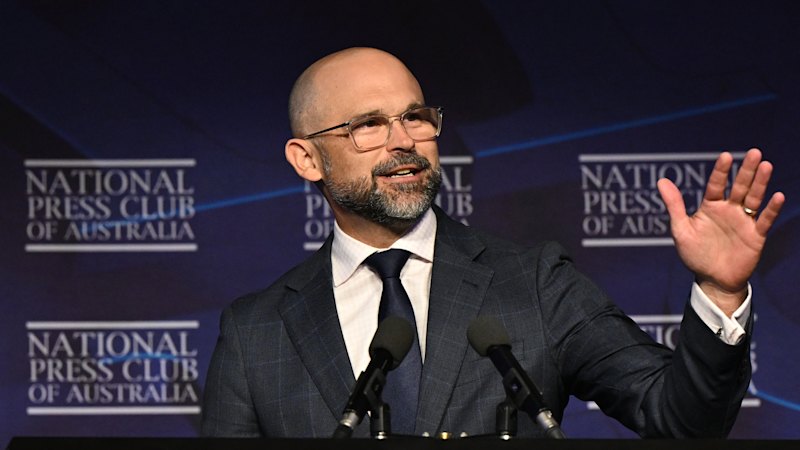
September 30, 2026 — 5:41pmTreasurer David Janetzki washed his hands of any responsibility for rising inflation fuelling interest rate rises, despite economists saying state government spending is a major driving factor.Janetzki lay blame for the ‘domestic capacity pressures’ pushing inflation higher entirely on the federal government, after the Reserve Bank increased interest rates to a 15-year high of 4.6 per cent and warned of further rises.“Jim Chalmers and the federal government must take responsibility,” the state treasurer told the first National Press Club held in Queensland.Queensland Treasurer David Janetzki addresses the National Press Club on Wednesday.AAPIMAGE“They have a role to play, and the Reserve Bank governor proved it yesterday.“When the governor said ‘domestic capacity pressures’, she’s talking about the federal government.”He rebuffed suggestions the LNP government’s infrastructure spending ahead of the 2032 Olympic Games and the cost-of-living support package in its last budget – which locked in 50-cent public transport fares and a $100 Back to School Boost for every student without any tax increases – were contributing factors.“We’ve been fiscally disciplined and we have improved the position of the budget, and that’s undeniable in terms of returning the budget to surplus at the end of the out years [by 2030],” Janetzki said.But independent economist Saul Eslake said state governments were guilty – if not more guilty – than the federal government for driving up the Consumer Price Index and heaping pressure on the RBA to lift interest rates.“In general, the states are as guilty of that as the feds,” he said. “Not only spending on their own account, but also giving cash to households who then spend it – and particularly because that spending isn’t well targeted.”Eslake said Queensland government spending, including capital expenditure, rose by 7.3 per cent in 2025-26 after an 8.5 per cent increase in 2024-25.Economist Saul Eslake says state governments are just as guilty as the federal government for driving up inflation.Alex Ellinghausen“That comes after three years of double-digit spending under the previous [Labor] government. The problem wasn’t created by the current government – they inherited it – but they haven’t done anything about it,” he said.Former federal treasury official and Brisbane-based director of Adept Economics Gene Tunny said the states were “obviously” adding to the total amount of demand in the economy.“There’s no denying that,” he told this masthead.“Queensland on its own is one state, so it’s the states collectively that are most relevant to the overall national inflation and, in aggregate, they do pack a punch.”Janetzki’s latest budget, in June, forecast deficits in each of the three coming financial years, sending the state’s debt spiralling from more than $142 billion to almost $216.5 billion by mid-2030.Earlier this month, ratings agency S&P Global downgraded Queensland’s credit rating from AA+ to AA, citing heightened deficits driven by Olympic infrastructure spending, and economic headwinds.“The fact that states are running significant deficits, largely to finance new infrastructure spending, is going to contribute to total demand,” Tunny said.“And it’s going to contribute to that situation [RBA Governor] Michele Bullock has talked about, how the total amount of demand – the desired spending in the economy – is outpacing the ability of the economy to deliver the productive capacity of the economy.”Janetzki said productivity (the amount of value created for each hour that is worked) in Queensland had improved by 1.37 per cent.“If you talk to any builders, and I was talking to one just recently, they’re talking about productivity on work sites improving from 2.5 to 3.8 days a week,” he said.“In Queensland, we are coming off a very low base of productivity. So we are driving productivity hard in Queensland, and that’s where we can lead the nation.”On infrastructure spending, Janetzki was confident the government could keep a lid on the $7.1 billion budget for Olympic venues.“That is the budget, and we’ve been really clear about how we’re going to achieve it,” he said.“We’re going to drive price competition, competitiveness in procurement ... we’re not going to set prices and then let everybody bid against it, we’re going to drive competitive price tension through the system, through the procurement process.”Asked if the prospect of an Olympic budget blowout keeps him up at night, Janetzki replied: “I sleep well – very little, but I sleep well.”From our partners
Qld treasurer washes hands of responsibility for rate hike
Full Article
Original Source
Read the full article at Smh →KhanList aggregates and links to publicly available news content. We do not host full articles from third-party sources. Always verify important information with original sources.