
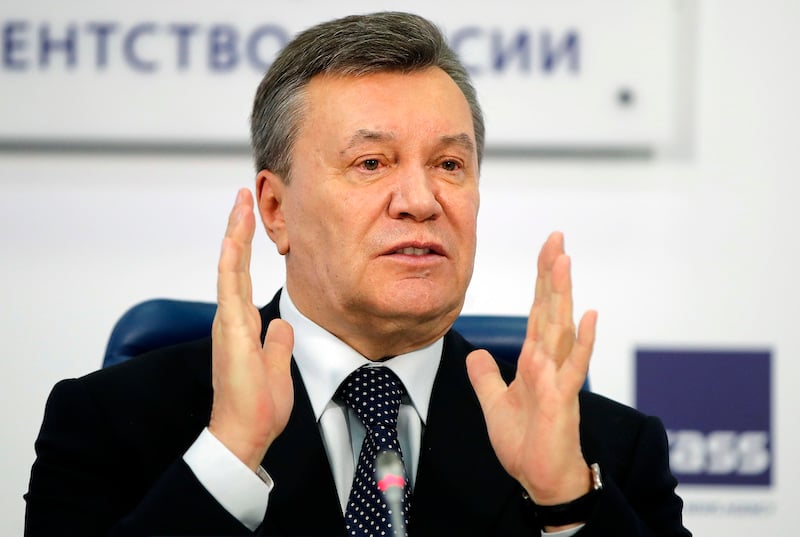
A Russian comeback plan and business ties to separatists proved costly for Viktor Yanukovych and his son Oleksandr as an EU court upheld sanctions renewals against both.(CN) — EU sanctions still stand for Ukraine’s ousted president and his businessman son, following a court’s Wednesday decision finding old evidence showing their support for Russia remains sound.The General Court of the European Union rejected separate bids by Viktor Yanukovych and his son Oleksandr to overturn sanctions renewed in September 2024 and March 2025. Both argue that the Council of the European Union lacked sufficient grounds to keep them listed..Judges found that the older evidence still established grounds for renewals. They linked Viktor’s support for Russian military intervention and weakening of Ukraine’s defenses to his involvement in a Russian plan to return him to power in 2022.For Oleksandr, the court accepted evidence that he continued running businesses and managing assets through ties to separatists controlling Donbas, located in Eastern Ukraine. His company’s registration under Russian law in 2023 reinforced that finding.Oleksandr points to Ukrainian freezes on his assets as evidence that his business activities had stopped. The court rejected that reasoning, saying: “Even though his assets are subject to the restrictive measures imposed by the Ukrainian authorities, the fact that it is impossible for those authorities to ensure that those measures are applied in the Donbas region renders those fund-freezing measures ineffective.”Luigi Lonardo, associate professor at the Luxembourg Centre for European Law, University of Luxembourg, said sanctioned people face a practical burden to show what has changed, although the council bears the burden of proof.He said future cases could give judges clearer guidance on what counts as enough. “The court confirms an interpretation of the sanctions that favors continuity in EU foreign policy and, ultimately, favors the council,” Lonardo said.Viktor fled Kyiv in February 2014 after protests triggered by his rejection of an EU trade agreement in favor of closer Russian ties. He relocated to Russia, which seized Crimea, while pro-Russian separatists took control of parts of eastern Ukraine’s Donbas region.The EU introduced asset freezes and travel bans in March 2014 to pressure those threatening Ukraine’s sovereignty. The Yanukovych pair joined this list in August 2022. The restrictions froze assets within EU reach, barred entry or transit and prohibited making funds available to the individuals.Tetiana Shevchuk, international relations head and lawyer at Kyiv’s Anti-Corruption Action Centre, said both men played an instrumental role in Russia’s aggression and considered continued sanctions justified. “The court confirmed that in wartime, when access to information is limited, the council can rely on open sources, media reports and intelligence data,” she said.Viktor denies attending a meeting in Minsk, Belarus in early March 2022 to discuss reclaiming power once Russian forces controlled Kyiv. He also disputes aircraft evidence, but judges found that a plane’s later arrival did not rule out his traveling by another mode of transportation. The court accepted reporting sourced to Ukrainian intelligence without requiring independent corroboration and cited further reporting based on intercepted communications and interviews with officials.Celia Challet, assistant professor in law and public policy at the European School of Political and Social Sciences, Université Catholique de Lille, saw the council’s ruling and use of older evidence as unsurprising but significant. She highlighted the continuity in Viktor’s conduct and the court’s practical view of Ukraine’s limited ability to enforce asset freezes in Donbas.Challet also noted that the Minsk finding held without direct proof of travel on his official aircraft. She saw the judgments as underscoring intelligence services’ importance in defending sanctions against legal challenges. “The Ukrainian intelligence services were considered to constitute a reliable source in this context,” she said.Oleksandr’s business ties alone gave reason for sanction renewal, leaving judges no need to decide whether his relationship with his father also justified it. The council declined to comment on the rulings. The applicants’ lawyer did not immediately respond to a request for comment.Both men were ordered to pay their own costs and the council’s. The challenged renewals stand. Their next legal option is an appeal to the Court of Justice, limited to points of law and due within two months and ten days of notification.Courthouse News reporter Eunseo Hong is based in the Netherlands.Subscribe to our free newslettersOur weekly newsletter Closing Arguments offers the latest about ongoing trials, major litigation and rulings in courthouses around the U.S. and the world, while the monthly Under the Lights dishes the legal dirt from Hollywood, sports, Big Tech and the arts.Additional Reads
Ukraine’s ex-president and son lose bid to break free of EU sanctions
Full Article
Original Source
Read the full article at Courthousenews →KhanList aggregates and links to publicly available news content. We do not host full articles from third-party sources. Always verify important information with original sources.