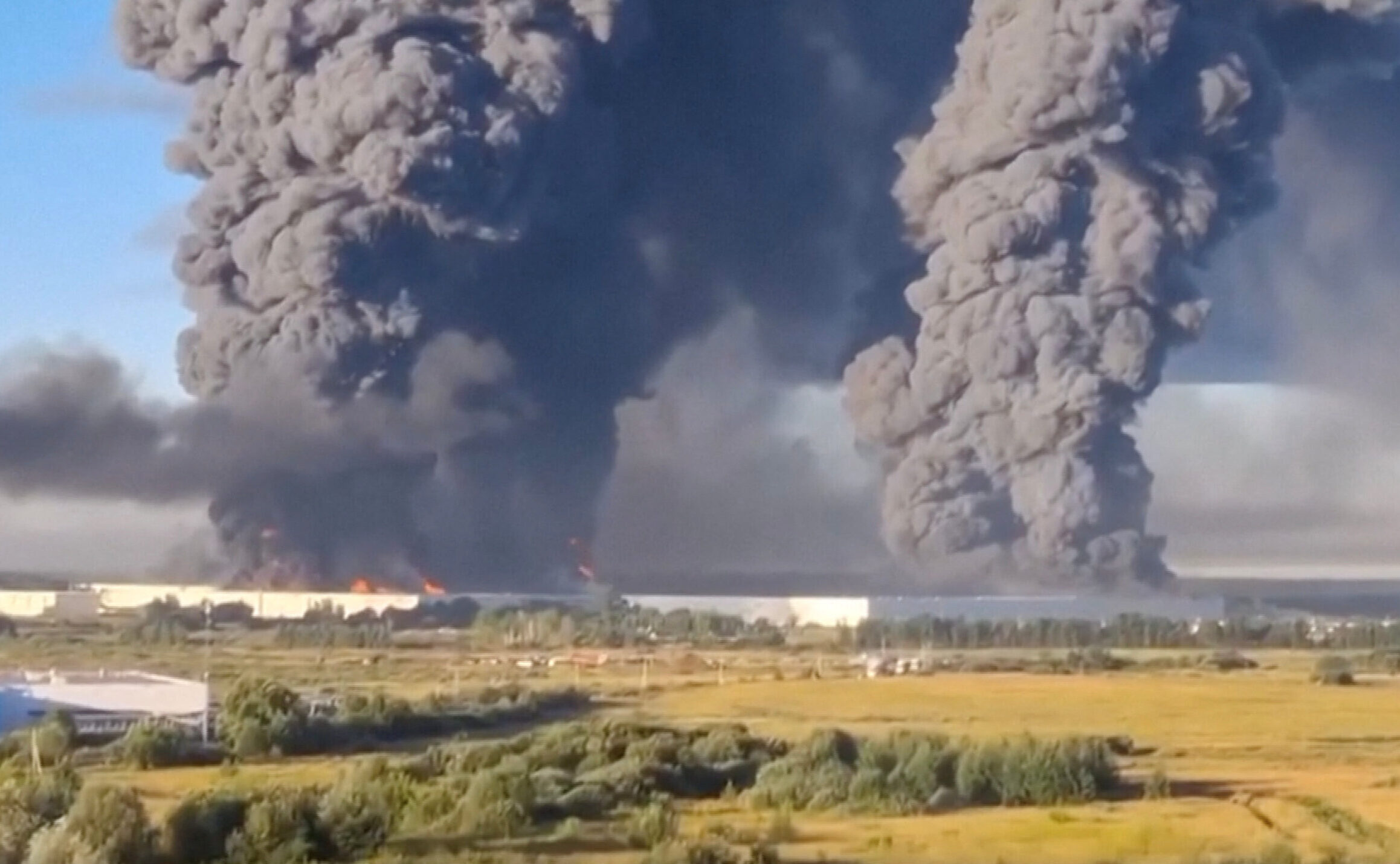
With Vladimir Putin still showing no signs of ending his invasion, Ukraine is expanding a strategic bombing campaign inside Russia that aims to undermine the logistics supporting the Kremlin war machine. The latest phase in this air offensive has included strikes on a number of major logistical hubs belonging to Russia’s largest online retailer, Wildberries, leading to extensive damage and a number of fatalities. Ukrainian President Volodymyr Zelenskyy said the attacks on Wildberries e-commerce facilities over the past week were part of Ukraine’s ongoing efforts to impose “long-range sanctions” on the Putin regime. He claimed the targeted distribution hubs were being used to supply the Russian army in Ukraine with items including sanctioned components for drone production and navigation equipment. The attacks also destroyed large quantities of non-military merchandise, leaving many Russian entrepreneurs facing financial hardship. Ukraine’s drone strikes on Wildberries warehouses produced powerful footage of wartime destruction, with huge plumes of black smoke visible throughout the Moscow area and in the skies above a number of cities in southern Russia. Such sights were once unthinkable in Putin’s Russia but are now becoming increasingly common. In recent months, Ukraine has repeatedly hit high-profile Russian targets including the St. Petersburg oil terminal and Moscow oil refinery. Meanwhile, Ukrainian drone strikes on Russia’s vast energy industry infrastructure are now an almost daily occurrence. In addition to the material damage caused by these attacks, Ukraine’s aerial offensive is also changing the mood among the Russian population, many of whom had grown accustomed to the idea that the invasion of Ukraine was a foreign war that did not concern them. With videos showing the consequences of Ukrainian strikes now an increasingly routine feature on Russian social media, it is becoming difficult to avoid the conclusion that the invasion unleashed by Putin in 2022 is coming home to Russia itself. Stay updated As the world watches the Russian invasion of Ukraine unfold, UkraineAlert delivers the best Atlantic Council expert insight and analysis on Ukraine twice a week directly to your inbox. Kremlin efforts to censor sensitive economic data make it difficult to accurately assess the full impact of Ukraine’s bombing campaign. However, publicly available information indicates a rapidly deteriorating logistical situation across much of Russia. The country is currently experiencing an unprecedented fuel crisis, with shortages leading to petrol rationing and a desperate search for imports. This has already resulted in skyrocketing gasoline prices and long queues at filling stations. If solutions cannot be found soon, the current fuel deficit could spill over into other sectors and disrupt everything from agriculture to transport, creating the conditions for a more general breakdown in the supply of food and other everyday essentials. Repairing the damage done to Russia’s highly vulnerable energy industry is likely to take time. For example, the Moscow oil refinery struck by Ukrainian drones in June is expected to remain offline until 2027, according to industry sources quoted by Reuters. Repair efforts will be further complicated by the need for replacement components that the Kremlin may struggle to source due to sanctions restrictions. The situation at sea is arguably even more unfavorable for Russia. In recent weeks, Ukraine has dramatically scaled up attacks on Russian shipping in the Black Sea and Sea of Azov, with hundreds of vessels reportedly targeted. This is creating the risk of a Strait of Hormuz-style crisis for Russian maritime logistics, with cargoes of oil and other key export commodities unable to reach international markets, CNN reports. The hardest hit region of all is Russian-occupied Crimea. Ukraine’s campaign to isolate the peninsula has been underway for months, with access routes placed under drone control and energy hubs subjected to repeated attacks. By early July, the occupation authorities conceded that they could no longer guarantee daily sales of gasoline or provide precise schedules for fuel distribution. Eurasia Center events Russia’s apparent inability to defend its airspace against Ukrainian bombardment is a major personal blow to Putin that makes a mockery of his carefully curated strongman image. Ukraine’s success is due to a number of factors including Kyiv’s decision early in the war to prioritize domestic drone and missile production. The vast size of the Russian Federation has also left the country dangerously exposed, with a limited supply of air defense systems often overwhelmed by large waves of Ukrainian drones striking deep inside Russia. Ukraine hopes that by methodically dismantling the logistical foundations of the Russian war machine, they can eventually push Putin toward meaningful peace talks. At this stage of the strategic bombing campaign, Kyiv officials believe they have already dispelled any delusions that the Russians can wage war in Ukraine while remaining safe from counterattacks inside Russia itself. “We have completely eliminated the very idea of Russia having a strategic rear,” Zelenskyy told the recent NATO summit in Ankara. So far, Moscow has sought to downplay the impact of Ukraine’s bombing campaign, with Russian officials rejecting suggestions that Ukrainian drone and missile strikes were putting Putin under mounting pressure to end the war. In early July, Kremlin spokesman Dmitry Peskov said the idea that escalating Ukrainian attacks could pave the way toward a peace settlement was a “misconception.” If Ukraine is able to maintain the current momentum beyond the summer months, the Kremlin may soon find it more difficult to remain so dismissive. Growing logistical problems are already hampering the invasion of Ukraine and disrupting daily life inside Russia. As winter approaches, the current challenges have the potential to evolve into a full-blown crisis that will test the resilience of the Russian population. Putin has tried hard to shield ordinary Russians from the realities of his invasion, but he appears unable to protect them from the consequences of Ukraine’s escalating air offensive. David Kirichenko is an associate research fellow at the Henry Jackson Society. Further reading The views expressed in UkraineAlert are solely those of the authors and do not necessarily reflect the views of the Atlantic Council, its staff, or its supporters. The Eurasia Center’s mission is to enhance transatlantic cooperation in promoting stability, democratic values, and prosperity in Eurasia, from Eastern Europe and Turkey in the West to the Caucasus, Russia, and Central Asia in the East. Follow us on social media and support our work Image: Smoke billows from a warehouse, after deadly Ukrainian drone attacks, as per regional governors, in Elektrostal, Moscow Region, Russia, July 18, 2026, in this screen grab obtained from a social media video. (Social Media/via REUTERS)
Putin’s invasion comes home as Ukraine expands attacks inside Russia
Full Article
Original Source
Read the full article at Atlanticcouncil →KhanList aggregates and links to publicly available news content. We do not host full articles from third-party sources. Always verify important information with original sources.