
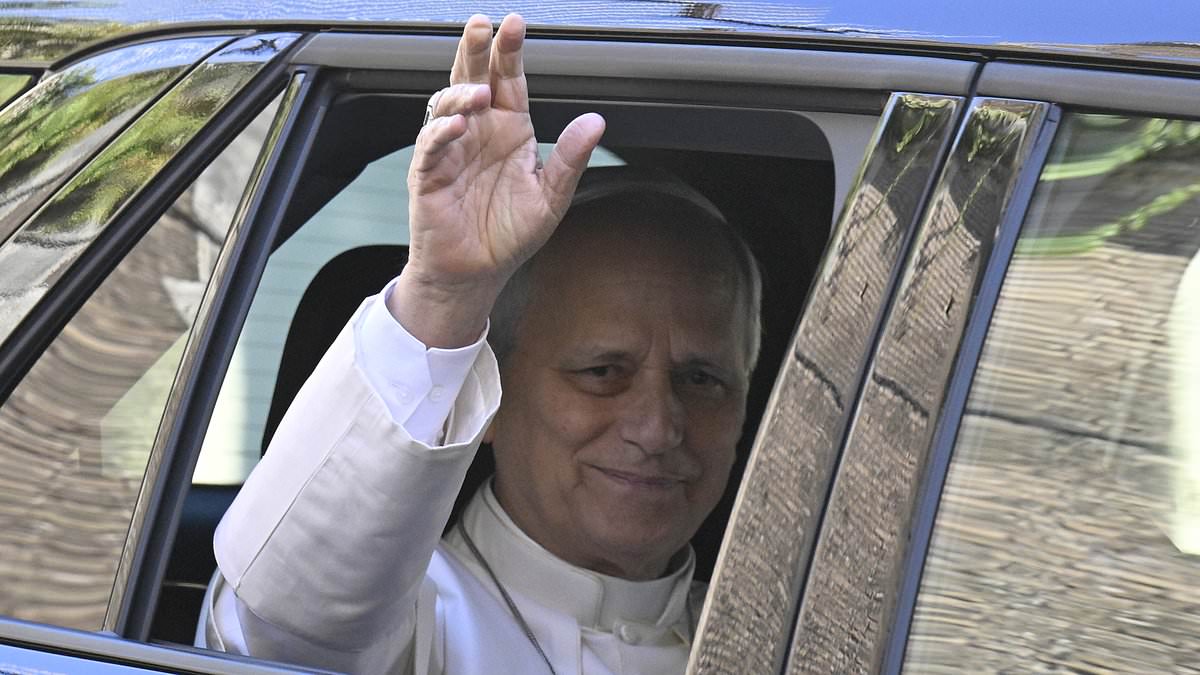
Pope Leo has been diagnosed with cancer after part of his lung was removed. The Pontiff, 71, went in for a 90-minute surgery this morning after a lesion was found on his chest. The Vatican confirmed on Tuesday night the nodule had been removed, but tests found it was cancerous. Leo was in the operating room for around three hours, a spokesman said. He added that the operation was successful and that there were no complications. After the surgery, Pope Leo XIV woke up normally and returned to his room on the tenth floor of the hospital. The operation requires a week-long hospital stay and the Vatican on Monday cancelled all Leo's audiences through to October 20. The pope had walked into Rome's Gemelli hospital through the main entrance earlier in the day and waved to dozens of well-wishers who had gathered to greet him. Pope Leo, pictured this morning, has been diagnosed with lung cancer, the Vatican has confirmed Pope Leo XIV arrived today at Gemelli Hospital in Rome, Italy, ahead of the surgery to remove a lung noduleDr Luigi Carbone and Professor Stefano Margaritora issued the following statement regarding this afternoon's operation: 'The Holy Father underwent thoracic surgery as scheduled.'To ensure a radical procedure, the lower lobe of the right lung was removed using a video-assisted technique. The intraoperative histological examination confirmed the diagnosis of lung adenocarcinoma, as suspected by the pre-operative tests.'The Holy Father was in the operating theatre for approximately three hours; the operation itself lasted about ninety minutes. The operation was successful and there were no complications.'Following the operation, the Pope woke up normally and, after a brief period of observation, returned to his room on the tenth floor.'The surgical team was led by Professor Stefano Margaritora, assisted by Professor Elisa Meacci, Dr Maria Teresa Congedo and Dr Leonardo Petracca Caravella.'The anaesthesia team consisted of Professor Massimo Antonelli, Dr Giovanni Punzo and Dr Giuseppe Bello.'The American pontiff has offered a rare level of transparency about the first publicly disclosed major health problem of his 17-month papacy.He revealed the discovery of the small, localized nodule during his Sunday noon prayer and announced that he would have it removed. Pope Leo XIV is welcomed by Health Director Andrea Cambieri as he arrives at the Agostino Gemelli University Hospital todayExperts said prior to the operation that even if the nodule turned out to be cancerous, Leo's prognosis is 'excellent' since it will have been removed at an early stage. A churchman who saw Leo on Monday, Tokyo Cardinal Tarcisio Isao Kikuchi Tsutomu, said the pope told him he felt fine and decided to have the surgery immediately so that he wouldn't have to alter his upcoming travel plans to Latin America.But the decision clearly came as a surprise. While Gemelli has a specific papal apartment that past popes have used, complete with a private chapel on the tenth floor, Leo will actually be staying in a nearby room since the papal apartment is currently undergoing renovations, according to the Vatican press office.The European Institute of Oncology (EIO) advises patients not to fly for three weeks after surgery – which would give the Chicago-born pope just the interval needed to make his planned November 6 to November 17 trip to Uruguay, Argentina and Peru, depending on his recovery.The current itinerary for the trip is ambitious and the longest of his papacy to date, calling for Leo to clock just over 31,000km (19,263 miles) (19,000 miles) on a dozen flights and two helicopter rides, and a significant altitude change in Peru.'I think the Holy Father is in excellent hands at Gemelli,' Dr Spaggiari, of the EIO said. 'They have everything needed to keep the Holy Father alive for a long time.'A lung nodule is a small abnormal area measuring less than 3cm (1.2 inches) that sometimes appears on a CT scan of the chest or abdomen.Often, the scans are done to investigate trauma or a lung infection, unrelated to a lung cancer screening.A nodule can be benign or malignant, and oftentimes surgical removal is recommended both to establish whether it is cancer and to treat a malignancy while it is still localised.This is a breaking news story. More to come.
Pope Leo has lung cancer, Vatican confirms
Full Article
Original Source
Read the full article at Dailymail →KhanList aggregates and links to publicly available news content. We do not host full articles from third-party sources. Always verify important information with original sources.