
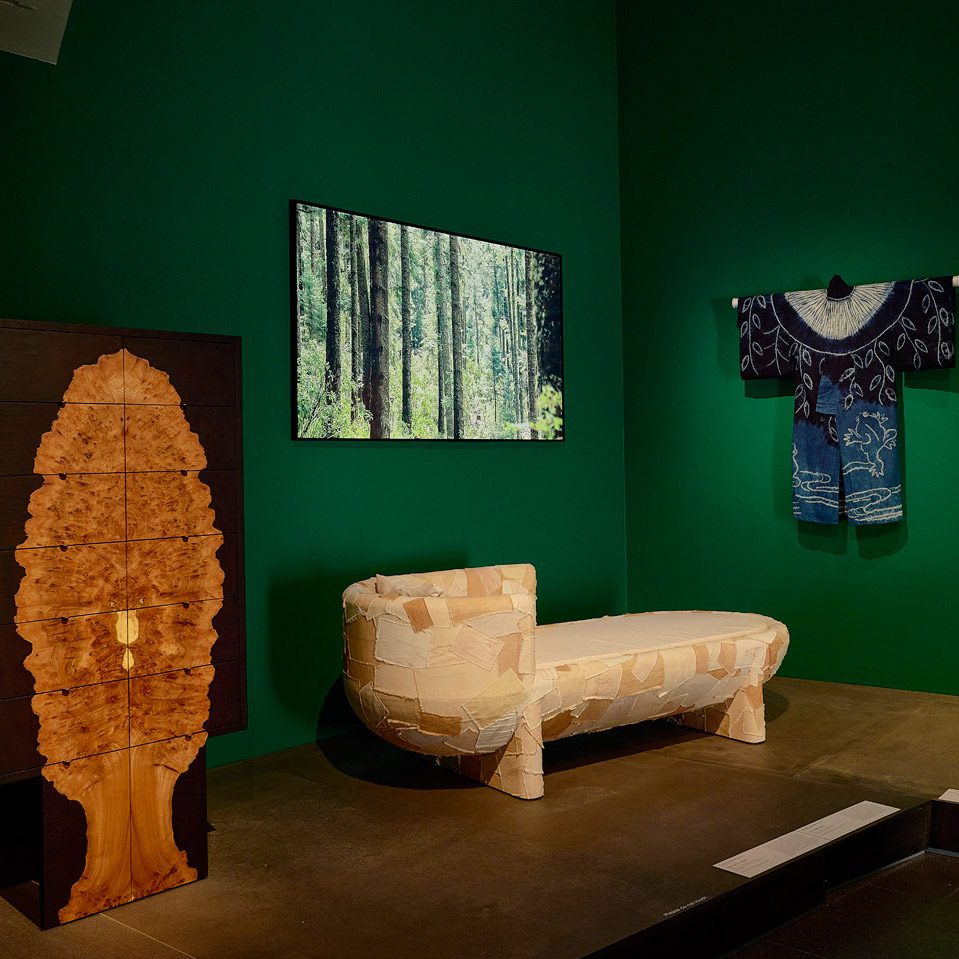
From a fire jacket grown from fungi to building blocks made from algae and oyster shells, the latest exhibition at Melbourne's National Gallery of Victoria (NGV) explores humanity's relationship with the plant world through design. Called Plant Life: The Nature of Design, the exhibition features more than 60 works that span furniture, architecture, decorative arts, craft, photography and film. It spotlights how plant-based materials can be a vital alternative to non-renewable materials and focuses on global Indigenous communities' engagement with the natural environment. The exhibition features over 60 works sourced from around the world "For most of human culture, up until the discovery and refinement of petrochemical-based products, everything was effectively either plant-, animal-, or mineral-based," senior curator of contemporary design and architecture at NGV Ewan McEoin told Dezeen. "So this idea of cyclical life was fundamental for thousands of years, across all cultures. What we're trying to do is look at a future where plants return as the dominant source." A new locally made biomaterial was selected to fabricate the display plinths and surfaces throughout the exhibition. Called Plantbord, the hemp board was developed by Australian designer Joost Bakker and sustainable building material supplier Forest One. It was bound with the bio-resin Plantics, which, according to McEoin, is the world's first 100 per cent bio-based thermosetting resin. Here, Dezeen selects eight of the most interesting design and material innovations from the exhibition: Urgent Is The Rhythm bio-masonry blocks by Kate Scardifield Sydney-based artist and material researcher Kate Scardifield developed a new building material by combining algae and oyster-shell waste. In this work, more than a tonne of algae biomass, collected from aquaculture industries in New South Wales and Queensland, was mixed with oyster-shell waste to form biomasonry blocks. Melbourne-based architecture studio Edition Office designed a series of speculative architectural drawings to imagine buildings made from the material. It envisions algae being processed into blocks, tiles and facade panels to form the building while being cultivated on site at a vast agricultural scale and storing carbon as the building blocks are constructed. Photo is courtesy of Collective Fashion Justice Ecotono Shiringa bio-leather jacket by the Awajún people of the Peruvian Amazon and Mozhdeh Matin Lima-based textile studio Mozhdeh Matin has worked with the Awajún people of the Peruvian Amazon to develop a plant-based leather jacket. The indigenous community, which is the guardian of the local shiringa forests, collects milky sap from the trees through shallow cuts on the bark. This is then applied to cotton, which is dried or smoked into a leather-like waterproof material. These traditional techniques tap shiringa trees without cutting them down, a technique that Matin hopes to preserve. Activist Emma Håkansson's film Shiringa: Fashion Regenerating Amazonia accompanied the jacket at the exhibition, documenting the indigenous community and their relationship with the forests. Ply Loop Chair by Joris Laarman Dutch designer Joris Laarman has created the Ply Loop Chair, using a plant-based thermoset resin derived from agricultural waste streams to bind plywood. The new material, called Plantics, replaces the conventional toxic urea-formaldehyde adhesives that are commonly used in furniture. According to Laarman, it is non-toxic, recyclable and biodegradable. The continuous looping form of the chair was enabled by digital design and fabrication. Photo is courtesy of Crafting Plastics Sensbiom 2.1 by Crafting Plastics Crafting Plastics, an interdisciplinary studio focusing on circular design, has developed a web-like plant-based plastic alternative that turns pink when exposed to ultraviolet (UV) radiation. Sensbiom 2.1 is a modular architectural installation made from the material, which can be used as partitions or light-filtering surfaces. The biopolymer lattices change colour in response to UV radiation, allowing the otherwise invisible environmental conditions to be perceived by viewers. Photo is courtesy of Fernando Laposse Resting Place daybed by Fernando Laposse Designer Fernando Laposse has created a daybed using patches of fabrics dyed with avocado-seed pigment and marigold flowers to cover the surface of the piece. The patchwork was informed by the Japanese Boro technique, where damaged textile is repaired through patching. It was stitched with images of guns and chainsaws to reference repairing a broken system. Laposse aimed to raise awareness of the surging global avocado demand, which has led to a social and ecological crisis in Mexico, where the majority of the world's avocados are grown. Photo by Robin Noordam Banet dining chair naked by Bart Schilder Dutch designer Bart Schilder created this dining chair with hemp fibre and fungi. The inner core of the chair was made primarily of hemp fibre and fused with mycelium, a root-like network of fungi that acts as a natural adhesive. The growth of the fungi was stopped through drying and heat treatment to ensure no living fungi remain in the chair core. According to the designer, producing this dining chair generates approximately five kilograms of carbon dioxide — roughly one seventh of an equivalent plastic chair. Photo is courtesy of Donna Cleveland Lanh My A black silk by Lo Silk Vietnamese fashion house Lo Silk has created a traditional Ao Dai – one of Vietnam's most recognisable female ceremonial dresses – using Lanh My A, a rare black silk textile. The black dye was achieved through a plant-based process, unique to the town of Tan Chau in Vietnam's Mekong Delta region. The silk is soaked in the resin of mac nua, the fruit of the Diospyros Mollis tree, whose resin darkens through oxidation. The resulting textile was then sun-dried, washed and beaten repeatedly in Mekong River water to further deepen the blackness. Mycelium Wildfire Jacket, by Judith Glover, Tien Huynh, Mohamad Arekha Bentangan and Alexi Freeman for RMIT University Industrial designer Judith Glover, material scientist Tien Huynh, microbiologist Mohamad Arekha Bentangan and bio-designer Alexi Freeman have collaborated to develop this fire jacket using fungi-grown materials for a new commission from RMIT University. The prototype was fabricated from mycelium leather, a biomaterial cultivated from fungal networks grown from agricultural waste in controlled environmental conditions. According to the team, the material is able to self-extinguish when exposed to flame, through further manipulation that extends its durability, fire resistance and thermal insulation. The photography is by Sean Fennessy unless stated otherwise. Plant Life: The Nature of Design will be on display at The Ian Potter Centre: NGV Australia from 28 August 2026 to 7 February 2027. See Dezeen Events Guide for an up-to-date list of architecture and design events taking place around the world.
Plant Life exhibition imagines a future where "plants return as the dominant source"
Full Article
Original Source
Read the full article at Dezeen →KhanList aggregates and links to publicly available news content. We do not host full articles from third-party sources. Always verify important information with original sources.