
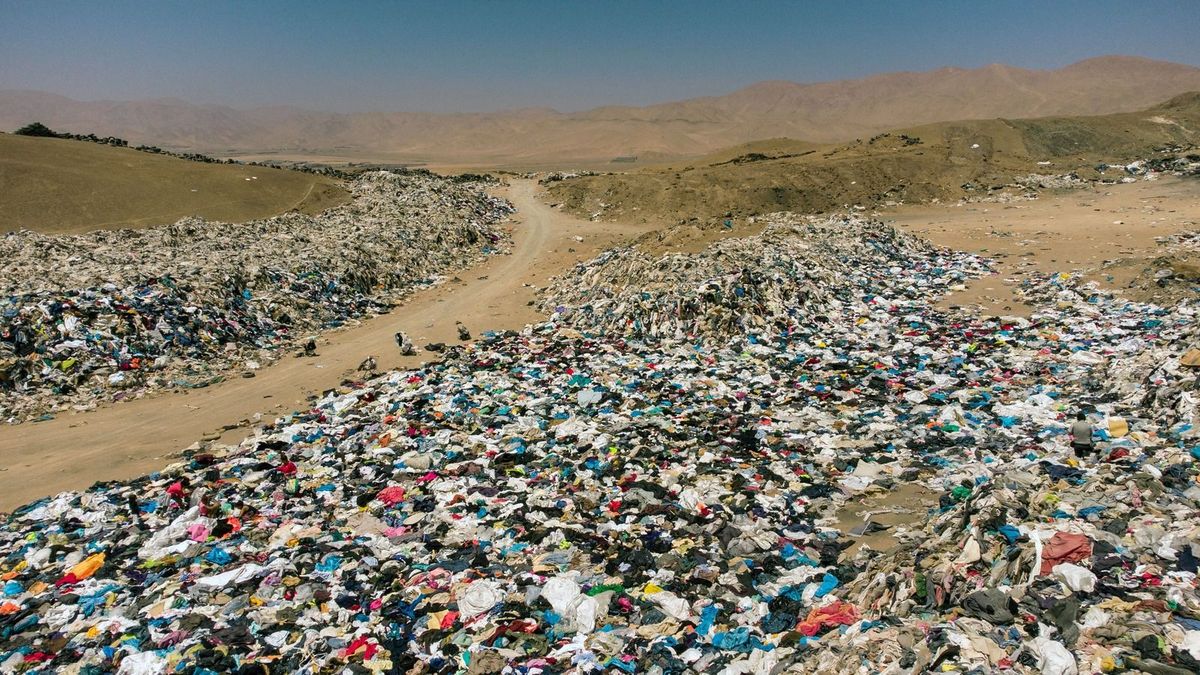
Since at least 2021, people have shared genuine photos, including satellite images, they said showed a "pile" of clothes in Chile's Atacama Desert so large it could be photographed from space. Unlike some other circulating images that have been identified as fake, these images were real. Chile is a major importer of secondhand and unsold clothing, a percentage of which people have illegally dumped north of the Alto Hospicio municipality in the Tarapacá region. In October 2026, Miguel Aguirre San Martín, Tarapacá's regional environmental secretary, told a local radio and TV program that crews have cleaned up the "mountains" of clothes — meaning at more than one location that appeared to be low-lying landfills and not so much the tall "piles" — that have appeared in past images. We emailed San Martín's office with questions. Google Earth's satellite images, displaying the most recent February 2025 capture date, showed that at least one large dumping site appeared to have been partially cleared, as well as other nearby areas that remained filled with garments as of that date and year. Another image from space Snopes obtained showed one of perhaps several examples of a dumping site still remaining as of this August. In December 2024, the United Nations published a report with steps on how to combat the clothes-dumping issue facing the fast fashion industry. In recent years, people have shared images allegedly showing a clothes "pile" in Chile's Atacama Desert that they claimed was so big that people could photograph it from space. For example, last month, an X user reposted (archived) a popular ground-shot photo of the clothes "mountain." The post's text caption began, "There is a mountain of unworn clothes in the driest desert on earth, large enough to be photographed from space." (@SamaHoole via X) Others reposted the same image, or in some cases a purported satellite image (archived), on Facebook (archived), Instagram (archived), Reddit (archived) and X (archived). One satellite image, first reported by the SkyFi satellite imagery company in 2023, was captured in 2022: In sum, past satellite images indicated more than one clothing dumping spot, or "pile," has existed in Chile's Atacama Desert — which truly is one of the driest places on Earth. Those images were real. As seen in the ground-shot photo earlier in this article, the real sites looked more like low-lying landfills instead of the ridiculously tall piles visible in other (archived) images (archived) that were generated using artificial intelligence. (The Pangram AI detection tool indicated the latter were created or edited with AI. Snopes doesn't rely on results from such tools alone as conclusive evidence but does include them as one of many data points.) Miguel Aguirre San Martín, the regional environmental secretary for the Tarapacá region, told the local Expreso Bío Bío radio and TV program in October that the images people most often shared were several years old and showed what he called "mountains" of clothes (possibly using the word after it first appeared on social media and in news articles) that crews have since partially cleared away. He also spoke of legislation aimed at holding the people doing the illegal dumping accountable. In the absence of capturing of brand-new satellite images or a making a physical visit to each site in the desert, we can't credibly confirm San Martín's statements or determine how many clothes dumping locations remained as of this month. We contacted San Martín's office and received word back on Oct. 22 that they were awaiting approval to respond to our questions. We will update this article if we receive further information. This article lays out the known facts, including information about the December 2024 proposed plan by the United Nations to combat the fast-fashion industry's waste problem. Researching the rumor Chile is a major importer of secondhand and unsold clothing. After workers in Chile sort through imported garments, a percentage of that clothing has ended up illegally dumped in the country's Atacama Desert, including north of Alto Hospicio, a municipality found within the Iquique Province in the Tarapacá region. In past years, news outlets and social media users have published real photos (and occasionally videos) showing views of the clothing piling up and lining roads — including the specific clothes dumping area SkyFi highlighted in 2023 with the 2022 satellite image. Google Earth's satellite images of the region, which display the most recent media publicly available from February 2025, appear to show that crews removed quite a lot of the clothing from the same garment dumping site that SkyFi reported about in 2023. Even so, some clothing or other waste still appeared to line the roads in the lower part of the image. We located that same SkyFi-reported "pile" north of Alto Hospicio. (Readers can copy and paste these coordinates into Google Earth, Google Maps or another mapping tool to find the same area: -20.2344898,-70.0888835.) (Google Earth) Other nearby locations also featured areas of apparent dumped goods. For example, SkyFi provided to Snopes a recent satellite image taken in August that appears to show a volume of waste similar to that of the February 2025 Google Earth capture. We couldn't match the specific dumping locations shown in a handful of ground-shot photos to those seen in satellite images. During San Martín's local interview, he specifically spoke of conducting aerial surveys to locate the largest amounts of waste. He also described already having completed the cleanup of 60,000 tons of clothing, coordinating public-private task forces, emphasizing environmental education and looking to the justice system to decide who should be responsible for the garment dumpings. In our correspondence to San Martín's office, we asked when exactly the clearing of the primary "pile" occurred, where the clothing ended up, whether or not the government planned to clear other dumpings and whether the government had determined which companies or countries dumped the items. We will update this story should we receive answers to these questions. The United Nations plan In May 2023, the United Nations announced research to combat the problem, stating, "United Nations will launch a study on global secondhand clothing trade and disposal in Chile." The announcement mentioned a forthcoming special report identifying Chile as "the world's fourth largest importer of secondhand and unsold clothes," with imports reaching "some 126,000 million tons, originating principally from China, the United States and the Republic of Korea." Part of the announcement read: About 40% of these clothes are imported through the Iquique free trade zone in the northern Atacama Desert. As a large share of these clothes have no value in the local secondhand clothing market and cannot be re-exported, they are dumped in the desert. Most of these low-quality clothes, made of synthetic or mixed fibers with chemicals, release pollutants into the air, ground, and water harming the environment and local communities. The post identified the European Union, U.S. and China as the leading used garment exporters as of 2021, with the U.S. leading per-country exports at 700,000 tons annually. "China has become a prominent player in the last five years, sending clothes to African countries such as Kenya, Angola and Ghana," the report said. The authors of the report identified an "urgent need for the global fashion market to move from a linear value chain to a genuinely circular one." In December 2024, the U.N. released its findings from the study, recommending in a special report that changes be made to international trade agreements and domestic policy actions be undertaken regarding importing and exporting countries. The report's authors stressed that "no single solution can reduce the massive volume of used garments," saying positive steps forward would include a reduction in the volume of new clothes, the ensuring that manufacturers design clothes free of toxic chemicals and the encouraging of using and reusing garments for a longer period of time. Those criteria, if put into practice, would help to foster "a circular economy for fashion." For further reading, we previously investigated whether satellite images showed piles of bodies in Sudan.
Photos claim to show 'clothes pile' in Chile visible from space. Is it real?
Full Article
Original Source
Read the full article at Snopes →KhanList aggregates and links to publicly available news content. We do not host full articles from third-party sources. Always verify important information with original sources.