
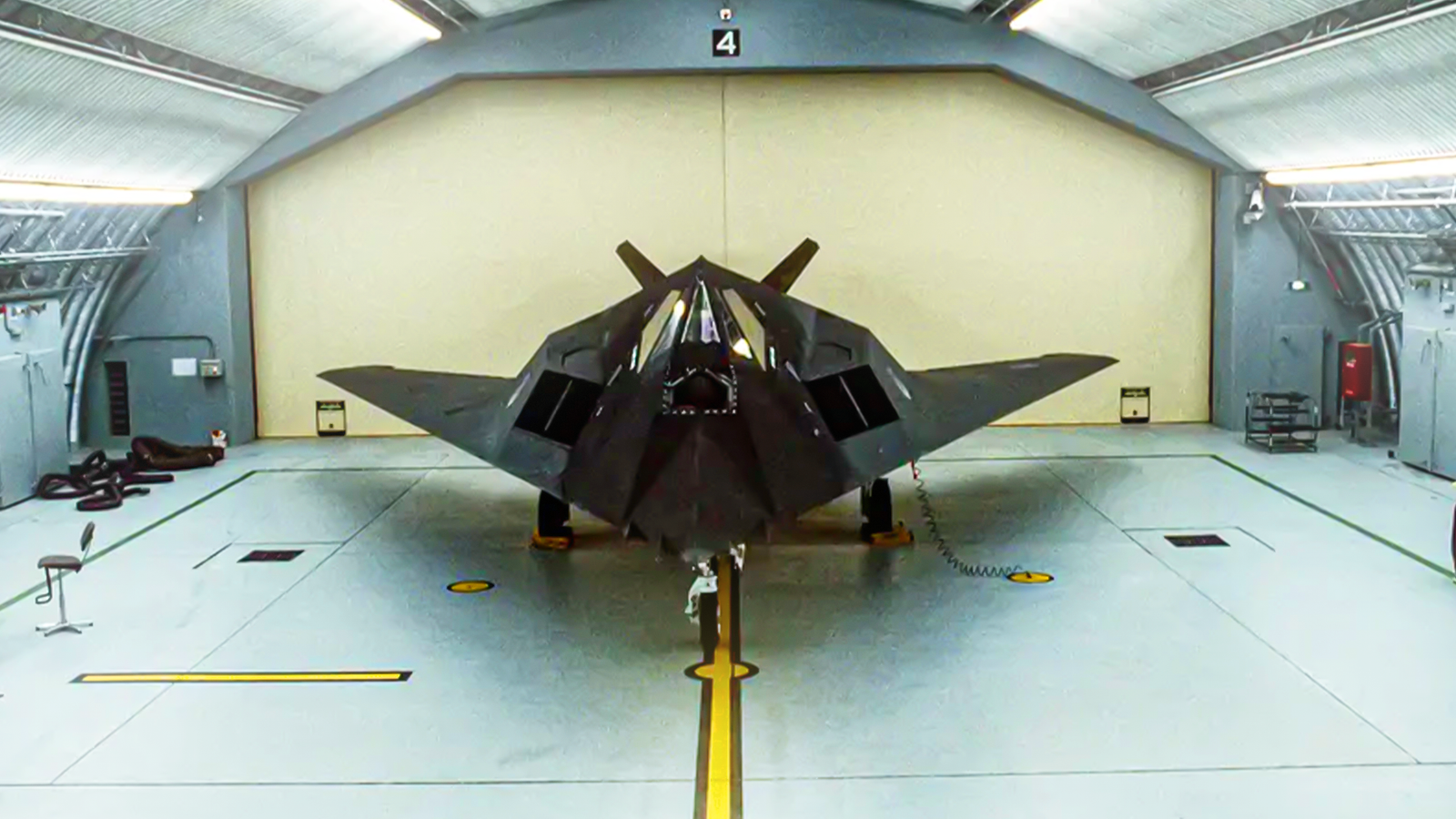
The Smithsonian National Air and Space Museum announced on September 14 that it would finally receive its first example of the legendary Lockheed F-117 Nighthawk. This particular airframe is affectionately known as 'overachiever' for its enduring service that spanned four conflicts, from the very first missions ever flown by a stealth plane into combat to the major air campaign of Operation Iraqi Freedom. As of October 6, the jet was inducted for its final display preparations at a special hangar on the field of Washington Dulles International Airport (IAD) in DC. Notably, despite the retirement of the Nighthawk from Frontline service, a select few remain in the official inventory. The US Air Force officially sunset the F-117 in 2008, just a few years after tail number 85-0818 flew its final combat sortie. Yet, it still flies a small cadre of Nighthawks at remote airfields in the American Southwest and has even indicated plans to keep doing so until at least 2034. The arrival of the iconic angular black jet is a milestone addition to the already unparalleled collection at the expansive museum in the Steven F. Udvar-Hazy Center of Chantilly, Virginia. As the first operational aircraft built with true stealth technology, the F-117 kicked off the race for low-observable, radar-defeating technology that defines the modern era of air warfare. Overachiever is a very carefully curated airframe with its decorated history of service, making it a must-see attraction for Av Geeks visiting the nation's capital. Enter The Nighthawk: Operation Just Cause Credit: The National Archives Catalog The F-117A made its combat debut on December 19, 1989, with Operation Just Cause. Six aircraft from the 37th Tactical Fighter Wing launched from Tonopah, Nevada, on a long-range mission that would require five aerial refuelings. The primary mission was an infrastructure strike at Rio Hato airfield, home to Panama Defense Forces Battalion 2000. Planners aimed to stun the sleeping garrison to clear the way for a low-level drop by US Army Rangers flying in on transports on the heels of the strike. The tactical plan required precise timing to detonate conventional bombs 30 seconds before the paratroopers arrived. At 1:01 AM, Captain Gregory Feest dropped a 2,000-lb (907 kg) GBU-27 laser-guided bomb next to the barracks, causing a shockwave that shattered windows and sent the local forces into chaotic disarray. A last-minute change in targeting, wind shifts, and technical errors caused the second F-117A's bomb to drift off target. The surprise attack was also compromised by a leak that had allowed some PDF troops to evacuate the buildings before impact. Despite failing to achieve all the original objectives, the Joint Chiefs of Staff deemed the mission an operational success. The psychological shock of the stealth attack delayed the PDF counterattack, allowing the Rangers to secure a vital runway after a five-hour firefight. The F-117As exited Panamanian airspace with impunity, validating the stealth concept for the first time in a real-world combat environment. Rulers Of The Night: Operation Desert Storm Credit: The National Archives Catalog The Nighthawk's second foray into battle proved to be a defining chapter in the warbird's legacy. As Operation Desert Storm commenced, F-117s took off in the early hours of January 17, 1991. The conflict would solidify the importance of low-observable combat planes, proving that a subsonic aircraft could infiltrate the most densely defended airspace on Earth completely unassisted thanks to stealth. Prior to the war, planners viewed an air assault on Baghdad as potentially suicidal due to sophisticated Soviet integrated air defenses linked to a central command system code-named 'Kari.' Against Kari, conventional aircraft required massive escort packages of radar jammers, fighter escorts, and anti-radiation platforms just to survive. The F-117 upended this dynamic entirely. Operating from remote bases in Saudi Arabia, the 37th TFW deployed their aircraft to fly as lone, independent platforms. They bypassed radar screens without electronic jamming escorts that would otherwise tip off Iraqi controllers. At 2:51 AM on night one, the first laser-guided bomb dropped by a Nighthawk struck a telecommunications tower in downtown Baghdad, instantly severing Iraqi command-and-control. Follow-on aircraft struck air defense headquarters, sector operation bunkers, and presidential palaces. Because Iraqi operators could not track the stealth aircraft, they resorted to blind saturation fire, filling the night sky with thousands of anti-aircraft rounds. Despite flying through heavy flak, 29 F-117s successfully hit over two dozen high-value targets. The final battle metrics underscored the asymmetric advantage of stealth technology. While the F-117 fleet comprised a mere 2.5% of total coalition aircraft, the jets struck roughly 40% of all high-value strategic targets during the first three days of the war. Over the six-week campaign, the fleet logged 1,271 combat sorties and more than 6,900 flight hours. Despite flying into the teeth of anti-aircraft fire night after night, not a single Nighthawk was damaged or lost to hostile fire. Behind Enemy Lines: Operation Allied Force Credit: The National Archives Catalog The illusion of absolute stealth invulnerability was shattered on March 27, 1999, on a mission under NATO’s Operation Allied Force over Yugoslavia. The paradigm shift came when an F-117, serial number 82-0806, call sign Vega 31, was shot down by a Soviet-legacy air defense battery. This event remains the first, and to this day only, successful combat shoot-down of a Nighthawk. The aircraft was piloted by Lieutenant Colonel Dale Zelko, a veteran combat flyer returning from a strike near Belgrade. Repetitive flight routes and complacency were largely attributed to the historic loss. Operating from Aviano Air Base, Italy, the Nighthawk fleet had flown predictable strike corridors into Serbia and underestimated the threat after so many successful sorties. NATO leaders declined to assign electronic jamming escorts like the Grumman EA-6B Prowler as it was viewed as necessary. Meanwhile, Yugoslav intelligence used airfield spotters to track takeoff times and coordinate with regional commanders to project exactly when the aircraft would enter the airspace near concealed surface-to-air missile batteries. Lying in wait for Vega 31 was the 250th Air Defense Missile Brigade, commanded by Colonel Zoltán Dani. To evade NATO anti-radiation missiles, Dani had practiced rapidly relocating his vehicles undercover and restricting radar broadcasts to brief 20-second bursts to search for targets. Crucially, he modified his SA-3 Goa SAM to operate at longer, low-frequency wavelengths capable of finding approximate vectors against stealth targets. When Vega 31 opened its bomb bay to drop its payload on that fateful night, the perpendicular doors and exposed internal surfaces spiked the jet's radar cross-section (RCS) momentarily higher than normal. This brief window of vulnerability allowed Dani to lock on and launch two missiles. The second missile detonated directly adjacent to the jet, tearing off the left wing and sending the F-117 into a violent spin. Zelko ejected safely into a muddy field near Buđanovci, hiding in a drainage ditch for eight hours while search parties closed in. A US Air Force Combat Search and Rescue team flying MH-53 Pave Low and MH-60G Pave Hawk later extracted him under total darkness. Years later, Zelko and Dani met in person, transforming their wartime rivalry into a lasting personal friendship which also inspired a Hollywood film based on the events. The Last Ride: Operation Iraqi Freedom Credit: The National Archives Catalog Twelve years after the Gulf War, the F-117A returned to the Middle East for Operation Iraqi Freedom in March 2003. This final deployment focused on specialized, time-critical missions targeting senior leadership rather than broad infrastructure raids. The stealth fleet operated without a single combat loss, utilizing advanced modifications that fixed past limitations. The campaign began abruptly on March 19, when intelligence placed Iraqi President Saddam Hussein at a fortified compound south of Baghdad, prompting an immediate decapitation strike before ground operations commenced. The mission fell to two F-117As from the 49th Fighter Wing, which flew under radio silence through severe thunderstorms. After refueling from a KC-135 near the border, the aircraft penetrated the dense radar network around the capital. At 5:30 AM on March 20, the aircraft dropped four 2,000-lb (907 kg) precision weapons onto the bunker network. While the target had evacuated shortly before impact, the strike disrupted the regime's early military coordination as coalition forces crossed the border. The deployment debuted the EGBU-27 bomb, combining traditional laser guidance with an internal GPS navigation system. This solved past vulnerabilities where cloud cover, sandstorms, or smoke forced pilots to abort missions due to obscured sensors. A detachment of twelve F-117As flew over 100 successful nighttime sorties against deeply buried command nodes. This marked the final combat deployment for the platform, which the Air Force officially retired from active service in 2008 as newer stealth platforms entered inventory. Overachiever Heads For Greener Pastures At The Smithsonian Credit: The National Archives Catalog The public debut of an F-117A at the Steven F. Udvar-Hazy Center in Virginia represents a significant milestone due to the scarcity of these aircraft on public display. For decades, the fleet remained under maximum military secrecy. Following active service retirement, the Air Force continued to guard the surviving airframes stored in climate-controlled hangars at Tonopah. Out of 59 production airframes built by Lockheed's Skunk Works, fewer than a dozen are accessible to the public today. The majority remain 'on ice' in Nevada, with a few serving as stealth aggressors during advanced air exercises, while others were dissected for classified testing. The Smithsonian acquisition of tail 85-0818 provides the world-class collection with a historically monumental link to the dawn of stealth warplanes, marking the preservation of a design that altered standard military aviation paradigms. The handful of other airframes that can be viewed are found at the National Museum of the United States Air Force, the Palm Springs Air Museum, and the Ronald Reagan Presidential Library.
Overachiever: The Only F-117 To Fly Combat In 4 Conflicts Finally Reaches The Smithsonian
Full Article
Original Source
Read the full article at Simpleflying →KhanList aggregates and links to publicly available news content. We do not host full articles from third-party sources. Always verify important information with original sources.