
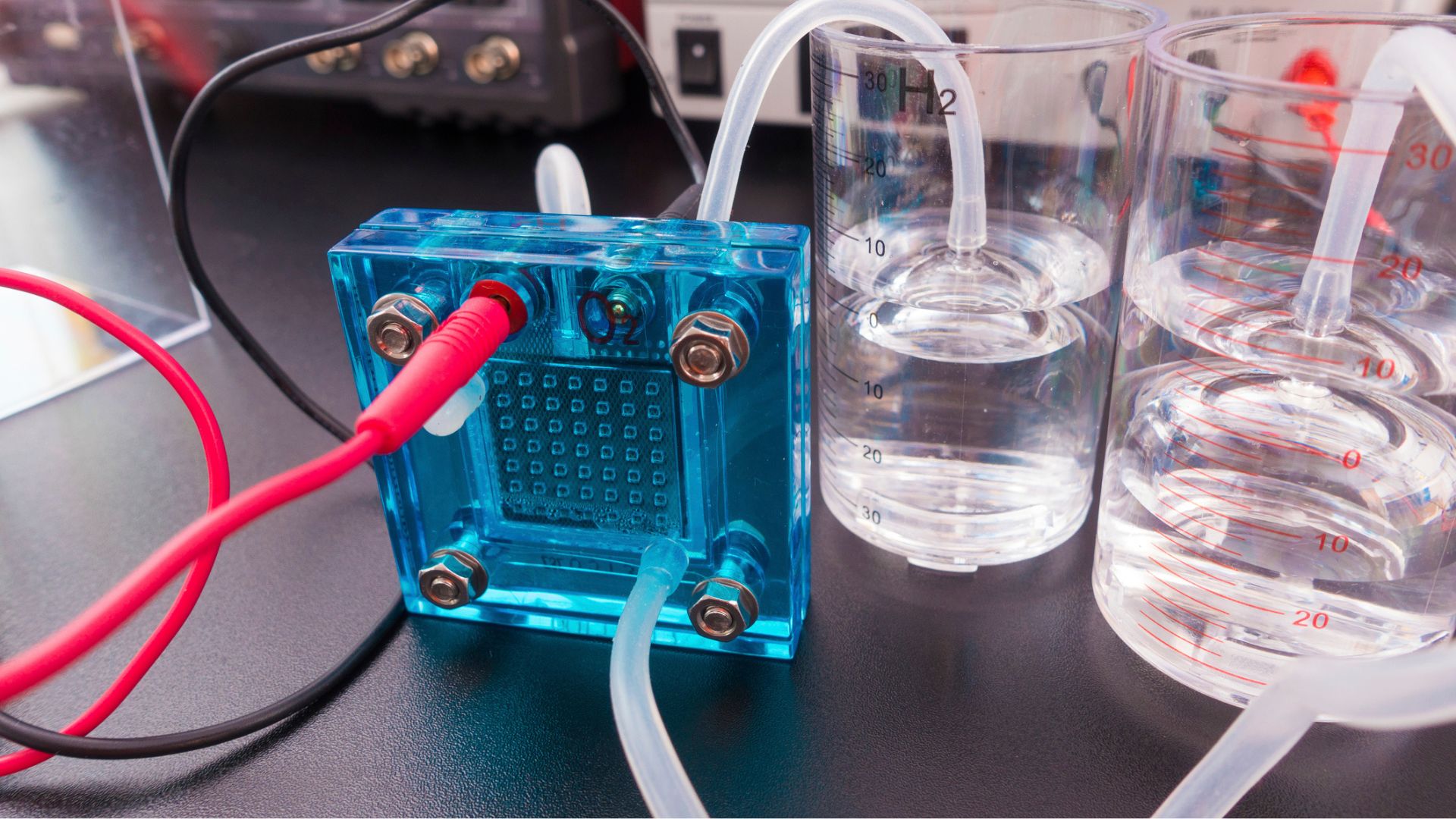
Key TakeawaysThe organic solar device sets a world record by converting sunlight to clean hydrogen at 7.9% efficiency.A new hybrid protective layer prevents corrosion.To cut costs, the team drastically reduced its dependence on precious metals.Scientists have found a way to produce clean green hydrogen using little more than sunshine and water. A team in South Korea has built a solar-powered device that splits water molecules completely on its own. By doing so, it has set a world record in efficiency for organic water-splitting devices. Plus, it runs without any external electrical supply.Traditionally, hydrogen production has relied on natural gas, which releases carbon dioxide in the process. In this regard, solar-powered devices offer a truly zero-emission alternative. However, such devices struggled to generate enough voltage on their own and required outside electricity. “Photoelectrochemical (PEC) water splitting offers a direct route to solar hydrogen, but organic semiconductor-based photocathodes have been limited by insufficient photovoltage and interfacial instability,” said the researchers in the study.Now, a research team at the Ulsan National Institute of Science and Technology (UNIST) has tried to solve this bottleneck. The researchers have designed a tandem device that stacks two light-absorbing layers on top of each other. Engineering a resilient tandem architecture In lab trials, the tiny cell reached a solar-to-hydrogen conversion efficiency of 7.9%. That marks the highest figure ever recorded for an organic semiconductor photocathode operating without an applied electrical bias.Splitting water requires a minimum electrical threshold of 1.23 volts. Single-layer organic materials cannot reliably reach this target. In the past, stacking two layers to boost voltage caused rapid degradation. The standard connector, a material known as PEDOT:PSS, is highly acidic and vulnerable to water, meaning it quickly damages the neighboring components.The UNIST team replaced this corrosive link with an entirely new hybrid layer. They combined molybdenum oxide with an organic molecule called 2PACz. The molybdenum oxide is neither acidic nor prone to absorbing moisture. It also forms a protective shield that stops liquid solvents from leaking through during the coating process. At the same time, the 2PACz molecules smooth out microscopic defects, allowing electrical charges to flow freely.“The resulting tandem photocathodes reach an onset potential of 1.67 V vs. RHE and a 7.9% solar-to-hydrogen (STH) efficiency under unbiased two-electrode operation, which, to our knowledge, is the highest reported for organic semiconductor-based photocathodes operating without external bias,” added the study. After 10 hours of continuous operation, it retained 86% of its initial photocurrent, whereas conventional designs saw their performance crash to 36%. Minimizing use of precious metals The technology has already moved beyond the laboratory bench. The researchers assembled an outdoor module spanning 320 square centimeters, which successfully churned out hydrogen under natural sunlight.To keep costs down, the engineers drastically scaled back their use of precious metals. Platinum was reduced to just 0.1% by weight on the hydrogen electrode, while the counter electrode relied on an affordable nickel-iron-cobalt catalyst. Because both sides work within the same chemical bath, the setup avoids expensive ion-exchange membranes altogether. Economic modeling suggests that if the device can reach its theoretical 16% efficiency limit at scale, it could deliver hydrogen at $4.26 per kilogram. Meanwhile, researchers at Nanyang Technological University in Singapore are taking solar fuel production in an intriguing new direction. Their leaf-inspired device uses sunlight to extract hydrogen directly from seawater while simultaneously neutralizing hydrazine, a toxic industrial chemical. Together, both breakthroughs signal that solar-driven chemistry is rapidly maturing from a fragile concept into a practical industrial tool. Get the latest in engineering, tech, space & science - delivered daily to your inbox.An active and versatile journalist and news editor. He has covered regular and breaking news for several leading publications and news media, including The Hindu, Economic Times, Tomorrow Makers, and many more. Aman holds expertise in politics, travel, and tech news, especially in AI, advanced algorithms, and blockchain, with a strong curiosity about all things that fall under science and tech.
Organic solar device sets world record for making clean hydrogen using only sunlight
Full Article
Original Source
Read the full article at Interestingengineering →KhanList aggregates and links to publicly available news content. We do not host full articles from third-party sources. Always verify important information with original sources.