
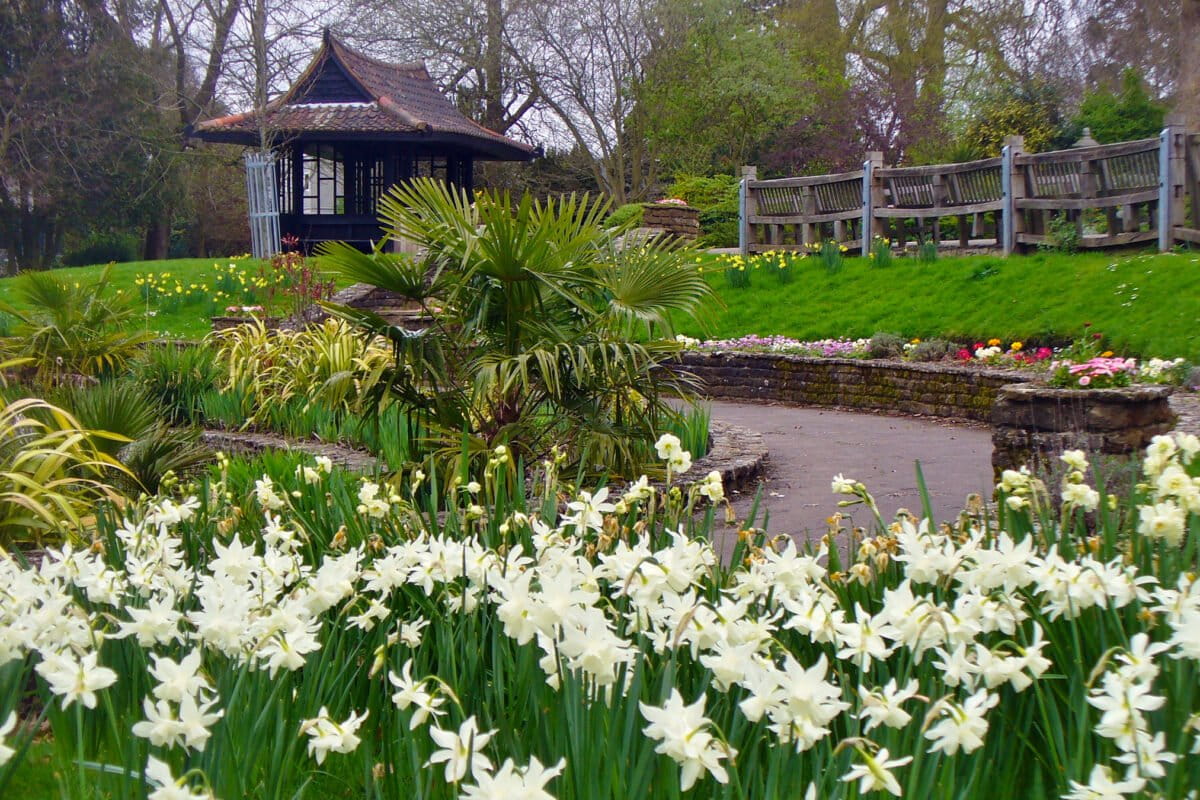
Two recent studies out of the U.K. town of Guildford, which has been equipped with a suite of sensors to become a “living lab,” show that green spaces provide significant benefits to urban centers — and do so with more detail than many previous studies.The first study, focused on a large park, showed that the park made the surrounding area cooler and less noisy, and reduced air pollution, with the park’s effects decreasing with every 100 meters from its border; it also showed that different types of green spaces offer different cooling effects for people within them.The second study showed that the type of green space within Guildford mattered when it came to temperature reductions during extreme heat, with large green spaces like woodlands showing the lowest increase in temperature.Experts say that these fine-scale details could be helpful for researchers, planners and engineers who want to design urban green spaces to provide cities and towns with greater protections from the impacts of climate change. Stoke Park is a natural haven in a busy British town. Centered in Guildford, Surrey, its rolling fields pop with wildflowers in the spring; birds sing and ducks paddle serenely in a pond beside ornamental gardens; and the sun casts dappled shade on the grass from oak, spruce and beech trees, scattered across 52 hectares (130 acres) of green. Yet as residents and visitors stroll, jog and lounge across Stoke Park’s green reaches, it’s doing even more for them than they realize: According to two recently-published studies, its green areas reduce heat, pollution and noise — and have benefits that extend beyond the park’s borders. Parks have a well-documented benefit to urban areas, particularly given the rising heat of climate change: Many previous studies have established that parks are much cooler than the surrounding area, and that they also tend to reduce air pollution and noise. These previous studies also found that air and surface temperatures were lower for tens or even several hundred meters around green spaces, depending on the park. However, “most of the work in this field has been focused around one benefit — so either you see just health benefits, or how they affect air pollution, or overheating,” Prashant Kumar, professor at the University of Surrey, co-director of the university’s Institute for Sustainability and director of its Global Centre for Clean Air Research, said in a Zoom interview with Mongabay. “You hardly see studies which look holistically at the multiple benefits of the plants [or] the multiple types of green infrastructure.” In order to create a more comprehensive picture of a park’s potential benefits, Kumar’s team hit the streets. Thrice a day — in the morning, afternoon and evening — over 10 days in the summer of 2023, a researcher donned a custom backpack kitted out with instruments to measure a variety of environmental conditions: Air temperature, solar radiation, relative humidity, wind speed, sound levels and air quality conditions, including CO2 levels and the amount of fine particulates. This walking laboratory also contained a GPS device that mapped its location and the time that these measurements were made. Taipei’s Daan Park offers residents a shady green respite from the surrounding urban environment. Image by Parks and Street Lights Office, Public Works Department, Taipei City Government via Wikimedia Commons. To complement this summer of data, the team also set up fixed sensors at other sites around Guildford with green or blue infrastructure — for example, lakeside in a town nature reserve, and within a small “pocket park” at the intersection of two roads — to monitor how their temperatures compared to urban areas over the summers of 2023 to 2025. The team had ample data about the urban area around these green sites to compare to: As part of the Guildford Living Lab project, the town itself is outfitted with a network of sensors recording temperature and humidity every minute of every day. The resulting data — published in August and September in the journals City and Environment Interactions and Environment International, respectively — confirmed what previous studies had found. All day long during summer 2023, Stoke Park was cooler and quieter than the surrounding areas: With every 100 meter (328 feet) that the researchers walked into the park, temperatures cooled by an average of 0.2° Celsius (0.36° Fahrenheit) and noise levels dropped by about 10 decibels. Significantly, the park also had an impact on the area around it: Temperatures warmed by more than 0.5° C (0.9° F), and noise levels increased by 3.4 decibels with every 100 m away from the park edge. Carbon dioxide levels and fine particulates of all sizes also increased as the researchers moved away from the park. This radius of benefits was particularly intriguing to Cecil Konijnendijk, founder of the Nature Based Solutions Institute, who has been studying the impact of urban forestry for more than 30 years but was not involved in the Guildford studies. The UK city of Guildford is located about 48 kilometers (30 miles) southwest of London. Image by Ian Capper via Wikimedia Commons (CC BY-SA 2.0). “Some of the other research has been unclear about the effect of a park on the wider surroundings,” Konijnendijk said, speaking to Mongabay by Zoom interview. He noted that other studies have shown this effect extending only a few meters at most. “This suggests it would be extending further and could be pretty significant. It shows an interesting narrative: That living close to a green space is not only good for recreation, but also air pollution and cooling effects even at a distance.” Over the multiple summers of monitoring, the researchers saw that all the green-blue areas across the town were cooler, on average, than the built-up areas surrounding them. The degree of cooling seemed to depend on the size of the area and its natural features: For example, the pocket park and a “green wall” of vegetation outside of a nearby arts center showed much less cooling than the lakeside sites or a large woodland area on the border of Guildford. In fact, across the three summers, the woodland was the only site that didn’t experience heat wave conditions during multiple days of extreme high temperatures. What Kumar finds most interesting, however, is the microclimates that the data revealed. Stoke Park has a small area with a dense concentration of trees, and beneath their shade, the researchers recorded an extraordinary little haven. Their 2023 strolls found that the tree-shaded area had the coolest average temperatures of the whole park: On average, 2.5° C (4.5° F) cooler than the built-up area. When the team performed a thermal comfort analysis — which factors in air temperature, humidity, wind speed and radiation to figure out how comfortable a person would be in a given location — they found that tree shade lowered a person’s perception of the outdoor temperatures by as much as 8.5° C (15.3° F) compared to the built-up area. Though the nearby grasslands and lakeside were also cooler than the surrounding urban spaces, by 2.3° C and 2.1° C (4.1° F and 3.8° F) respectively, their thermal comfort analysis levels were much lower. The Guildford studies found that tree shade lowered a person’s perception of the outdoor temperatures by as much as 8.5° C (15.3° F) compared to a built-up area. Image in the public domain. How to make places and people cooler To Leslie Brandt, the sustainability and resilience project manager at the U.S.-based engineering firm Bolton & Menk, the Guildford studies’ focus not just on overall urban heat reduction but specifically on human comfort, was particularly notable. “I think that where this leads us is the need to not just cool places, but cool people, and focus on making sure that the urban design features that we create really benefit people at that local level,” she said in a Zoom interview. Functionally, she explained that this means planting trees to maximize comfort in places where people congregate, such as around bus stops, playgrounds, or park benches, in addition to on the borders of open spaces. It also means recognizing that not all green spaces will benefit people equally; for instance, this study shows an open meadow wouldn’t offer the same cooling benefits to a person during a heat wave as a single tree. Indeed, presenting these environmental benefits in meter-by-meter amounts provides data that planners could then use to help create green spaces that are tooled to the extremes of climate change. This is the focus of Brandt’s role at Bolton & Menk, which works primarily in Minnesota’s Twin Cities region, and she said it’s a topic she’s seeing cities increasingly consider as part of heat mitigation and climate equity plans. However, both she and Kumar pointed out that this data is most effective when viewed holistically. Many green spaces are developed “in silos,” Kumar said, with a primary focus on appearance. Park designers might factor in plant maintenance, growth speed, or toxic species, but according to Kumar, “aesthetics remains on top, and in the process, we forget that this could create more issues.” As a recent commentary in PLOS Climate pointed out, this could include accidentally increasing habitat for disease-carrying creatures like ticks and mosquitos, which are increasing in many areas due to rising temperatures. Festival goers seek out shade during a hot summer day in the southern city of New Orleans. Image by Derek Bridges via Wikimedia Commons (CC BY 2.0). “Where I’ve seen success is when you have interdisciplinary teams of engineers, landscape architects, foresters, planners, scientists, all working together to help make an informed decision,” Brandt said. When it comes to potential disease vectors, for example, the fix can be simple as long as designers are made aware of them: “Things like making sure there is not stagnant water, or making sure there are not tall grasses right along trails that would be an area for people to be exposed to ticks.” The next project for Kumar’s team aims to help support this kind of decision-making for towns and cities. He’s designing computer models that can analyze design considerations that a town might want in a green space — such as an open area for events or a water feature — and recommend how that could be included while still factoring in benefits like cooling and pollution mitigation. As Konijnendijk pointed out, large cities like Paris and Toronto are already betting big on green spaces to make their cities more climate-resilient; researchers hope that by creating tools that provide practical and flexible solutions, urban areas of all sizes could be both greener and better-prepared for the changes ahead. Banner image: Stoke Park in Guildford. Image by Colin Smith via Geograph Britain and Ireland (CC BY-SA 2.0). Urban heat islands have solutions; many tropical cities can’t afford them Citations: Ferguson, M., Garrett, J. K., Tschirren, B., Wheeler, B. W., Vaux, A. G. C., Guell, C., Medlock, J. M., Bonneaud, C., Taylor, T. J., … Huebner, G. M. (2026). Balancing urban green space benefits and vector-borne disease risk under climate change: Critical decision-making for 21st century public health. PLOS Climate, 5(9), e0001016. doi:10.1371/journal.pclm.0001016 Khalili, S., Jones, L., Pfautsch, S., … Kumar, P. (2026). Quantifying the benefits of parks for mitigating heat, air and noise pollution to inform climate-resilient planning. City and Environment Interactions, 100407. doi:10.1016/j.cacint.2026.100407 Khalili, S., Jones, L., … Kumar, P. (2026). Microclimatic performance of greening against urban overheating: a multiseasonal analysis using in-situ monitoring and satellite data. Environment International, 110452. doi:10.1016/j.envint.2026.110452 FEEDBACK: Use this form to send a message to the editor of this post. If you want to post a public comment, you can do that at the bottom of the page. Cite this articleClaudia Geib (2026). A town-wide ‘living laboratory’ shows how green spaces can combat climate extremes. Mongabay Conservation news. DOI: https://doi.org/10.66709/news-334168 Credits Topics
A town-wide ‘living laboratory’ shows how green spaces can combat climate extremes
Full Article
Original Source
Read the full article at News →KhanList aggregates and links to publicly available news content. We do not host full articles from third-party sources. Always verify important information with original sources.