
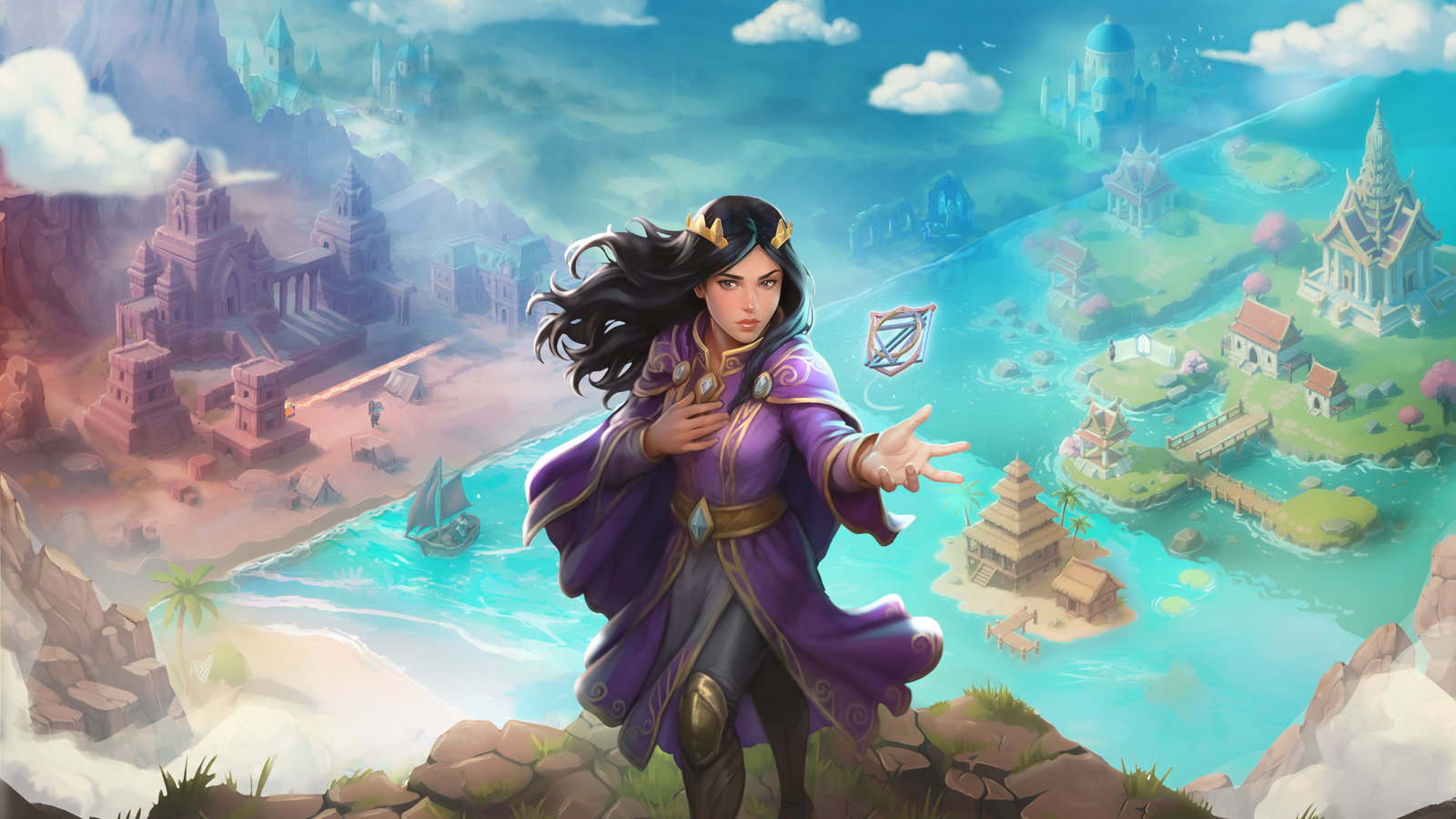
First Released Systems Leave a Review Overview Score Published Oct 7, 2026, 9:00 AM EDT An encyclopedic collection of visually sumptuous puzzles, Thekla Inc.'s latest is an epic of the form. Ingenious, frustrating, and utterly sublime. Like others who bleed warehouse crates and refracted beams of light, Thekla’s designers seemingly crafted Order of the Sinking Star as both an homage to countless and specific Sokoban-likes and a lighthouse to the uninitiated. See Pros & Cons I'm not neccesarily a "puzzle game guy." I've tangled with the breakouts—which, like many, is how I came to know Jonathan Blow & co.’s oeuvre—and a number of niche entries besides. It is upon such confessions that I praise Thekla Inc.'s enormous, seemingly bottomless block-pushing magnum opus Order of the Sinking Star. From that vantage, this momentous and intricate project still feels fit to my form, from the ingenious way it stacks its mushrooming ruleset to feel conquerable, to the omnipresent hallmarks of quality in its vast trove of rooms, how they read and move and urge you onward and through. I struggle to think of another puzzle game with comparable scale. Blocks and Light and Skipping Stones My own experience sits somewhere in the low-middle of that hierarchy, but I still found myself improving screen by screen, juiced with brief flashes of mastery that accelerated as I traveled further, higher, and lower through the map. I wouldn’t call the game beginner-friendly, exactly, but it is indeed beginner-aware in how it regards its tropes as fresh insights, though certain rooms will assuredly make puzzle vets roll their eyes. From its starting point of four (formally licensed) independent projects, Order of the Sinking Star quickly spirals, swirling rules, heroes, and environmental hazards. Unknown character abilities get casually introduced on the fly, interactions between yet-unmet mechanics spawn surprising new strategies and techniques. A recurring sense of novelty and revelation persists well past the tradition of any other puzzle game I’ve played, which can admittedly become overwhelming; thrilling, impressive, delightfully extensive, but overwhelming all the same. A Queen is rescued moments before a dire act, whisked away to a strange land filled with portals into other realities, maybe even memories. Within these, she vanishes completely, replaced by one or several characters of various origins and archetypes; the initial Wizard, Rogue, and Warrior are more immediately familiar than The Caver, a kind of archaeologist searching for tomb treasures wielding gems and tools. Each hero is introduced alongside their core ability, set to clear paths to the exit on their own or in tandem, occasionally chatting with one another. In rare moments, this dialogue can present a clue to a solution. This Canterburian crew actively commands the bulk of the game's discrete puzzles, most of which exist in this staged meta-layer. On completion, the Queen tracks her progress through a broadening overworld with fog clearing at each discovery. A clever shortcut method lets you hop around the map with minimal fuss, and two stages of zoom allow you to orient yourself or ponder the mechanisms that connect access and travel between the far corners of Sinking Star’s world. Audio logs expand the game’s cryptic overarching narrative, though little of it read as coherent at first. I did get frustrated at how the story wasn’t conveniently collected for review, though I admit I was equally put off by some odd line reads and, well, certain lines outright. This didn’t hamper my experience or esteem of the game as a whole, but I do wish these aspects were tightened up or even edited down, though some hero pairings and their resultant banter proved more interesting and direct. You Have No Choice But To Pull The Queen is functionally simple at first; she pushes blocks, that very elemental Sokoban root expression. However, she is soon granted opportunities to briefly wear the garb of the game’s heroes, playing into solutions on the overworld that unlock further puzzles. Yes, the game spotlights puzzles, its map is a puzzle (both of puzzles and to puzzles), and it gets recursively deeper from there. Most heroes have an ability that is, for lack of a better term, forced, with no direct input required. The Wizard immediately teleports, swapping places with an entity in a cardinal direction, and early rooms demonstrate how cursed this trait would be. The Bard cannot help but ensorcell companions and enemies alike to dance in her aura, which easily traps her in corners, and the Rogue doesn’t simply pull objects; she must. Reckoning with each hero’s ambient nature is integral to progression in Order of the Sinking Star, a sensibility I found frustrating in my earliest hours. This is softened by the game’s generous undo function, which lets you quickly restart or scrub backward (even after death), and you can just as easily hasten the world speed to wait out machinery and other environmental actions. Such friction-free failure reminded me of Super Meat Boy’s lightning-fast restarts, easing the try-and-die routines of Sinking Star’s most fiendish demands. You're Lucky This Fiendish Game Is Such A Stunner Barely anything in the game is offered so willingly; I lost count of the rooms where acknowledging its basic requirements preceded the will to put thoughts to action and play the puzzle itself. And, yes, I also steamrolled a few on my run, empowered by strategies that slowly became second-nature, but such moments were nothing compared to its toughest solves. It’s helpful, then, that the game’s puzzles are so beautifully adorned. I maintain that its floor tiles may be the loveliest I’ve ever encountered, stacked with textures oriented to make them appear single-handedly crafted, many succumbed to random patches of wavering flora. Flames and beams of energy sparkle magnificently and blend into lighting effects that set a variety of moods that tint each challenge. It may seem minor, but red velvet has never been so astonishingly presented in a game. Hero animations are extravagant but never distracting, with idle and reactive body language fleshing out personalities alongside their dialogue. Deadly creatures are reactive things, singing a claw on an invincible hero’s aura, gnashing in wait when standing just out of reach. Hardcore puzzle games are not commonly known for feeling alive, but Order of the Sinking Star constantly breathes and murmurs and evokes a sense of place, and it's a pleasure to get lost in it. Such praise extends to its soundtrack as well, a diverse collection of orchestral variations that smartly fade when you’re staring at the screen lost in thought, cautiously reintroducing instrumentation when the heroes get back to the task at hand. Along with highest marks to its visual presentation, Sinking Star’s overall aesthetic helps the game feel supportive and encouraging, and I don’t believe I’d have stuck with it otherwise. 1,000+ Puzzles And The Drive To Best Them All I’ve struggled with 2016’s The Witness in multiple bouts since release, relearning its rules in cycles over time. There, sequences of puzzles always guided through the basics one layer at a time, but Order of the Sinking Star is much less patient and formal, its flow of rules discovery more nuanced and constant. It still organizes puzzles on the overworld by theme, but its mechanical vocabulary feels richer than anything Thekla has produced, which also makes its lessons more prone to error or misunderstanding than The Witness or Braid. In other words, the moments in Sinking Star when the game explicitly communicates another new rule diminish in frequency early on. The lessons do not conclude, but they’re picked up “on the job,” so to speak, with the express belief that you’ve internalized all that’s come before. Everyone thinks and solves tasks differently, but Order of the Sinking Star’s design magically accounts for this with its open world, letting you stray to other avenues when hard-stuck. The Witness functioned in much the same way, but Sinking Star’s sheer size makes this routine feel more potent, possibly even more rewarding, which is what keeps me fixated and returning to its most vexing rooms. You're Always Playing Order of the Sinking Star A bookstore in Italo Calvino’s If on a winter's night a traveler is filled with every genre and organized purpose, including “Books That Everybody's Read So It's As If You Had Read Them, Too.” Order of the Sinking Star can feel like its puzzle equivalent, a geography of thinking games, inspired by the genre’s past, present, and future, with tropes internalized and functionally ignorant of your own background in the genre. I don’t know if I'm the targeted audience for Order of the Sinking Star, nor whether I have what it takes to best its apparent 1,000+ puzzles, but the fact that I feel like I could, granted a long enough timeline, sets the game well apart from others, your Snakebirds and Stephen’s Sausage Rolls, confirmed classics which firmly halted me at the door. It's somewhat ungainly narrative-wise, but Sinking Star feels approachable, inspiring, even absolutely frustrating much of the time. But also sublime, delicately drawn, frequently dazzling, and somehow welcoming in the same breath. Even after The Witness, Braid, and the many PuzzleScript games and Sokoban-likes that form its foundation, I'm sure I've never played anything to match. It’s not just a game of the year contender; fall in its clutches, Order of the Sinking Star might also end up the game you simply play the most, even—and most importantly—when you’re far away from the screen. SR Score Pros An almost-unparalleled collection of relentlessly challenging yet inviting puzzles throughout. Possibly the most visually beautiful block-pushing puzzle game ever made. Hundreds of hours of content with multiple end-game milestones, making for one of the highest-value puzzle games ever put to market. Generous undo system urges experimentation and minimizes any friction from failure. Inventive new rules and tools granted at nearly every step of progress keeps the experience feeling fresh. Cons Early game narrative is unsatisfying and opaque. Storytelling is often tonally inconsistent, with some grating voice performances. Hard to track overall game progress, though this might help its gargantuan amount of content feel somehow conquerable.
Order of the Sinking Star Review: A Maxed-Out Puzzle Game Masterpiece
Full Article
Original Source
Read the full article at Screenrant →KhanList aggregates and links to publicly available news content. We do not host full articles from third-party sources. Always verify important information with original sources.