
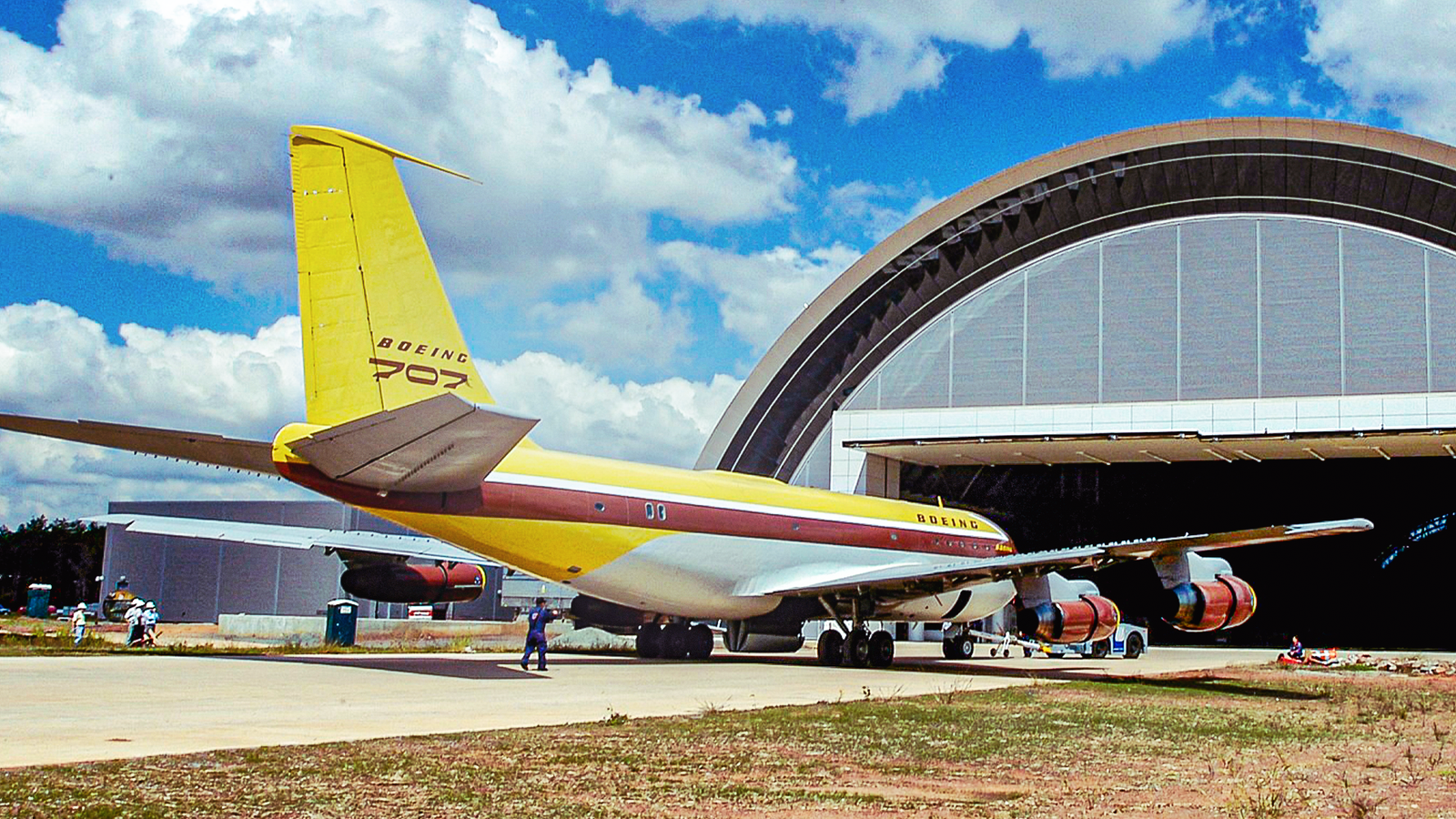
Published Oct 24, 2026, 4:00 PM EDT Journalist - Steven has a varied background in communications, and it was this passion for writing combined with his in-depth knowledge of the aviation industry that led him to Simple Flying. A keen linguist, he also has experience in translation and interpreting. Based in Palma, Spain Sign in to your Simple Flying account The arrival of the jet age promised faster journeys, greater passenger comfort, and a new era of commercial aviation, but it also presented aircraft manufacturers with an important engineering challenge: building a pressurized fuselage that could withstand thousands of flights without suffering a catastrophic structural failure. For Boeing, developing the 707 meant proving that a large aircraft could safely endure the repeated stresses of climbing to cruising altitude and descending to the ground, even when its metal skin suffered damage. Known as Operation Guillotine, Boeing's mid-1950s investigation subjected sections of the 707's fuselage to deliberately destructive tests, revealing how cracks could spread through an aircraft's structure and how carefully positioned reinforcements could stop them. The program emerged from lessons learned after the fatal accidents involving the de Havilland Comet, and its findings helped establish damage tolerance as a fundamental principle of airliner design, influencing generations of aircraft long after the Boeing 707 entered service. The Comet Disasters Changed Everything When the de Havilland Comet entered commercial service in 1952, it became the world's first production commercial jet aircraft, introducing passengers to speeds and altitudes that had previously been uncommon in scheduled airline operations. However, two catastrophic accidents in 1954, involving BOAC Flight 781 and South African Airways Flight 201, exposed a serious weakness in the aircraft's structure, as investigators determined that metal fatigue had contributed to the in-flight break-ups. The de Havilland Comet's pressurized cabin expanded slightly as the aircraft climbed and contracted during descent, creating repeated stress cycles in the fuselage skin and surrounding structure. Although engineers understood that metal could weaken under repeated loading, the consequences of these cycles were not yet fully understood, particularly around openings such as windows and other areas where stress became concentrated. Small cracks could develop, grow with each flight, and eventually cause the cabin structure to fail. The accidents transformed the industry's approach to aircraft safety, demonstrating that a fuselage could not be considered safe simply because it survived its initial strength tests. Engineers needed to understand how damage developed over time, how cracks propagated through metal, and whether a damaged structure could retain its integrity long enough to prevent a catastrophic break-up. Boeing's 707 program arrived at a critical moment, when these questions had become central to the future of commercial jet aviation. Building Confidence In The Boeing 707 Credit: Wikimedia Commons, Simple Flying The Boeing 707 represented a major step forward for the US manufacturer, combining swept wings, four jet engines, and a pressurized cabin in an aircraft designed for long-distance commercial operations. Derived from Boeing's experience with jet-powered military aircraft, the 707 was developed during a period when airlines were preparing to replace many of their slower piston-engine aircraft with jet-powered alternatives. Yet the new aircraft's potential depended on more than speed and passenger capacity, because its fuselage had to survive repeated pressurization cycles throughout its operational life. Engineers needed to establish not only how much pressure the structure could withstand when undamaged, but also what would happen if its skin developed a cut or crack. A structure that failed immediately after sustaining relatively localized damage would present a very different safety risk from one that could contain the damage. The Boeing 707 was available in a number of different variants. Data from ch-aviation shows that the largest historical operator of the Boeing 707 was Trans World Airlines, followed by Pan American World Airways and American Airlines: Ranking Airline Boeing 707 1 Trans World Airlines 130 2 Pan American World Airways 128 3 American Airlines 103 4 Pakistan International Airlines 37 5 Qantas 35 Beginning in 1955, Boeing developed an extensive testing program to investigate this problem, constructing large, curved, pressurized fuselage sections that reproduced important features of an actual airliner. These test structures featured curved metal skins and internal structural elements, allowing engineers to examine different materials, skin thicknesses, and reinforcement arrangements under controlled conditions. Rather than relying solely on calculations, Boeing set out to demonstrate physically how a damaged fuselage would behave. When The Guillotine Blades Fell Credit: Peter Scharkowski | Shutterstock The most distinctive feature of Operation Guillotine was its deliberately destructive approach, which allowed engineers to observe how pressurized fuselage structures responded to sudden, concentrated damage. Boeing subjected the test panels to saw cuts and dropped heavy guillotine blades onto their skins, simulating the kind of structural damage that could initiate a dangerous tear. Early configurations proved vulnerable, as the blades penetrated the metal and cracks spread rapidly through the surrounding structure, sometimes causing extensive failure rather than remaining confined to the damaged area. The experiments demonstrated that simply increasing the thickness of the fuselage skin was not enough to guarantee safety, because the way loads traveled through the structure mattered just as much as the strength of the metal itself. Engineers experimented with different reinforcement arrangements, including tear straps positioned beneath the skin and shear ties connecting structural components. These additions were intended to interrupt the progress of a crack, allowing the surrounding fuselage to continue carrying loads even when part of the skin had been damaged. As Boeing refined its design, the reinforced test panels became increasingly resistant to the blades, and the results provided practical evidence that damage could be contained rather than allowed to spread unchecked. In the final configuration, the structure survived seven blade drops without losing its overall integrity, while saw cuts no longer propagated beyond the reinforcing straps. The significance was considerable: instead of assuming that a damaged fuselage would remain intact, engineers could design specific features to limit the consequences of structural failure. Tear Straps & The Science Of Damage Tolerance Tear straps became one of the most important engineering lessons to emerge from the program, providing a relatively straightforward way to prevent a crack from traveling indefinitely through a pressurized fuselage. Positioned beneath the outer skin, these reinforcing elements act as barriers that resist crack propagation and help distribute loads around damaged areas. When a crack reaches a sufficiently strong strap, the reinforcement can prevent it from continuing into the next section of the fuselage, preserving the integrity of the remaining structure. The arrangement worked alongside the fuselage frames, which provide the aircraft's curved skin with structural support and help maintain its shape under cabin pressure and other operational loads. In the designs examined by Boeing, reinforcement spacing was particularly important because engineers wanted the structure to tolerate damage extending across at least one frame bay, approximately 20 inches (50.8 cm). This approach provided a defined level of protection, ensuring that localized damage would not automatically become an uncontrolled structural failure. The underlying principle became known as damage tolerance, in which an aircraft is designed to withstand specified levels of damage while retaining sufficient strength for continued safe operation under the required conditions. Rather than relying on a perfectly intact structure throughout its service life, engineers account for the possibility of cracks, material deterioration, and damaged components, while inspections and maintenance help identify problems before they become critical. Operation Guillotine helped turn that principle into a practical design approach that could be demonstrated through physical testing. From Engineering Experiment To Airline Sales Film Operation Guillotine also became a powerful demonstration of Boeing's confidence in the 707, although the manufacturer's engineering program and the film shown to airline customers were not the same thing. The engineering work involved a series of detailed tests, adjustments, and evaluations of pressurized structural panels, whereas the film presented selected results in a dramatic format designed to communicate the advantages of Boeing's fuselage design. Its striking imagery translated a complicated structural engineering problem into something airline executives could readily understand. In the demonstration, blades penetrated a conventional pressurized fuselage structure, which then suffered catastrophic damage, while a reinforced Boeing 707 fuselage endured multiple blade strikes with its overall structure remaining intact. The film emphasized that the damage to the 707 produced limited air leakage rather than the uncontrolled tearing that had characterized earlier test configurations. Although this presentation simplified the engineering process, its central message reflected the purpose of the actual experiments: a carefully designed fuselage could contain serious local damage instead of allowing it to compromise the entire aircraft. For airlines considering the transition to jet-powered operations, such as Qantas, Air India, and Continental Airlines, structural reliability was an essential commercial concern alongside speed, range, and operating economics. A new generation of aircraft would accumulate substantial numbers of pressurization cycles, and operators needed confidence that its structure could withstand years of demanding service. By presenting visible evidence of its testing program, Boeing could demonstrate that the 707's design addressed a problem that had already undermined confidence in commercial jet aviation, helping establish structural safety as an important part of the aircraft's appeal. How The Boeing 707 Influenced Modern Fuselages The principles established through the 707's development continued to influence later Boeing aircraft, including the 727, 737, 747, 757, and 767, as engineers refined their approaches to fatigue resistance, crack growth, and structural reinforcement. Subsequent programs used further destructive testing to assess how fuselage panels responded to cuts and blade impacts, while improvements in analysis and testing methods helped engineers predict how cracks would behave under different loading conditions. Boeing's later technical publications describe tests involving both narrowbody and widebody structures, demonstrating how the original research developed into a broader engineering discipline. The work also evolved as aircraft designs and materials changed, because modern fuselages cannot all rely on precisely the same reinforcement techniques. Aluminum structures continue to use features such as tear straps and related reinforcements to arrest cracks, while composite aircraft require different methods of evaluating damage, load transfer, and structural integrity. The 787 Dreamliner and the Airbus A350, for example, use composite fuselage structures, meaning their damage-tolerance strategies must account for material behavior that differs from traditional aluminum construction. The fundamental objective, however, remains the same: prevent localized damage from developing into a catastrophic structural failure. Boeing's later development programs also retained the emphasis on testing real structures under demanding conditions, extending the original philosophy through increasingly sophisticated fatigue rigs, pressure tests, and analytical techniques. These programs show how an experiment devised during the early jet age became part of a continuing process of verification and improvement, connecting the 707's pioneering tests with the engineering methods used to develop and maintain modern commercial aircraft.
Operation Guillotine: How The Boeing 707 Paved The Way For The Design Of Today's Fuselages
Full Article
Original Source
Read the full article at Simpleflying →KhanList aggregates and links to publicly available news content. We do not host full articles from third-party sources. Always verify important information with original sources.