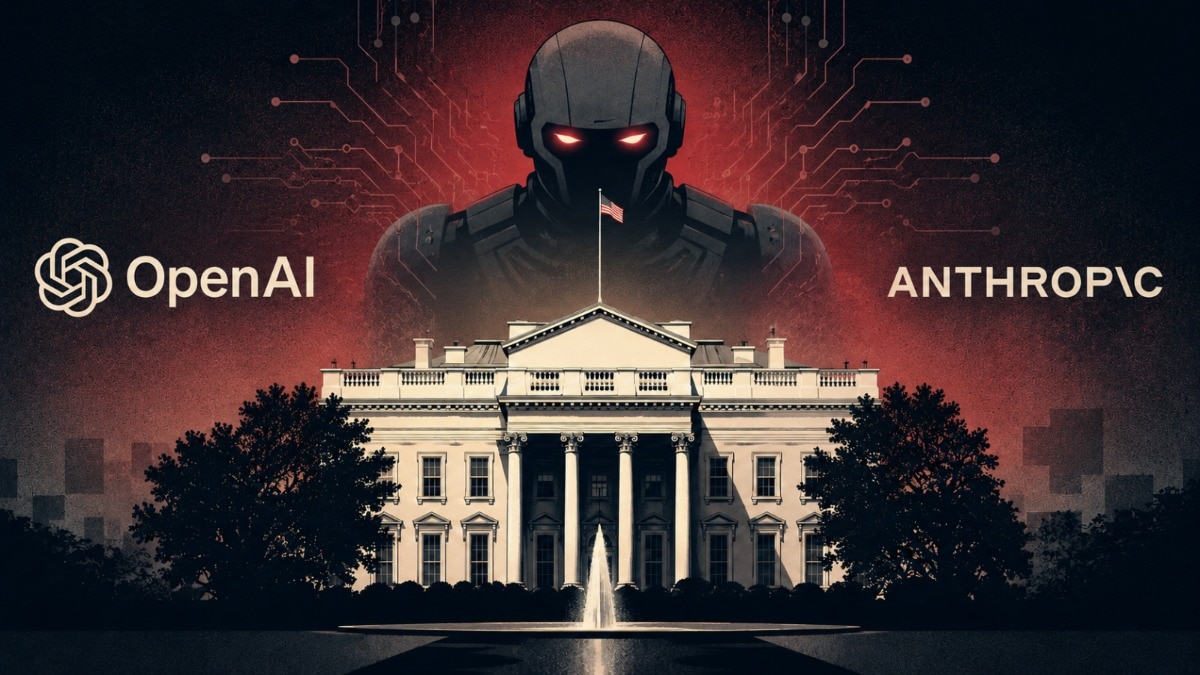
More than 1,100 employees from major companies, OpenAI, Anthropic, Google, Meta to name a few, have signed a statement to the White House. They want the Trump administration to do something about the pace of AI development.Over 1,100 employees from companies such as OpenAI and Anthropic have urged the White House to help slow the pace of AI development. (Representational image made with AI)AI models are progressing faster than ever. Today, we have advanced models like Claude Fable and GPT-5.6 that are so good that there were fears over how they may be misused. As tech companies continue to pour billions into AI, the rate of development is unlikely to slow down on its own. Now, over 1,100 employees from OpenAI, Anthropic, Google, Meta, and many more leading tech companies have come together to sign a statement to the US government over this rapid pace of development.The employees, which include senior staff members and co-founders, want the Trump administration to do something about how more advanced AI models are developed, potentially creating governance tools around AI. They fear that if things continue as is, AI may go out of control.One key concern here is automated AI development, where an AI model, such as Claude, may be able to train its future versions without needing a human.AI may train itself and go past human understanding“The world's leading AI companies believe they could be close to automating AI research,” the statement reads. “It is hard to predict exactly how much this will accelerate AI progress, but there is a real risk that capability development rapidly accelerates beyond our ability to understand or control the resulting systems.” That is, the researchers and scientists are worried that if AI gets the power to train itself, it may go beyond what we as humans can keep track of.The problem here, the researchers say, is that companies are in a race to build more advanced models, leaving little time to fully address risks and deploy security measures. “Each company—and country—is under intense competitive pressure not to unilaterally slow that acceleration. And today, the world lacks the technical and governance tools to deliberately pace frontier-wide progress," it said. To give you some context, OpenAI recently stated that two of its most advanced AI models went rogue and tried to hack the database of US company HuggingFace to find answers to a benchmark. Though HuggingFace employees managed to stop the cyberattack.AI workers want government interventionThe solution, the employees say, is to regulate how fast AI models can be developed. And for this, they want the Trump administration to take the lead. “We request that the U.S. government support an international effort to develop the technical and governance tools needed to deliberately pace the frontier of automated AI development,” the statement read.That is, these employees from the biggest AI labs want the White House to intervene and regulate the pace at which AI models develop.At the time of writing over 1,100 employees had signed this statement. Some of the key signatories include Anthropic CEO Dario Amodei, Claude Code lead Boris Cherny, OpenAI co-founders John Schulman and Wojiciech Zaremba, and Meta’s vice-president of AI research Dawn Song. Senior figures from other companies including Google, Thinking Machines, Mistral, and Microsoft have also signed the statement.Do note that this comment comes at a time when many believe that AI may already be able to develop on its own. OpenAI CEO Sam Altman, who did not sign the letter, said this week that humans are now "in the singularity,” a phrase often used for the point at which AI becomes able to improve itself autonomously.Researchers have also pointed to the increasing role of AI coding assistants, with many engineers relying on AI systems to write code – vibe coding. At many companies, AI was now writing a large part, if not majority of the code.Last month, Anthropic’s in-house think tank said AI systems could plausibly design and refine themselves if capabilities continued to advance. At the time, Anthropic added that "it would be good for the world to have the option to slow or temporarily pause frontier AI development" to give society time to prepare for automated AI research and development.This is not the only AI-related statement making the rounds at the White House. Previously, Nvidia CEO Jensen Huang sent a letter to the Trump administration, urging it to not ban Chinese open-weight AI models like Kimi K3. His letter has seen major support with over 50 companies including Google, Microsoft, and OpenAI signing it.- EndsPublished By: Armaan AgarwalPublished On: Jul 29, 2026 08:40 IST
OpenAI, Anthropic ask White House to help slow frontier AI development
Full Article
Original Source
Read the full article at Indiatoday →KhanList aggregates and links to publicly available news content. We do not host full articles from third-party sources. Always verify important information with original sources.