
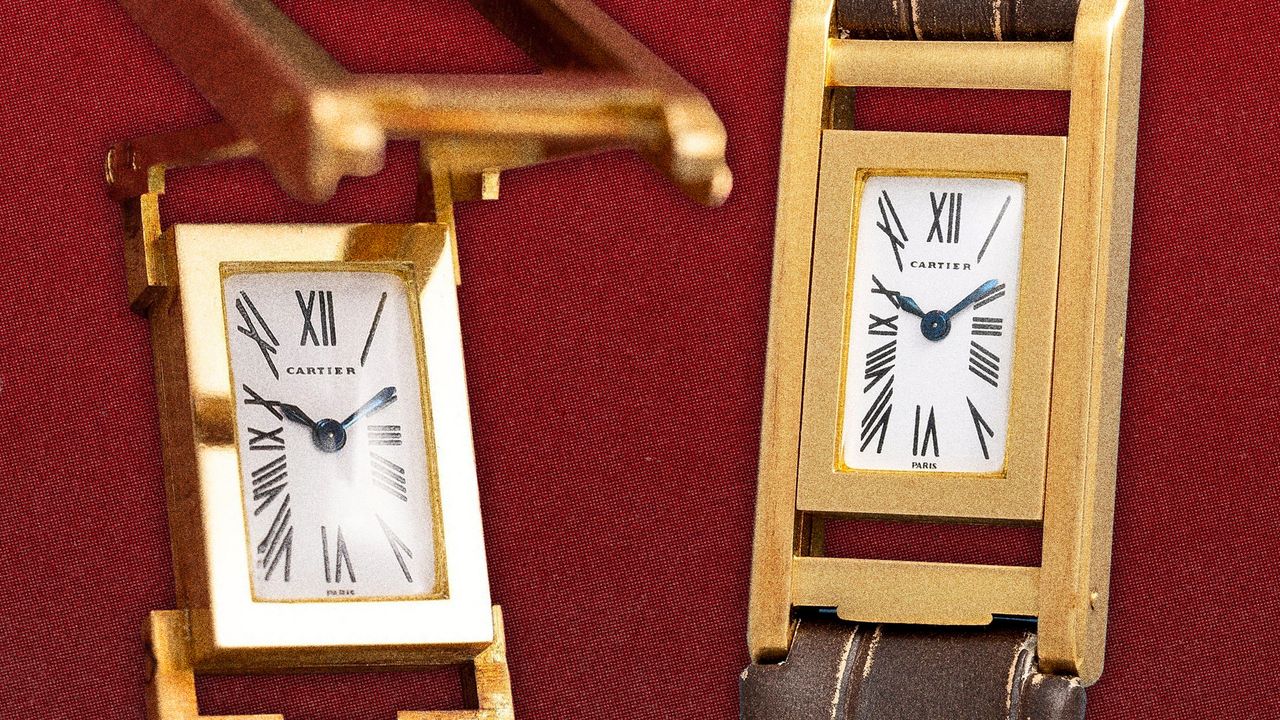
Roni Madhvani has largely amassed his jaw-dropping collection by DMing with dealers on Instagram. Now, he’s bringing a handful of his one-of-one timepieces to auction for the first time ever.This is an edition of the newsletter Box + Papers, Cam Wolf’s weekly deep dive into the world of watches. Sign up here.Few watch collectors can claim the dialed-in taste and idiosyncratic perspective of Roni Madhvani. Strip the handles off of Instagram, and I’m certain I could still point out with 100% accuracy which wrist photos belonged to the Uganda-based Madhvani. It helps that if I had his kind of cash, I would be picking up exactly the same pieces: Patek Philippe’s most daring designs, often dreamt up by Gilbert Albert in the ’50s and ’60s; beautiful enamel-dial watches from Omega, Universal Genève, and Eska; plus a fleet of the rarest, funkiest Cartiers ever made. But while I’m used to seeing new pickups from Madhvani on the ‘Gram, I wasn’t expecting his recent announcement that he was selling a few of his most prized timepieces in an upcoming Monaco Legend Group auction.“It’s me testing the water for the first time and getting rid of some things,” Madhvani says on a call from London. The collector decided specifically to put these pieces up for sale after his relationship with reps at present-day Cartier soured. He’s now planning to set loose nearly all of the house’s pieces from his collection. “Some of those I’ll probably hang onto for sentimental reasons until the grave,” Madhvani says, “but I’ve lost that emotional connection with the others, unfortunately.”It’s fitting that I first learned of Madhvani through Instagram, because the platform has been one of the most important tools for him to grow his collection. He is a great case study for how the watch business operates at the highest levels. Because his tastes are so crystal clear, he says that dealers frequently reach out to him with pieces they think he would like before they go to market. Madhvani estimates that 40 percent of his collection came to him through Instagram.“That’s the biggest thrill to me every morning: to wake up and see on Instagram what direct message someone sent offering something,” Madhvani says. “It’s really like a child waiting for something.” He says he gets a message about an interesting watch at least five or six times a week. “Instagram's changed the dynamics of collecting watches totally,” Madhvani says.A couple of the watches below came through a dealer he met on Instagram and are now estimated to sell for over six figures at auction. I spoke with Madhvani about what makes each of these four watches special.Cartier “Cornice”High estimate of €120,000 (about $134,000)The history of Cartier can be sliced into two different periods. Before 1972, the individual Cartier branches in London, Paris, and New York were creatively empowered to make whatever they liked. This era birthed icons like the Crash—famously a product of Swinging ’60s London—along with many more obscure and oddball pieces that never became fixtures in the catalogs. After ’72, Cartier started consolidating its watch production in Switzerland and has been producing watches in a much more standardized way ever since.However, in the decades leading up to that formalization, it was the Wild, Wild Romandy. The various branches could make their own designs bespoke for individual clients or small groups of them. Official documentation is difficult to come by. “Without [Cartier] willing to give an archive or confirm anything, it’s really a poke in the dark for anyone,” says Madhvani. And that’s if paperwork even exists in the first place—it’s so unusual to find that Mike Nouveau, TikTok’s favorite watch dealer and a Cartier expert himself, recently made a video just to show off an invoice from the London branch.The Cornice exemplifies this more freewheeling era of Cartier. It sorta looks like a Tank, if you somehow managed to stick a pump into its side and puff it up with air. Madhvani, who has been collecting rare vintage Cartier for decades, says he’s never seen anything like this piece. “For me, it epitomizes what the maison is about in terms of design,” he says. “It’s from the days when creativity was not stifled and was able to be expressed by the individual casemaker—I think [the Cornice] is a culmination of that.”I started with this watch because it neatly captures a lot of the basics of vintage Cartier: the distinct shapes, the creative license each branch had, and the markings typical of any watch a few decades old. This Cornice’s dial is discolored, and the sword-shaped hour hand looks like it went into actual battle—but in Madhvani’s view, that’s all part of the magic of collecting. “I think that’s what makes a piece attractive,” he says of the wear and tear. “It communicates the history of where it’s been. It’s obviously aged over time rather than rough use or anything, and that’s the beauty of it.”Cartier “Deck Chair”High estimate of €120,000 (about $134,000)Putting on a watch by opening the bracelet or unhooking the leather band? Boring, old-fashioned, pedestrian. Putting on a watch by separating and unfolding the case? Cool as hell. This one-of-one model was designed so that the strap could remain closed, but getting it on and off the wrist is as simple as popping open a deck chair. We’ve seen pieces like the Jaeger-LeCoultre Reverso, with its flippable face, or even the Tank Basculante, which can turn on a hinge at 12 o’clock, but this particular Cartier is a truly unique contraption. “I’ve never seen another one in 40 years of collecting,” Madhvani says.This is another product of Cartier’s decentralized production model. The eagle head stamped into the backside of the gold case signifies that the watch was made in France. (The bird’s visage is the country’s official hallmark. Did you know it’s legally required for 18-karat gold to be branded in this way to verify its purity, and different regions use different symbols?) The stamp has to be the coolest way to tell people your gold is the real stuff. Despite the watch’s age—it was made in the ‘60s—both that symbol and the watch in general are in nearly pristine condition. “I think it’s such a sort of dandy piece that probably the original owner never wore it,” Madhvani says.For Madhvani, the “Deck Chair” represents Instagram’s magic. Not only did he acquire the watch through a dealer he met on the platform, but oftentimes, when he posts one of his new acquisitions, he’ll also receive messages from folks who claim to have privileged knowledge of them. “I’ve had many instances where you find out about a particular watch and who the owner was,” says Madhvani. “Or if it’s kind of unique, or it has an engraving, someone from the original family will contact you and say, 'Well, yeah, that belonged to my great uncle,’ or something. And there’s always a story which makes the watch more fascinating.” After he shared this pickup, a dealer contacted him claiming to be the one responsible for buying it from the original owners in Canada.Cartier TankHigh estimate of €120,000 (about $134,000)This is the watch that Madhvani struggled the most with including in this auction—though he says all three of the lots we’ve covered thus far were very difficult to put up for sale. “Parting with any watch is really a painful decision,” Madhvani says. Still, when pressed, he came back to this piece. “That Tank, for me, epitomizes Cartier, and to see it in this form with the enamel bezel, I’ve never seen this ever before.” Like the “Deck Chair,” this piece is engraved “N° UN,” signifying that it’s unique.What’s so exciting about this Cartier is that it takes the unmistakable form of the Tank and tweaks the bezel so that you know it’s truly special. You get the flourish without giving up the iconic shape. The numerals on the 24-hour bezel look almost carved into the enamel, and serve as a great contrast to the sharp, elegant Roman numerals on the dial.Cartier Pasha “Arab Watch Club”High estimate of €20,000 (about $22,300)This is a very pretty version of the Pasha made for members of the Arab Watch Club. The ruby-red dial is as succulent as the inside of a cherry. The side of the case, meanwhile, is engraved with the phrase, “Time is master of all.”It’s a very cool watch, but one that wasn’t particularly difficult for Madhvani to see go. “I bought it on a whim,” he says. “I never even wore it. I mean, I don’t have any affinity for, or come from, the Middle East. So that was one which would have gone anyway.” Madhvani says he bought the watch after friends from the Arab Watch Club “coaxed [me] into getting it.”See all of our newsletters, including Box + Papers, here.Cam Wolf is GQ’s Watch Editor. He joined the magazine in 2017 after working at Racked (RIP) as the site’s (first!) (and only!) Menswear Editor and Complex in the role of Style News Editor. Shortly into his GQ tenure, he immersed himself in the world of watches and quickly fell ... Read More
One of the World’s Most Interesting Watch Collectors Is Selling His Outrageously Rare Cartiers
Full Article
Original Source
Read the full article at Gq →KhanList aggregates and links to publicly available news content. We do not host full articles from third-party sources. Always verify important information with original sources.