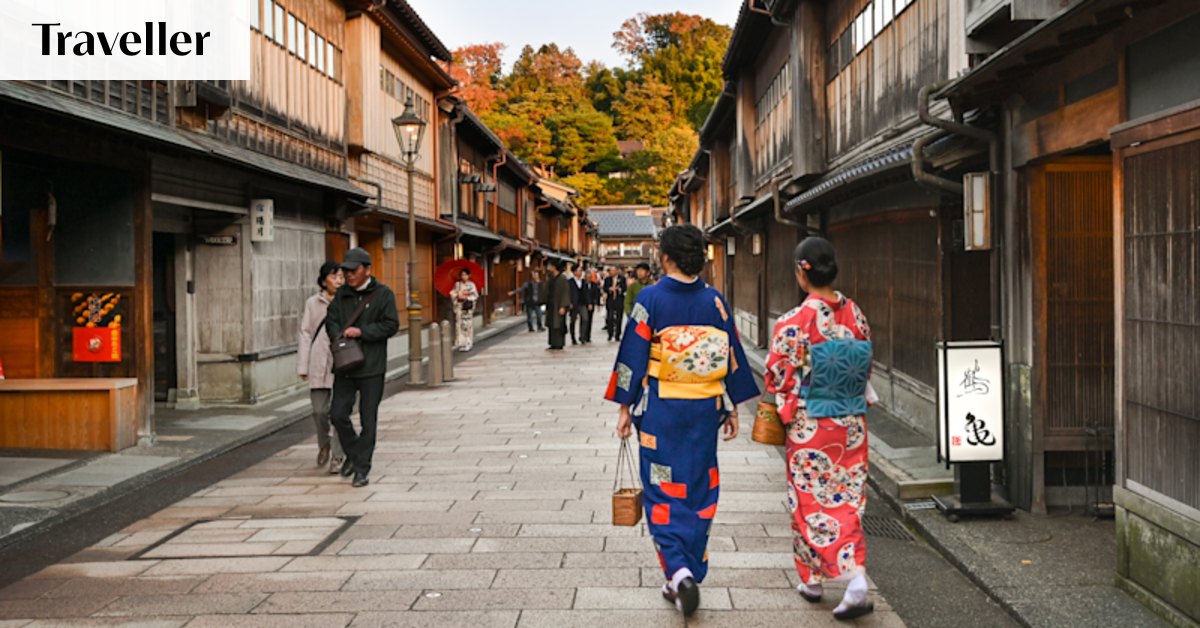
I know Kanazawa will be my kind of town when Evelyn Evans, Silversea Cruises’ onboard lecturer, reveals that this Japanese city of 460,000 – a regional commercial hub and historic samurai centre – once rivalled Kyoto and Tokyo, then known as Edo.It gets better when she reveals that in Kanazawa, “the streets were designed with angles and dead ends, so as to confuse invaders. Locals say that if you can navigate Kanazawa without a map, you were obviously a samurai in your past life.” But accompanied by a local guide and as part of a group, I don’t get the opportunity to explore my Japanese warrior DNA.Kanazawa Castle was once the residence of Maeda Toshiie, the head of the medieval Maeda samurai clan.Having escaped the firebombing of World War II, and with Japanese flair for aesthetics, Kanazawa is so well-preserved that I almost expect Maeda Toshiie, the head of the medieval Maeda samurai clan, second only to the Tokugawa Shogunate, to emerge from around a corner.We first head to Kanazawa Castle, via the bustling 300-year-old Omicho Market, a noisy and colourful experience.Kanazawa Castle, says our guide, became Maeda Toshiie’s residence in 1583. She explains how, to demonstrate to the Shogun that they were no political threat, the Maeda lords stimulated arts and crafts throughout the Kaga Domain, thereby exposing the entire community of Kanazawa to cultural pursuits and knowledge.Sign up for the Traveller Deals newsletterGet exclusive travel deals delivered straight to your inbox. Sign up now.Thus, during the Edo period (1603-1868), Kanazawa was not only at peace, but was one of feudal Japan’s most important artistic, scholarly and cultural towns alongside Edo itself, which was renamed Tokyo in the 1860s when the government of Meiji replaced the Shogunate.The bustling Omicho Market in Kanazawa is renowned for its seafood. iStockKenrokuen Gardens and yukitsuri, a traditional technique that uses ropes to protect trees from the weight of snow.iStockKanazawa’s historic evolution is on show at our next stop, the Ishikawa Prefectural Museum of History. Intricate displays showcase artisanal legacies including calligraphy, poetry and tea ceremony rituals, and evoke the Samurai’s martial arts culture (these became a discipline rather than fighting techniques). It’s fascinating, if overwhelming.At this point, I peel off from the group and wander alone to the nearby Kenrokuen Gardens, not officially part of my tour. One of the “three great gardens of Japan”, this was formerly an extension of the castle grounds. The beautiful design – with a central pond, an array of conical trees and symbolic sculptures – reflects how a medieval Japanese garden was a sign of power and aesthetic sensibility.In her lecture, Evans had described a classic Chinese poem about a garden of six features; the poem’s premise is that it’s impossible to recreate such beauty. Kenrokuen can claim all elements including water, distant views, seclusion and artistry. And the result is stunning.Accessible from within the garden grounds, the Museum of Traditional Arts and Crafts showcases about 36 designated crafts that continue today, including the likes of Kinpaku (gold leaf), Kutani-yaki porcelain and Maki-e lacquerware production.In Kanazawa, kimonos are made using the traditional Kaga Yuzen silk-dyeing technique.For a taste of current creativity, I visit the 21st Century Museum of Contemporary Art, where the highlight is The Swimming Pool by Leandro Erlich, an illusionary exhibit where visitors appear to be standing within a “filled” pool. Unfortunately I don’t have time to visit the Kaga Yuzen Kimono Centre, where you can appreciate flawless kimonos, made using Kanazawa’s traditional silk-dyeing technique.Next, I plunge into the historic Nishi Chaya District, one of Kanazawa’s three geisha districts. But it’s teeming with rain; the streets are empty. So, I forge ahead to the Nagamachi District, a stunning network of laneways lined with the original homes of high-ranking samurai who served the Maeda. Here, high earthen walls and hedges hide private gardens.Kanazawa’s 21st Century Museum of Contemporary Art.Nishi Chaya is one of Kanazawa’s three geisha districts.iStockMy final stop, the Higashi Chaya District comprises dense laneways with buildings of Edo-era teahouse design. It’s the perfect spot to take shelter over matcha tea. The tea’s accompanying plate of wagashi, brightly decorated sweets, are too beautiful to eat. Nevertheless, I gobble them down. I could linger instead over a gold-leaf-covered soft-serve ice-cream, available for about $10 each.But having had a taste of Kanazawa’s extraordinary history and its exquisite legacies, the gimmick is a touch too rich for my taste.THE DETAILSTRAINReach Kanazawa by train from Tokyo on the JR Hokuriku Shinkansen. The journey takes two-and-a-half to three hours and costs $142.BUSThe Kanazawa Loop Bus runs both clockwise and counter-clockwise to most sights of interest. Buy a day pass at Kanazawa Station, ¥800 ($7), or swipe your credit card on the bus for individual journeys ¥220. See kanazawastation.comMOREvisitkanazawa.jp, silversea.comThe writer was a guest of Silversea aboard Silver Moon.Travel writer Kate Armstrong divides her time between the US, Mexico and Europe exploring places and subjects that spark her interest: culture, cuisine, cruises and anything offbeat. She usually travels solo.From our partners
Once a rival to Tokyo and Kyoto, this extraordinary city is exquisite
Full Article
Original Source
Read the full article at Smh →KhanList aggregates and links to publicly available news content. We do not host full articles from third-party sources. Always verify important information with original sources.