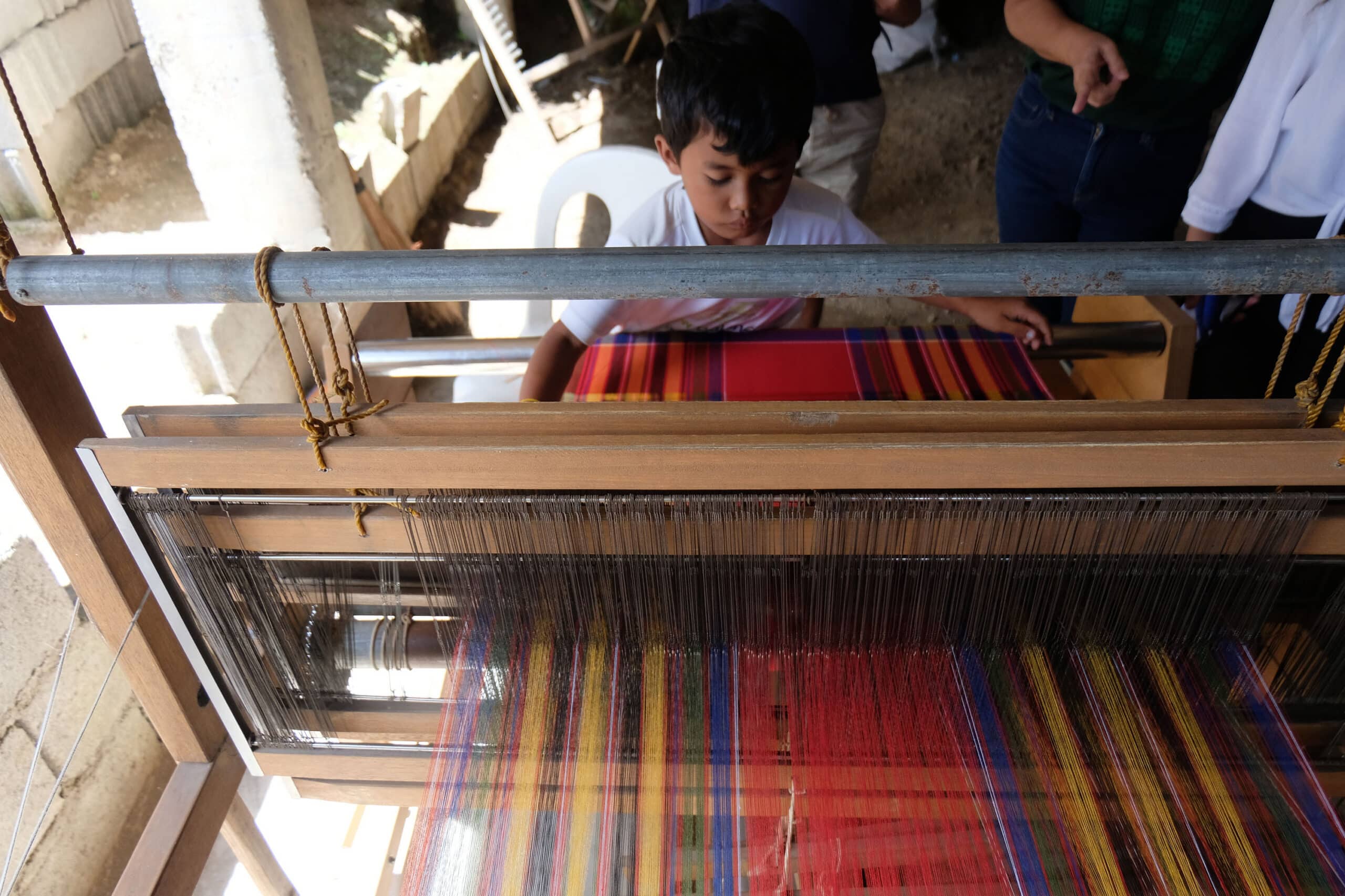
STARTING EARLY A young boy weaves a “malong” at their community in Sitio Amgu-o, Barangay Landan, Polomolok, South Cotabato. —BONG S. SARMIENTO GENERAL SANTOS CITY—For the Blaan people, “mabal,” or weaving, is more than a craft or a form of cultural expression. It is a way of life rooted in memory, survival, and the continuity of tradition across generations. Arthur Dulo Gulili, a Blaan weaver and grandson of the late Gawad sa Manlilikha ng Bayan (Gamaba) awardee Yabing Masalon Dulo, describes weaving as “something that has existed since time immemorial.” “From childhood, that was our first clothing—whether for boys or girls. During our grandmother’s time, commercially made fabrics were not yet available,” he said in Filipino. Article continues after this advertisement Yabing Masalon Dulo, affectionately known in her community as Fu Yabing, was among the country’s foremost custodians of Blaan textile heritage. She was renowned for her mastery of mabal “tabih,” the traditional woven abaca cloth of the Blaan people. A display of finished handwoven products At her home in remote Sitio Amgu-o, Barangay Landan, Polomolok, South Cotabato, she not only preserved traditional weaving patterns but also ensured they would be passed on to future generations. “None of us—neither my siblings nor my cousins—ever imagined we would eventually learn what our grandmother was doing,” Gulili said, recalling that weaving was never initially seen as a path he would pursue. Although weaving was always part of daily life at home, Gulili said he did not yet see it as his future. That changed after he finished school and became involved in community volunteer work, where he encountered weaving beyond the household. Article continues after this advertisement In 2016, he turned the craft into a livelihood. The transition was gradual, he said, until weaving and cultural work became a source of income alongside his career as a schoolteacher. The facade of the Handloom Weaving Innovation Hub in Polomolok, South Cotabato marks a major collaboration between the Department of Science and Technology-Philippine Textile Research Institute (DOSTPTRI) a Family tradition Long before Yabing Masalon Dulo was named a National Living Treasure and Gamaba awardee in 2016, she had already begun teaching her grandchildren how to weave. Article continues after this advertisement Gulili said learning under his grandmother was far from a casual family activity. She treated her grandchildren like students, expecting them to pay close attention, follow instructions and remember every lesson. “My grandmother taught us differently. She didn’t explain things at length. She would demonstrate something once, and you were expected to understand it immediately—as if you had to memorize it,” Gulili recalled. The lessons she once taught within the family are now reaching a wider audience through an innovation hub that carries on her legacy. Kalyak Blaan Care Group Located in Fu Yabing’s village is the Department of Science and Technology-Philippine Textile Research Institute (DOST-PTRI) Handloom Weaving Innovation Hub. The facility is part of DOST-PTRI’s initiative to strengthen indigenous weaving communities by providing equipment, skills training, design development, and production support. It is linked to the institute’s broader textile development program in Mindanao, including the Regional Yarn Production and Innovation Center in Kabacan, Cotabato. The center processes locally sourced fibers such as pineapple, abaca and cotton into yarn for weaving communities, helping strengthen local supply chains and reduce dependence on imported materials. When asked what his grandmother would think of the innovation hub, Gulili answered without hesitation. “If she could see this, she would be very happy. We know her—she would be amazed by something like this,” he said. The facility, he explained, is unlike anything that existed during his grandmother’s lifetime. The equipment is more advanced, the scale is larger, and the opportunities available to weavers now extend beyond a single community. Gulili said the community now has nine handlooms available to weavers, including four units provided by DOST-PTRI in 2018 and five newer looms installed as part of the innovation hub. Unlike earlier equipment, the newer looms enable weavers to create more intricate patterns directly on the loom and expand the variety of products they can produce. “What we used to do years ago, we still do today. The difference is that we can now create new products,” he said. For Gulili, the innovation hub does not replace tradition—it gives it more room to grow. For years, one of the biggest challenges facing Blaan weavers was limited access to equipment. COMMUNITY PRIDE Dr. Julius Leaño Jr., director IV of Department of Science and Technology-Philippine Textile Research Institute, leads the inauguration of the Handloom Weaving Innovation Hub in Polomolok, South Cotabato, last month. New challenges “When there is competition for equipment, or when there isn’t enough of it, that becomes a challenge. If weavers need a tool but cannot afford it, they simply cannot continue,” Gulili explained. He recalled that weavers had long wanted to produce more complex textiles but were constrained by the lack of proper tools and limited access to raw materials. Now that equipment has become more accessible, another challenge has emerged: attracting younger generations to the craft. “Young people today have different interests, especially if their parents have little or no knowledge of weaving,” he said. HERITAGE Traditional craftsmanship meets modern weaving technology to boost local textile production inside the Handloom Weaving Innovation Hub. Drawing from his 16 years as a weaver, Gulili said he has witnessed this shift firsthand. “When weaving is no longer practiced at home, the chain of learning becomes much harder to sustain,” he added. To ensure the family’s tradition lives on, Gulili has begun teaching his two young sons how to weave. With the establishment of the Handloom Weaving Innovation Hub, the lessons Fu Yabing once taught inside their home now continue in a place where more weavers can learn, collaborate and keep the Blaan weaving tradition alive. Your subscription could not be saved. Please try again. Your subscription has been successful. The challenge now, Gulili said, is ensuring that the knowledge of mabal is passed on to future generations. INQ
Old craft, new future for Cotabato’s Blaan weavers
Full Article
Original Source
Read the full article at Newsinfo →KhanList aggregates and links to publicly available news content. We do not host full articles from third-party sources. Always verify important information with original sources.