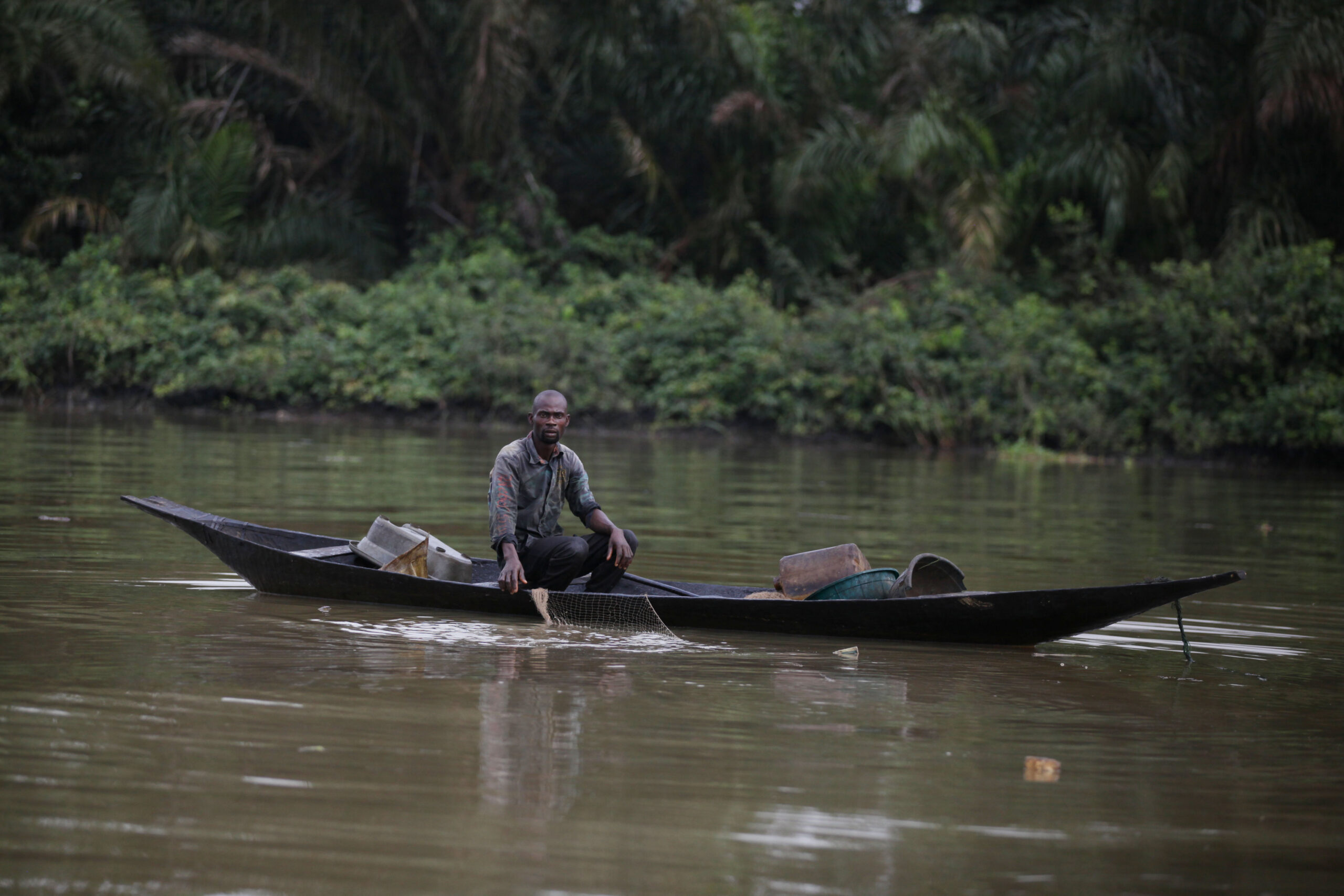
On this week’s episode of the Mongabay Newscast, I speak with travel writer Noo Saro-Wiwa. She has documented the violence and natural destruction that the presence of oil companies have brought to the people of the Niger Delta in her latest book, The Burning Ground: Oil and Militancy in Nigeria.Saro-Wiwa is also the daughter of the late activist Ken Saro-Wiwa, who was executed by the Nigerian government in 1995. Her father led a peaceful resistance against the oil companies’ presence in the Niger Delta by mobilizing 300,000 people from Ogoniland in 1993. It is fair to say his activism started the movement against the destruction and exploitation led by oil companies in the nation. While peaceful at first, Noo Saro-Wiwa says many people gave up hope on peaceful resistance when the government failed to hold the companies accountable, and men turned to forming violent militant groups. “Oil has been literally the worst thing that’s happened to the Niger Delta. If I could go back in time and I had the power, I would never have allowed oil to have been discovered,” she says.“ The amount of instability, political, economic instability it causes. And the damage to the environment … that goes without saying. So we really need to shift to solar power … oil companies do not have this kind of leverage over people, and governments will have no incentive to go in and destroy people’s lives.”While her latest book chronicles the harm of oil and the resulting violence, I put it to her that it’s also a story about how the absence of women’s rights is destroying societies. Saro-Wiwa explains how Nigeria isn’t unique in this regard, but rather a stark example of how this dynamic plays out.“ Going around the Niger Delta and talking to activists like Emem Okon … I could see very clearly how women’s rights directly affects the environment … and society, and how the absence of those rights feeds into this militancy which ultimately hurts men.”In reading Saro-Wiwa’s book, she doesn’t push a solution upon you, but I do believe one reveals itself in her conversations with civic leaders and ex-militants. Many of them tell her, in so many words, that if the government cared less about supporting oil companies and more about supporting the people — especially women — who are actually trying to restore the region’s livelihoods, farms, nature and peace, then the delta could truly develop.Her conversations with ex-militants now reformed and working in agriculture, such as a man named Mac-Eteli, reveal a sentiment that the government’s priorities are askew. Instead of supporting the people working to bring sustainable development to the region, the Nigerian government started providing financial incentives to militants to leave violence behind in 2009. Ironically, this has only seemed to beget more violence as disaffected men turn to militancy — and the promise of a government stipend to give it up.“ The government has done things completely the wrong way round. It’s having to spend billions of dollars in monthly stipends to pay off these to pacify militants, when really … those billions should have gone towards promoting farmers like Mac-Eteli. It should have gone towards educating the young people of the Niger Delta so that they can then go on and create job opportunities for themselves and for other people,” Saro-Wiwa says.Much of the work that Saro-Wiwa says the government should be doing is done by women, and in her conversations with them, it swiftly becomes apparent that they are not just undervalued, but marginalized, to the detriment of Nigerian society. All the while, oil continues to propagate in the region, polluting the delta, and giving little back to the people it is harming. “A lot of women are farming the land. But the problem is that when there is an oil spill, the government … if they’re gonna give any money or compensation, they’ll give it to the men, not the women,” she says. “But it’s the women who are looking after the children. It’s the women who are farming the soil.“ If the women are taken care of, the children are taken care of. And if the children are taken care of, then you don’t have these young boys going off and wanting to become militants. So everything boils down to looking after women. That is how you fix society.”The Burning Ground is a harrowing read, but of all the books I’ve read for this podcast, it might be the very first one I suggest you pick up.Mike DiGirolamo is the host & producer for the Mongabay Newscast based in Sydney. Find him on LinkedIn and Bluesky.Banner image: A man fishes in the Niger Delta near the village of Diebu, Nigeria, Saturday, May 18, 2013. Image by Jon Gambrell / AP Photo. TranscriptNotice: Transcripts are machine and human generated and lightly edited for accuracy. They may contain errors.Noo Saro-Wiwa: We talk about women’s rights because we believe in it on principle, right? But a lot of people, and particularly men in Nigeria, when they hear the word women’s rights, they just tune out. They’re not really thinking about it. And I think going around the Niger Delta and talking to activists like Emem Okon, I could see very clearly how women’s rights directly affect the environment, the natural environment and society, and how the absence of those rights feeds into this militancy, which ultimately hurts men. It’s a very clear, rational, logical rationale there, and I was just struck. I think the Niger Delta really illustrates that more clearly than in any other society. Mike DiGirolamo: Welcome to the Mongabay Newscast. I’m your host, Mike DiGirolamo, bringing you weekly conversations with experts, authors, scientists, and activists working on the front lines of conservation, shining a light on some of the most pressing issues facing our planet, and holding people in power to account. This podcast is edited on Gadigal land. Today on the newscast, we speak with writer Noo Saro-Wiwa, who is also the daughter of the late activist Ken Saro-Wiwa, who was executed by the Nigerian government in nineteen ninety-five. Her father led a peaceful resistance against the presence of oil in the Niger Delta in the nineteen nineties. But I’ll let her explain that more in her own words. Today, we talk about her latest book, The Burning Ground: Oil and Militancy in Nigeria. It’s a story about how the presence of oil is destroying the lives and the nature of the Niger Delta and fueling armed insurgency in militant groups. But I also believe it is a story about how the absence of women’s rights is destroying societies. What emerges from this book and this interview is that women’s rights directly affect the environment and society, and how the absence of those rights feeds into militancy, which ultimately hurts everybody. It’s clear the presence of oil has not helped the people of the Niger Delta develop, and if anything, it has only harmed the environment and their lives and led to violence. In reading Saro-Wiwa’s book, she doesn’t quite push a solution upon you, but I do believe one reveals itself in her conversations with civic leaders and ex-militants. Many of them tell her in so many words that if the government cared less about supporting oil companies and more about supporting the people who are actually trying to restore the region’s livelihoods, farms, nature, and peace, then the Delta and Nigeria could truly develop. Much of this work is done by women, and in Saro-Wiwa’s conversations with them, it swiftly becomes apparent that they are not just undervalued but marginalized to the detriment of Nigerian society. Providing financial incentives to militants to leave violence behind, ironically, only seems to beget more violence as disaffected men turn to militancy and the promise of a government stipend to give it up. All the while, oil companies continue to propagate the region, polluting the Delta and giving little back to the people it is harming. It’s a harrowing read, but of all the books that I’ve read for this podcast, it might be the first one that I suggest you pick up. Hi, Noo. Thank you for joining us. Welcome to the Mongabay Newscast. Noo: Well, thank you for having me. Mike: So we’re gonna be talking about your book, The Burning Ground, over the course of this conversation. But to just set a context for our listeners, and I know this is a really large question, but can you explain how, as you outline in the book, instead of becoming wealthy through oil, the people of the Niger Delta have paid a heavy price for it? Noo: Yeah. Well, the Niger Delta is one of the biggest eco wetland systems in the world. It’s where the Niger, the Niger River, drains into the Gulf of Guinea. So it’s a very kind of rich, fertile area. There are thousands of small river channels. And so for hundreds of years we’ve been farmers, fishermen, and that’s how we’ve sustained ourselves from this very rich, fertile soil. And then oil came along, and rather than it enriching us, it’s damaged and polluted the environment, and the proceeds of the oil have gone to enrich multinational companies like Shell and a succession of corrupt military dictatorships. So we haven’t seen any of the financial benefits of the oil, but what we have done is seen the complete degradation of our environment. Thousands of oil spills have occurred since oil was discovered in the 1950s, and so it’s left us between a rock and a hard place. Oil hasn’t helped us develop economically, but at the same time, it’s prevented us from continuing the subsistence agricultural economy that we’ve relied on all this time. And that’s why my father, Ken Saro-Wiwa, described it as a genocide. When you prevent people, when you take away people’s fundamental livelihoods, you poison the water that they drink, the soil that they grow food from, and then you provide them no alternatives. They can’t get an education, they can’t get a decent education, and they can’t get alternative jobs in the cities. Then are you really sort of, there’s an existential problem there. Mike: You have a very unique vantage point growing up in the Niger Delta and the work of your father. Can you explain what was or what is the Movement for the Survival of the Ogoni People, and how was your father involved in it? Noo: Yeah. Well, I should correct you. I didn’t actually grow up in the Niger Delta. I was born there, but I grew up in England. But yeah, my father, he was extremely concerned about the degradation of the environment and the number of oil spills, and we’re talking about thousands of oil spills. And so he set up an organization called the Movement for the Survival of the Ogoni People, Ogoni being our ethnic group, where… Well, it’s one of several ethnic groups where the oil is. And yeah, the aim was to demand a greater share of oil revenues and a call for companies like Shell to clean up their oil spills and to clean up their general operational activities that were causing these spills, particularly in the ’60s and ’70s. So my father’s organization, which ran under the acronym MOSOP, encouraged people to stand up for their rights, the Ogoni people, and to be outraged by what was going on because up until the early ’90s, when my father’s campaign really took off, the Ogoni people were quite docile. We’re a small ethnic group. We’re used to being dominated, and my father really changed all that. And through MOSOP, they challenged the government, and they challenged the oil companies, and this was a huge threat to the government and the oil companies. They’d never seen anything like it. And my father was able to take that campaign out beyond Nigeria and gain attention internationally, draw attention internationally to the problem. And this was particularly threatening to the then military dictatorship at the time, and as a result, he lost his life. Mike: So you, in the book, you describe taking summer vacations with your father in the Niger Delta in the 1980s, and there were, I believe, you kind of painted the picture of the drive from Port Harcourt to your home village, and you would see these giant gas flares along the drive. Hmm. And I believe in the book you mentioned they’re still there today. I was just kind of wondering if you could describe for the audience the evolution of the landscape from the time that oil became a presence there to now. Noo: Okay. Well, initially, you’ve got this very, very sort of rich, fertile landscape. It’s lowland rainforest, so you would’ve had… It would’ve looked in some areas a bit like the Amazon if there’s no farming there. And then you have other areas where people are farming the land, lots of palm trees and animals. If you speak to elderly people, they’ll tell you that they saw there were lots of pythons. There were alligators in the rivers, pygmy hippopotamus, just an incredibly—The biodiversity is just incredible. We have chimpanzees, elephants. We still have a few today, but not many, and lots of tortoises, that sort of thing. And just loads of rivers. This is a huge river delta system, and so lots of creeks and rivers with antelope, fish, extremely rich area, and it supported a huge population. So that’s what it looked like up until the 1950s, and then they discovered oil. And so when I was traveling to the village as a child in the ’80s, you then saw this landscape change. You had sort of gas flares. They looked like these sort of candles on the horizon, which is what the oil companies… It was their way of getting rid of the excess from oil extraction. But you can turn it into liquid gas and export it, but that requires infrastructure, and so the way—If you don’t have that infrastructure, then the oil companies just flare off that gas into the atmosphere, which is extremely polluting. And because this is Nigeria, and we had governments that don’t care and don’t impose regulations properly, the oil companies felt at liberty to just have these gas flares, and they would just dot the landscape. There are fewer now than there were before, but they’re still there, and a lot of the ones that are still running have now been turned. Rather than pointing upwards into the sky, they now turn them sideways so that you can’t see them from a distance. It’s also a lot of the river channels that you see. Some of them are sort of blackened by oil. Only two years ago, I was near a town called Ndoni, and I stopped by a river, and you could see it just bubbling. It looked like a geyser or like a Jacuzzi even. There was just this bubbling, and it was basically a burst oil pipe, and oil was just pumping through, and no one did anything about it for months, and that’s quite normal. Mike: So, and do correct me if I have this wrong, but the way I read this, the book, is that your father was quite responsible for mobilizing the public movement and sentiment against oil companies, particularly when he mobilized 300,000 Ogoni people to demonstrate peacefully in 1993, which I believe you said led to Shell permanently ceasing operations. What— Noo: Yes… Mike: What happened? Can you sort of chart out what happened next up until the first democratically elected president? Noo: So yeah, my father mobilized 300,000 people to demonstrate, and as a result, Shell stopped operating in Ogoni land, which is just a small part of the Niger Delta, but it’s the part of the Niger Delta where my family comes from. But the government cracked down on people. You had the army coming in and just sort of massacring individuals. They even assaulted my paternal grandmother, my father’s mother, and you saw a lot of that. And then there was a sort of ideological split within the members of my father’s organization, MOSOP, and the government exploited this division, which saw some of the senior members killed by sort of young, unruly Ogoni activists, and the military government took advantage of this situation and falsely accused my father and eight of his colleagues of inciting those murders. And so my father and his eight colleagues were then arrested by the government and charged with treason and incitement to murder, and it was a court case that the international community witnessed and labeled a kangaroo trial. Witnesses were bribed, but either way, it was judicial murder. My father and his colleagues were charged and found guilty, sentenced to death, and executed on the 10th of November 1995. As a result, people demonstrated some more. You had other ethnic groups, particularly the Ijaw ethnic group to the west of us in the Niger Delta. They started mobilizing as well for their rights, but they saw similar crackdowns. The government came in, and the army killed people and arrested activists. And so the general perception by 1996, 1997, was this belief that peaceful protest would get you nowhere. And it really… what you then saw was the start of this non-peaceful protest, this violent militancy. And you started having certain groups emerge, militant groups that took on this ideological mantle, but they armed themselves and began to demand oil rights in a more direct physical way. They started kidnapping oil workers, demanding ransoms. They attacked the oil infrastructure because they believed that if they weren’t going to be enriched by the oil, then they would just access the oil directly for themselves since the oil pipelines were running through their own land. And yeah, you kind of saw this evolution from peaceful protest into this militancy that then became intertwined with the criminal networks that existed in Nigeria anyway. And so that was the situation. And then in 1999, four years after my father died, we had our first democratically elected government, and there was a lot of optimism at the time. People believed that the new president, Obasanjo, would listen to our concerns and there would be none of the violent crackdowns and that there’d be a real turnaround. Mike: But that’s, as you describe in the book, that’s not quite what happened after that election. Can you describe what did happen? Noo: Well, I mean, the government just never really—the demands that we made in terms of changing the operational activities of the oil companies, cleaning up the oil spills, none of that really changed. The government just continued as normal. And so frustrations mounted and the militancy just simply intensified. You had a proliferation of these organizations and groups, and they were essentially bandits, and they started to really take over the Niger Delta. And the government as a result then set up what it called the Joint Task Force, which was a mix of naval forces, military, and police. And they sent this task force into the Niger Delta to fight with, to try and control the militants. And so you saw a real sort of escalation in violence and instability across that region. So it was a very difficult time for the Niger Delta. Mike: Hello listeners and thank you for tuning in. As I always like to mention, Mongabay is a nonprofit news organization. We rely on funding from listeners like you. So if you’d like to support the podcast, go to patreon.com/mongabay to become a monthly sponsor of the show and support us. If you want to read Noo Saro-Wiwa’s book, The Burning Ground, I’ve put a link to where you can purchase a copy in the show notes of this episode. So in this book, you spoke with a number of ex-militants—right—and we’re going to talk about some of those conversations, but before we get to that, in 2009 there was the presidential amnesty program, which was, as I read it, designed to provide a pathway for militants to give up their violent ways, so to speak. Can you talk about how that changed the trajectory of events in the Niger Delta? Noo: Yeah, so they introduced this amnesty program, and militants were encouraged to give up their weapons in exchange for money, like monthly stipends. A lot of young men had joined these militant groups really just as a source of income because they could no longer do the farming that they used to do. And so once the amnesty program was established and the government started paying these men significant amounts of money—about 400 US dollars a month—that really helped to pacify them. Things calmed down a little bit, but really it was just a sticking plaster. What the government also did was take the top militants, the ones who headed these organizations, and give them security contracts, which was basically just saying, “Okay, we will give you money to prevent the sabotaging of pipelines.” And so these top militants became very rich. They were given millions and millions of dollars to protect the pipelines that they themselves once sabotaged, and that’s the situation you still have today. People like a man called Tompolo—he’s the most influential militant—and he’s been given huge sums of money by the government to protect the pipelines. If you go to the Delta today, you can see the employees of his company, which is called Tantita. They’ve got these vests with the Tantita name on them, and you can see them trying to prevent young men from sabotaging those pipelines. But of course, it has created an irony. This granting of security contracts actually inspired younger men to sabotage pipelines because there was a financial reward for it. And that’s the irony of the situation. Now you have top militants like Tompolo being paid by the government to stop younger men from emulating him. A lot of people have a real problem with this because the government has essentially outsourced its security to the very people who undermined the security in the first place. People argue that the military should be in charge of protecting oil installations and Nigeria’s coastline, but instead they’ve outsourced it to these militants. So it’s created a sort of peace, but it’s really just a sticking plaster because this militancy emerged as a result of a lack of job opportunity, and that situation hasn’t changed. The moment the government stops paying these stipends to these former militants is the day you’ll see an increase in violence and instability again. Mike: I found it really striking because in your conversation with an ex-militant by the name of Makateli, he had a very strong vision for how to bring about sustainability in the Delta through agriculture. And he said he thinks of himself as a peace builder and not a peacemaker. Something he said really stuck out to me: “Governments are not interested in the persons who are ready to contribute to sustainable peace.” What did you think of that when you heard him say it? Noo: Yeah, he’s absolutely right. The government has done things completely the wrong way round. It’s having to spend billions of dollars in monthly stipends to pay off these, to pacify militants, when really those billions should have gone towards promoting farmers like Makateli. It should have gone towards educating the young people of the Niger Delta so that they can then go on and create opportunities for themselves and for other people. And so that’s the problem that you have now: our governments haven’t quite figured out that you invest in people. You should be investing in farmers like Makateli. But instead, it’s just the sticking plaster, throwing money at people to prevent them from sabotaging the oil infrastructure. And that’s ultimately what the government cares about. They just want the oil to keep flowing, and that’s it. And they want to collect the revenues from that. And they’ll pour all the money into protecting that process rather than investing in agriculture and things like that, which would actually bring fundamental peace to the region. Mike: I’m curious to know from your point of view, did anything surprise you in your conversations with the ex-militants? Was there something that really struck you perhaps that you weren’t expecting to hear? Noo: I guess I was struck by just how ordinary they were. They were just very ordinary, non-violent men who were recruited into this militancy because they just couldn’t see any other way of making money. And that’s what’s so sad. When you talk to them, you can see that they’re just very ordinary guys. They’re married, they’ve got kids. They just want to raise their families and look after everyone, and that’s what’s so sad: this violence is so unnecessary. Violence is really the language of desperation, and yeah. Mike: As you were talking to someone in the book whose name was Eris, you mentioned that you have a dream to build a solar-powered school, first in Ogoniland, and then throughout the Niger Delta, and I was just curious to know where you are in that process and how it’s going. Noo: Oh, well, right now it’s just a dream. And nothing more. But that’s my sort of long-term plan. I did connect one of my friends who runs an NGO, Fineface Dumeme, and I connected him with a friend of mine who’s Norwegian, lives in England, and is part of Extinction Rebellion and environmental work. And so together they have set up an NGO, and they raised enough money to buy solar panels for one particular community, a very remote community in one of the creeks in the Niger Delta. As a result of that, this community no longer relies on oil for power. They don’t need it to power their generators. They don’t need kerosene for lamps, because our electricity system is very unreliable, so people were using kerosene lamps and things like that. All of that’s gone, and this one little community is now using solar power completely, and I would love to see that rolled out throughout the region ultimately. Mike: So there’s a section in your book where you talk with civic leaders, and they’re women, and you mentioned that organized groups of women activists have often acted as a stabilizing force during volatile elections and violence. Can you explain how? Noo: Yeah. The thing is with oil companies, they create these divisions within communities, and this is how it works. You have an oil pipeline, and then a company like Shell, but there are others: Agip, the Italian oil giant, and Chevron, the American one as well. They all do the same thing. They set up an oil installation, an oil wellhead or a pipeline, and they basically need someone in the community to protect that infrastructure. They’ll pay an individual who comes from one particular ethnic group, but there’ll be a neighboring ethnic group in the same area that then feels left out. They feel that the oil companies are giving money and power to one person, to one ethnic group, and not the other. And so that’s created a lot of tensions. Some people would say that this is a kind of divide-and-rule tactic imposed by oil companies, but oil companies will tell you something different, obviously. Those sorts of tensions happen in the Niger Delta, and they would sometimes become violent. It was often the women who had to come in and mediate because sometimes a guy—there was one guy who got shot, for example, in the leg—and that created reprisals. And so it’s the women who have to step in and talk to the victims and their families and just try to foster some sort of truce. They’ve been doing that a lot. In the absence of proper governance from above, these women are basically doing the work that the government should be doing in trying to pacify and help the two sides understand each other. Noo: But the problem with Nigeria is that there is this huge gender imbalance. And so in the wake of the amnesty program, you saw the government pouring lots of money into sending young men on peace and conflict courses, sometimes abroad, and learning how to negotiate peace. But meanwhile, it’s the women who are actually doing these things on an informal basis. And you can see this where you can see how this is a real problem in the Niger Delta, where all the money, all the resources go into helping the men, but it’s the men who are causing the problems at the same time, and it’s the women who are actually doing things in a really effective way without government assistance. And yeah. I just think it’s really a real shame that the work of women, the role that they play, not just as peacekeepers, but also as farmers and just holding families together, raising the children, is not recognized, it’s not valued. If you don’t recognize that, if you don’t value that, then you’re never going to solve the problem in the region, because they’re the ones who are holding everything together. Mike: This would be a great place to talk about your conversation with Emem Okon, because she describes the link between women’s rights and the environment that you’re talking about. Can you describe what she said to you, and also what her organization is doing? Noo: Emem Okon’s just this fabulous woman. She really ought to be like the president of Nigeria, if not just the Niger Delta itself. But she also really explains how women—there’s a lot of polygamy, for example, in the Niger Delta. If you talk to the militants, I was really struck by how many of them said, “Oh, my father had three, four wives, and I have eight siblings, and I needed to look after them.” And that’s why they became militants. And so it’s the women who are really keeping these families together, and they’re often the ones farming the land. I mean, men farm too, but a lot of women are farming the land. But the problem is that when there is an oil spill, the government, if they do help at all, will tend to give any money or compensation to the men, not the women. And it’s the women who are looking after the children. It’s the women who are farming the soil. But the money is then given to the men, and in a situation where you have flooding, because the region is prone to flooding as well, in those sorts of situations, the men tend to be more mobile. They can go to another town and seek refuge or try and find work. But it’s the women who are stuck with the children, and they have to go and find shelter somewhere. When they seek shelter, the government then appoints a man and puts him in charge of the relief organization. But those men may not understand the women’s immediate needs as mothers and as farmers. So there’s this constant flow of money that’s just going to the wrong people. If you give it to the women, then they’re the ones who know exactly what to do with it. They’re the real custodians of the land and of raising the next generation. And so Emem Okon’s organization does a lot of things, but one of them is really focusing on women’s rights and ensuring that they’re taken care of, because if the women are taken care of, the children are taken care of. And if the children are taken care of, then you don’t have these young boys going off and wanting to become militants. Everything boils down to looking after women. That is how you fix society. But the problem with very traditional sexist thinking is that people feel all the resources and all the power should go to men, and somehow that is how you sort out society. It’s very difficult to overturn that mindset because, for whatever reason, people are threatened by the idea of giving women resources and power. But I think female power is generally very benign and very good for society. It has a huge multiplier effect. Mike: Something that was said in your conversation with David Udofia stuck out to me, and he said, “People can’t think about the environment when they’re struggling to eat. The alternative is presenting the holistic picture, the importance of peace for development.” Can you talk about what he meant by that? Noo: I mean, for me, when I was talking about, I would say to him, I was bemoaning the fact that people were sabotaging pipelines and ultimately sabotaging themselves, and he said to me, “You’re looking at it from a much more, I don’t know, I guess, cerebral point of view,” whereas for the people on the ground, it’s about survival. They don’t have time to think about the environment. They’re just trying to get money in order to feed their families. And if that means engaging in sabotage of pipelines or illegal refining of oil, which is another big activity in the region, then they will do that. But what David Udofia and his organization, PIN, are working towards is arming people, giving people the tools to create job opportunities for themselves. If you can give these guys training—I’m talking training in terms of vocational training—then you create a sort of peaceful environment that allows businesses to flourish and breaks that cycle of constant violence and environmental degradation, which then creates more violence. Mike: This is a bit of a duplicate question from the one I had about your conversations with militants, but likewise, in your conversations with civic leaders, especially the women, was there anything that really stood out to you? Noo: Well, for me, it was just a real learning process. I’m slightly duplicating my answer as well, but it was just the real importance of women. You don’t think about it a lot, so in that sort of detail. We talk about women’s rights because we believe in it on principle, right? But a lot of people, and particularly men in Nigeria, when they hear the word “women’s rights,” they just tune out. They’re not really thinking about it. And I think going around the Niger Delta and talking to activists like Emma Okon, I could see very clearly how women’s rights directly affect the environment, the natural environment, and society, and how the absence of those rights feeds into this militancy, which ultimately hurts men. It’s a very clear, rational, logical rationale, and I was just struck. I think the Niger Delta really illustrates that more clearly than in any other society. It’s quite difficult in the West. You can talk about women’s rights and how it affects society, but people may not visualize it as starkly as you can in the Niger Delta. You can see it so clearly. For me, that was a real eye-opener. Mike: Is there anything, because we’ve gone over a lot, about the book that I haven’t touched upon with you that you wanted to mention or discuss? Noo: I think you’ve covered the main areas. I’m glad you raised the female issue, because that, for me, is a very big thing. But yeah, that is the situation we have right now. I would say the issue now is that the decades of instability and militancy have prompted a lot of the oil companies to divest from the Niger Delta. Shell has pulled out a lot of its onshore operations, which have now been taken over by local Nigerian consortiums. And that’s another huge cause of concern because by divesting and handing over their investments to local companies, companies like Shell might no longer be liable for any of the damage they’ve caused in the past, which still hasn’t been addressed. There have been quite a few court cases against the oil companies, but those court cases have happened in the US or in The Hague in the Netherlands, because Shell is a Dutch-British company. The people of the Niger Delta have been able to hold them to account in foreign courts. But if they now divest their operations and hand them over to Nigerian consortiums, then it’s only the Nigerian courts that we have recourse to. The Nigerian legal system is nowhere near as effective as European or American ones. So that’s the huge concern now: by divesting, they no longer have to take responsibility for any of the damage they’ve caused in the past. Mike: At the end of the book, you say that the question that opened it remains, and I don’t necessarily want to say what the question is, so to speak, or I guess I could, but what do you want audiences to do with that question? I guess what I’m trying to say is, what do you want audiences to take away from this book and think about and maybe even do? Noo: I think we just—oil has been literally the worst thing that’s happened to the Niger Delta. If I could go back in time and I had the power, I would never have allowed oil to have been discovered. And we’ve seen from the events in Iran and the Hormuz Strait how destructive oil is: the amount of instability, political, economic instability it causes, and the damage to the environment, that goes without saying. So we really need to shift to solar power. With solar power, you don’t have—oil companies do not have this kind of leverage over people, and governments have no incentive to go in and destroy people’s lives. Solar power is cleaner, and it doesn’t affect social hierarchies in the way that oil does. I think it will just have a huge pacifying effect if we could just roll out solar power and move away from oil completely. And so that’s what I would like to see, and my family—we’re in the process of starting up the Ken Saro-Wiwa Foundation. It’s an NGO, and I would love to raise money so that we could roll out more solar-powered projects in the Niger Delta. Mike: Well, Noo Saro-Wiwa, it’s been a pleasure speaking with you, and I really appreciate you speaking with me today, so thank you. Noo: Yeah, no, thank you. Thank you for giving me a voice. I appreciate it. Mike: As always, if you’re enjoying the Mongabay Newscast or any of our podcast content and you want to help us out, please spread the word about the work we’re doing by telling a friend and leaving a review. You can also support us by becoming a monthly sponsor through our Patreon page at patreon.com/mongabay. Mongabay’s a nonprofit news outlet, so when you pledge a dollar per month, you are really making a big difference in helping us offset production costs. So if you’re a fan of our audio reports from Nature’s Frontline, go to patreon.com/mongabay to learn more and support the Mongabay Newscast. You can also read our news and inspiration from Nature’s Frontline at mongabay.com or follow us on social media. Find Mongabay on LinkedIn at Mongabay News and on Instagram, Threads, BlueSky, Mastodon, Facebook, and TikTok, where our handle is @mongabay, or on YouTube at MongabayTV. Thank you as always for listening.
Oil has harmed the nature and people of the Niger Delta; human rights may save it
Full Article
Original Source
Read the full article at News →KhanList aggregates and links to publicly available news content. We do not host full articles from third-party sources. Always verify important information with original sources.