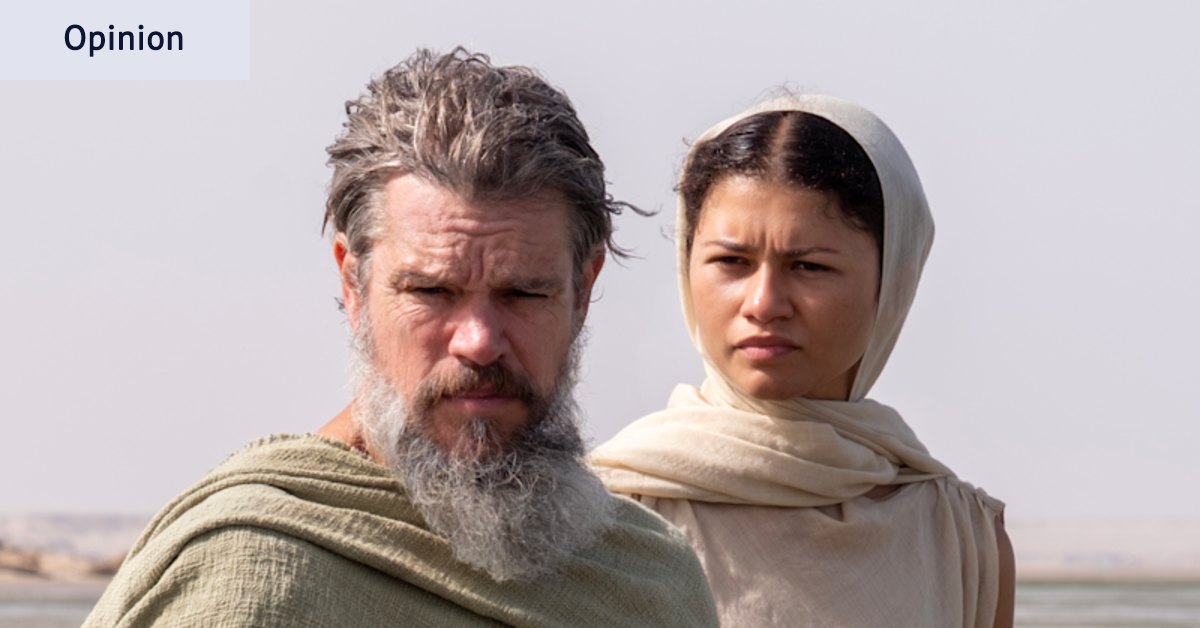
OpinionJournalist, broadcaster, historian and authorJuly 25, 2026 — 9:30amThe phrase “resting on your laurels” hasn’t always been a criticism; once it was a point of praise. Instead of suggesting complacency and laziness, it was a public recognition of achievement. In Ancient Greece, athletes were awarded wreaths of laurel leaves – also known as bay leaves, the kind you pop into a soup or stock.The term had arisen from mythology and the age-old phenomenon of spurned men really not picking up the vibe. In short, the god Apollo had the hots for the beautiful river nymph Daphne, and pursued her doggedly despite her lack of interest. One day, when he was chasing her and had just caught her, she begged her father, the river god, to save her. Naturally, he turned her into a laurel tree. (To be fair, Cupid, annoyed with Apollo, had shot him with a gold-tipped arrow of love and Daphne with a lead-tipped arrow of repulsion, so this was never going to go well).Matt Damon as Odysseus and Zendaya as Athena in The Odyssey.Apollo tried to salvage this turn of events by kissing the tree, whispering: “Since you cannot be my bride, you must be my tree!” He hacked off some branches to make a wreath for his head. Laurels became crowns of victory. From the 6th century BC, bay leaves were placed on the head of every winner at the Pythian Games in Delphi.Now, with the broad public dissection of The Odyssey, a rare box-office triumph, including talk of Odysseus’ relentless drive, I’d like to suggest we revert to the original, Grecian meaning of this long-misused term. Tell people to rest on their laurels for a bit! Stick it to the “rise and grind” of hustle culture, and celebrate a time to pause, regroup, be satisfied after something you’ve accomplished, instead of maniacally thundering towards the next hurdle.When Chaucer wrote The Knight’s Tale in the late 1300s, he wrote that when someone is crowned with laurels, he is “crowned a conqueror [who] lived in joy and honour”. This, in my view, is what the phrase should mean: joy and honour. You’ve achieved something? Rest up, relax, marinate in that joy and honour.Then, as with so many traditions, things took a dark turn in Regency and Victorian times. In 1825, The Literary Chronicle and Weekly Review told novelist Maria Edgeworth that despite her literary success, she must not rest: “We do not affect to wish she should repose on her laurels and rest satisfied; on the contrary, we believe that genius is inexhaustible … For Miss Edgeworth there must be no rest on this side the grave.”This is so daft. As though it’s a bad thing to “rest satisfied”. The fact that the meaning of laurel-resting has flipped so firmly since its inception is surely a sign of the ushering-in of hustle culture following both the industrial and technological revolutions. (Note that the hustle is always assumed to occur in jobs outside the home, despite the considerable hustle within.)And anyway, why is Odysseus, a man who left his wife and son for decades to carry on in other countries, now being heralded simply as a hero without the observation that he is also the central figure in a cautionary tale?Ryan Holiday, a bestselling author and advocate for stoicism, says that those who find Odysseus inspiring miss the fact that when he arrives home after a 20-year journey, he quickly turns on his heels and goes out raiding in an attempt to build wealth. He is restless, unsated, discontent.Holiday cites a poem I was obsessed with as a teenager, and stuffed into my backpack when I travelled: Ulysses by Tennyson. (Read it here.) The old king is pondering his life and future, his unquiet soul and inability to stop wandering the earth: “I cannot rest from travel: I will drink/Life to the lees … always roaming with a hungry heart”. He continues: “I am a part of all that I have met;/Yet all experience is an arch wherethro’/Gleams that untravell’d world whose margin fades/For ever and forever when I move./How dull it is to pause …”When I was a teenager, stomping around Europe with backpack and boots, this hunger for adventure mirrored my own. But now I can better see that perhaps the man needed to relax for a bit, spend time with his wife and son. Stoics generally recognised Odysseus’ good qualities, such as a capacity to endure and resist temptation. However, as Holiday points out, Stoics like Seneca objected to the romanticising of Odysseus and considered his insatiable appetites for motion more curse than blessing.Sometimes we forget the beauty of the pause, especially after a period of struggle. In the same way we tell people to “move on”, to rush past relationships or grief or the pain of giving birth, we need to have words and respect for a period when a kite lands, having sliced through clouds. To stop, to look in wonder. This doesn’t mean never trying again, not working hard in the future – nor sitting around gloating – just that, for a period, you should allow yourself to be content without punishing yourself with the next goal, or measuring your distance from various heights that others may have reached.Surely we can accept that exhaustion does not equate to accomplishment? The automatic response to “how have you been?” shouldn’t be “yeah, crazy-busy, hectic, flat out”.As Angie Dixon wrote in digital magazine OnlySky after being forced into retirement by disability: “The reward for productivity is the expectation of more productivity. You finish one project and receive another. You hit one goal and create a bigger one. There is no finish line. Nobody appears with a certificate declaring that you have finally done enough and may now rest without guilt.”Well, if you’d like a certificate, please accept this column as one. Pin a bay leaf in your hair, or slip it into your wallet as a reminder that you’ve worked hard, you’ve cared immensely and that, when the time is right, you really should go and have some sweet rest on those laurels.Julia Baird is a journalist, author and regular columnist. Her latest book is Bright Shining: how grace changes everything.From our partners
Odysseus didn’t rest on his laurels. But like the rest of us, maybe he should have
Full Article
Original Source
Read the full article at Smh →KhanList aggregates and links to publicly available news content. We do not host full articles from third-party sources. Always verify important information with original sources.