
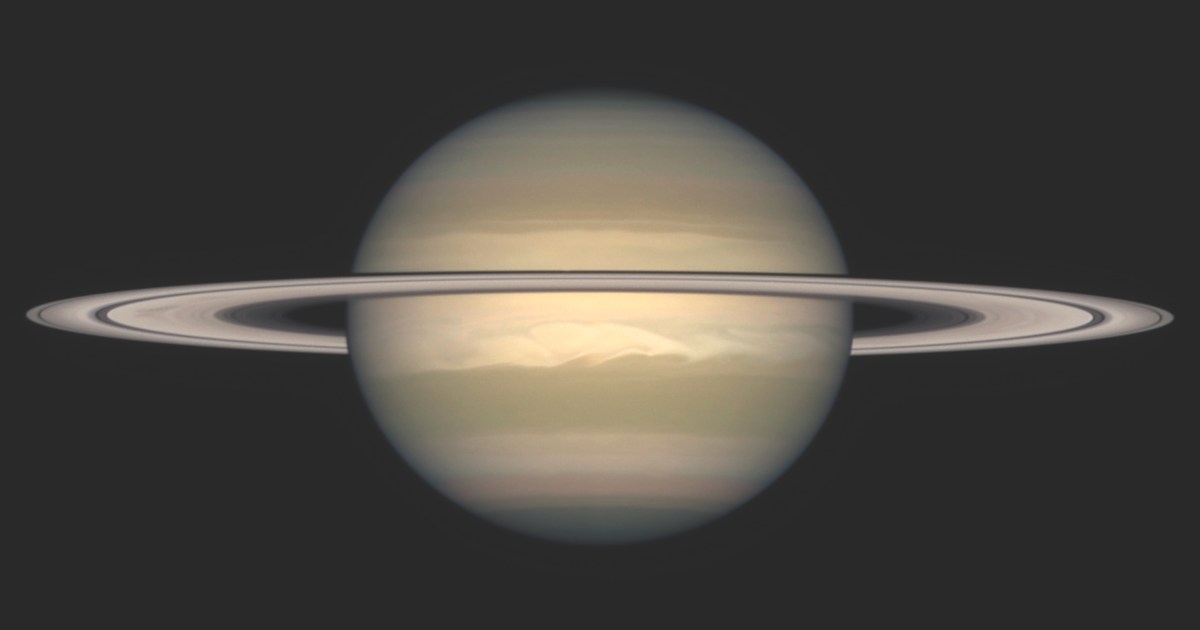
The Hubble Space Telescope captured this view of the ringed planet in October 1996. A similar orientation will greet observers through the eyepiece this month. Credit: NASA/ESA and The Hubble Heritage Team STScI/AURA Saturn reaches opposition this month, putting on a fine show. Mercury is briefly visible early in October, while Venus remains low after sunset. Neptune lingers near Saturn, and Uranus is well placed between the Pleiades and Aldebaran. Mars makes a magnificent transit of the Beehive Cluster, not to be missed. Jupiter dominates the morning sky and undergoes a lunar occultation. Let’s dive in! Mercury is best seen from the Southern Hemisphere because it is south of the ecliptic, which for northern observers is angled low to the western horizon after sunset. With a clear western horizon, Northern Hemisphere observers may catch a glimpse in the first two weeks of the month, when it glows around magnitude 0. On the 1st, Mercury is magnitude –0.1 and stands a shade over 2° high 30 minutes after sunset. It sets 15 minutes later. Good luck! Although Mercury is only briefly visible in the evenings, try on Oct. 12, when it is near the delicate crescent Moon. Credit: Astronomy: Roen Kelly On Oct. 5, Mercury stands 5° due north of Venus, but the latter is very difficult to spot. Venus is a brilliant magnitude –4.7 but barely 0.5° high 20 minutes after sunset. Only ideal circumstances — a clear, flat western horizon and perhaps higher elevation — will reveal it. You might spot Venus soon after sunset if the sky is crystal clear, but it’s gone quickly. Venus moves toward inferior conjunction Oct. 23. It maintains a southerly path, more than 6° south of the Sun. Neptune is a few days past opposition as October opens, visible in the eastern sky an hour or so after sunset. It’s best to view the planet around midnight, when it stands high in the south. Neptune lies in southern Pisces with no bright stars close by, although Saturn is 8° east of the ice giant. You can also use the eastern side of the Square of Pegasus to guide you south with binoculars to the right location. At magnitude 7.7, Neptune is challenging but within range of 7×50 binoculars. Aiding your view is a parallelogram of 4th- and 5th-magnitude stars: 27, 29, 30, and 33 Piscium. These four stars jump out in binoculars if you’re in the right area. Neptune stands 3.6° northeast of 29 Psc on Oct. 1 — within the same field of view. This gap narrows to 2.9° by the end of the month. The evening of Oct. 23, Neptune lies 4° due south of the nearly Full Moon. Saturn stands 8° southeast of the Moon. Late in the month, the Moon forms a triangle with Saturn and Neptune — note the latter requires binoculars or a telescope to spot. Credit: Astronomy: Roen Kelly Saturn is in Cetus; it rises around 7 p.m. local daylight time in early October and remains visible all night. It reaches opposition on the 4th, when it stands 780 million miles from Earth. Shining at magnitude 0.3, it’s the brightest object in this region of the sky (except when the Moon visits). It’s best viewed when highest above the southern horizon, in the hour on either side of local midnight. The planet reveals a disk 20″ across in a telescope. Resist the inclination for high magnification unless seeing conditions are particularly good. Eyepieces with 150x to 200x give the best results, but higher magnification causes the planet to become fuzzy. The ring tilt of 7.4° shows off the full southern hemisphere of Saturn, along with most of the northern hemisphere. Titan sits closest to the planet Oct. 7/8 and 23/24 (north), and Oct. 15/16 (south). It’s an easy target for any telescope. On smaller orbits, fainter Tethys, Dione, and Rhea change position quickly. Tethys continues a series of challenging transits and shadow transits. It’s a good target for observers with video imaging experience to capture, and near opposition the moon and its shadow are close together as they cross the disk. One event occurs the night of Oct. 14/15: Tethys begins transiting around 3 a.m. EDT on the 15th, its shadow joining about 13 minutes later. They leave the disk simultaneously just before 5:30 a.m. EDT, with the planet very low along the East Coast. Tethys and its shadow make several transits of Saturn’s disk this month. Video capture is your best bet for spotting such an event, while other moons may be visible to telescopic observers. Credit: Astronomy: Roen Kelly Tethys begins a transit around 12:17 a.m. EDT Oct. 17 (still late on the 16th in all other U.S. time zones), the best-timed event this month for evening observers. Its shadow appears just after 12:30 a.m. EDT. The transit ends, again nearly simultaneously for moon and shadow, around 2:25 a.m. EDT. A third event on Oct. 18 starts at 9:35 p.m. EDT (still light in the Pacific time zone) and ends just after midnight EDT. Dione transits the northern edge of Saturn this month. Again, video recording under the best conditions is necessary to capture the event, but there are six opportunities. The first is Oct. 1, from 6:07 a.m. EDT to 6:30 a.m. CDT (note the time zone change). Dione’s shadow will be challenging to catch as it grazes Saturn’s northern limb, just ahead of the moon. Dione repeats the trek Oct. 3 just before 11:45 p.m. EDT, ending shortly after 1 a.m. EDT (now Oct. 4 in the eastern half of the U.S.). The moon and its shadow will appear merged with Saturn near opposition and the Sun directly behind us. Dione’s shadow trails the moon Oct. 12: Dione begins its transit at 4:36 a.m. EDT, and its shadow appears at 5 a.m. EDT and leaves roughly an hour later. The best time to record the shadow is in the middle of this timeframe. Dione leaves the disk about 10 minutes after its shadow. Dione also transits Oct. 14 beginning at 10:12 p.m. EDT, Oct. 23 at 3:05 a.m. EDT, and Oct. 25 at 8:43 p.m. EDT. Iapetus reaches western elongation Oct. 3, 9.7′ west of Saturn. Its brighter face is turned earthward and the moon reaches magnitude 10.2. It’s an easy target for small telescopes, but the challenge is its large distance from Saturn. Iapetus’ orbit carries it to superior conjunction Oct. 22; the now 11th-magnitude moon is 1.7′ due south of the planet the night of Oct. 21/22. Uranus is an easy binocular target, nicely placed between the Pleiades (M45) and Hyades star clusters. It’s well above the horizon by 10 p.m. local daylight time. Begin by finding 5th-magnitude Omega (ω) Tauri and 4th-magnitude 37 Tauri, 3.3° apart. They’re easy to spot along a line from Aldebaran to M45. Uranus stands 1.1° northwest of Omega on Oct. 1. The planet tracks west, ending the month 1.8° west of Omega. Magnitude 5.6 Uranus is a month from opposition. You might spot it with the unaided eye from a dark location with a moonless sky. The pair of guide stars makes it easy to locate its position. Uranus’ disk spans 4″. Mars rises before 1:30 a.m. local daylight time among the stars of Cancer. The morning of Oct. 5, a waning crescent Moon crosses the northern edge of the Beehive star cluster (M44), with Mars 3.4° west of the cluster. Lucky observers with a telescope will see the Moon occult a number of the cluster’s stars. Wake early on Oct. 11 to find magnitude 1.1 Mars in the center of M44, a spectacular scene. The motion of Mars relative to the stars is evident within 10 minutes or so. Mars reaches the eastern side of Cancer by Oct. 30, when it is just over 6° from Jupiter, across the border in Leo. Mars crosses into Leo the next day. The martian disk spans a mere 6″ and its features remain challenging to view under most conditions. Jupiter spends the month in Leo. Reaching magnitude –2.0, it far outshines the Lion’s brightest star, Regulus. Jupiter slowly approaches this star, leaving a gap of 6° on the 31st. The planet rises just before 3 a.m. local daylight time on the 1st, and by 1:30 a.m. on the 31st, offering many hours of observing time. Through a telescope, Jupiter shows off a 33″-wide disk on the 1st, which grows to 36″ by the 31st. Its banded atmosphere is on display, speckled by plumes, festoons, and spots. The Galilean moons occasionally transit the disk. Europa transits Oct. 5, preceded by its shadow, as well as the shadow of Callisto. The shadow transits are underway as Jupiter rises in the Central time zone, with Europa’s shadow leading. Europa’s transit begins at 4:56 a.m. EDT and ends at 5:50 a.m. MDT (just before sunrise in the Central time zone). The moon catches up with Callisto’s shadow, which leaves the disk around 6:15 a.m. MDT and takes many minutes to disappear. The next morning, Oct. 6, is Ganymede’s turn, its shadow transiting from 5:37 a.m. EDT to 6:14 a.m. PDT. Before dawn in the Mountain time zone, attentive observers will notice Io lingering off Jupiter’s western limb. Between 6:30 a.m. and 6:40 a.m. MDT, Io fades as it enters eclipse within Jupiter’s shadow. West Coast observers will see the start of Ganymede’s transit at 6:42 a.m. PDT. Io passes in front of Callisto Oct. 14 between about 5:39 a.m. and 5:44 a.m. CDT (in bright twilight along the East Coast). Such mutual events are rare and difficult to observe in detail, with most observers simply seeing the moons appear to merge. Experienced photographers might catch more detail. Jupiter is approaching a December equinox, so a number of these events occur over the next few months. Some are merely close passes: The eastern half of the U.S. sees Ganymede and Callisto 1″ apart (almost a grazing occultation) Oct. 4 around 4:40 a.m. EDT. Jupiter is occulted by our Moon Oct. 6. Visible from the eastern portion of the U.S., the event begins around 4:20 a.m. EDT, with Jupiter nearly 20° high along the East Coast. During the five minutes prior, three of Jupiter’s moons are occulted (Europa, Callisto, then Io), and Ganymede is occulted within two minutes following Jupiter. See “Jupiter and the Moon play hide-and-seek” on page 38 of the October issue for more details. Note: Moon phases in the calendar vary in size due to the distance from Earth and are shown at 0h Universal Time. Credit: Astronomy: Roen Kelly Rising Moon: A striking glance A really easy find in the equatorial region of the Moon is a most unusual crater doublet called Messier. It was named in honor of the 18th-century comet hunter because of the long cometlike tail of material spreading westward across a darker background. The origin of the barely diverging white rays puzzled astronomers for centuries. Their theories were bizarre and completely off-base until 1978, when Don Gault and John Wedekind’s experiments plainly showed how Messier was made. At the Ames Vertical Gun Ballistic Range, the scientists shot small pellets at mind-blowing speeds of 15,000 mph at different targets, observing how the craters and the spray change shape as the firing angle is adjusted. What may have brought the biggest smile to their faces was that they could create a double crater with only one pellet. There was no need to invoke the coincidence of a double impactor, although we now know that those do exist as contact binary asteroids. Our first view can occur on the 14th, when the low Sun angle exaggerates the topography: Power up to 100x or more to see that the craters are distinctly out of round compared to others nearby. To see the rays stretching westward, wait another night, when the higher Sun emphasizes albedo (brightness) differences. The rays remain visible until just before lunar sunset on the 28th. It might be two days after Full, but as it’s only been a month since the equinox, our satellite rises early enough to be well placed at midevening in our earthly sky. Meteor Watch: Outlast the Moon This year’s Orionidmeteor shower is partially affected by moonlight, but early-morning hours are the best for viewing it. The annual shower is active from Oct. 2 through Nov. 7, with the peak occurring the morning of Oct. 21. The radiant is above the eastern horizon by 11 p.m. local daylight time on the 20th. The brilliance of the gibbous Moon in Capricornus strongly affects the visibility of Orionid meteors until it sets soon after 1 a.m. The shower has a zenithal hourly rate of up to 20 meteors per hour on the maximum morning, corresponding to an observable rate of 15–18 per hour between 2 a.m. and dawn, the best time to watch the Orionids. Wait until after the Moon sets on the morning of Oct. 21 to catch the Orionids. Credit: Astronomy: Roen Kelly Comet Search: It’s a two-fer tonight Now and then the random timing of cometary orbits offers us two telescopic targets. With both at 9th to 10th magnitude, we’ll have to sidestep the Moon’s glow and head out to the country during the first two weeks of October. Inbound is 161P/Hartley-IRAS. Imagers will easily catch the green emission from the inner coma. Some may read this far enough ahead of time for an extra reward Sept. 24–25, when the dust fan is edge-on, sporting a short anti-tail. This dirty snowball is vaulting north at 15″ per minute, enough for a visual observer to see it move in just a few glances, and too fast for a standard one-minute sub. The orbit is inclined nearly 96° to the plane of our solar system. Its dust tail starts as a broad but stubby fan that gradually opens to a nice side view in a few weeks. Compare it to tilted spiral galaxy NGC 7606. As midnight approaches, 10P/Tempel has arched off the southern horizon in its slow, eastward swim past Fomalhaut. Use the second chart below to track it down. Comet Hartley-IRAS is covering a lot of sky this month. It is most readily visible in early October, shown here, but you can find charts for the rest of the month online. Credit: Astronomy: Roen Kelly Highest in the hours around midnight, Comet 10P/Tempel (also known as Tempel 2) is swimming its way through eastern Piscis Austrinus, near bright Fomalhaut. Credit: Alison Klesman (via TheSkyX) Locating Asteroids: Back on easy street — mostly 4 Vesta has returned! The main-belt asteroid can be tracked with binoculars from the suburbs — no hunting amongst dim stars with a scope for the next four months. It reaches opposition on the 13th, peaking at magnitude 6.5. Wait until 10 p.m. local daylight time for Vesta to rise above treetops and fences. There is a challenge — it is swimming this month across the open ocean between Pisces and Cetus, with no nearby bright stars to act as easy guideposts. However, Theta (θ) and Eta (η) Ceti (both mid-3rd magnitude) fit nicely in a binocular field, and along with a few fainter stars, they form a recognizable pattern to anchor your one-field sweep to their north. If you’re unsure which dot is Vesta, make a quick sketch of four or five stars, note the date, and come back the next clear evening to peg which one has moved. Heinrich Olbers (of the “why is the night sky dark?” paradox) discovered Vesta in 1807. Keep an eye out for “intruder” stars not on the chart. This is the season and the zone where geostationary satellites reflect sunlight to northern midlatitudes for a few minutes. As the angles line up, they can brighten to 2nd magnitude! They don’t move, so the stars slowly shift past. To figure out the azimuths where they might be, just look at where the big satellite dishes in your city are pointing. While Vesta is not immediately near any bright stars, you can use Theta and Eta Ceti to its south to orient your view. Credit: Astronomy: Roen Kelly Star Dome The map below portrays the sky as seen near 35° north latitude. Located inside the border are the cardinal directions and their intermediate points. To find stars, hold the map overhead and orient it so one of the labels matches the direction you’re facing. The stars above the map’s horizon now match what’s in the sky. The all-sky map shows how the sky looks at: 10 p.m. October 19 p.m. October 158 p.m. October 31 Planets are shown at midmonth Martin Ratcliffe is a planetarium professional with Evans & Sutherland and enjoys observing from Salt Lake City. Alister Ling, who lives in Edmonton, Alberta, is a longtime watcher of the skies.
October 2026: What’s in the sky this month?
Full Article
Original Source
Read the full article at Astronomy →KhanList aggregates and links to publicly available news content. We do not host full articles from third-party sources. Always verify important information with original sources.