
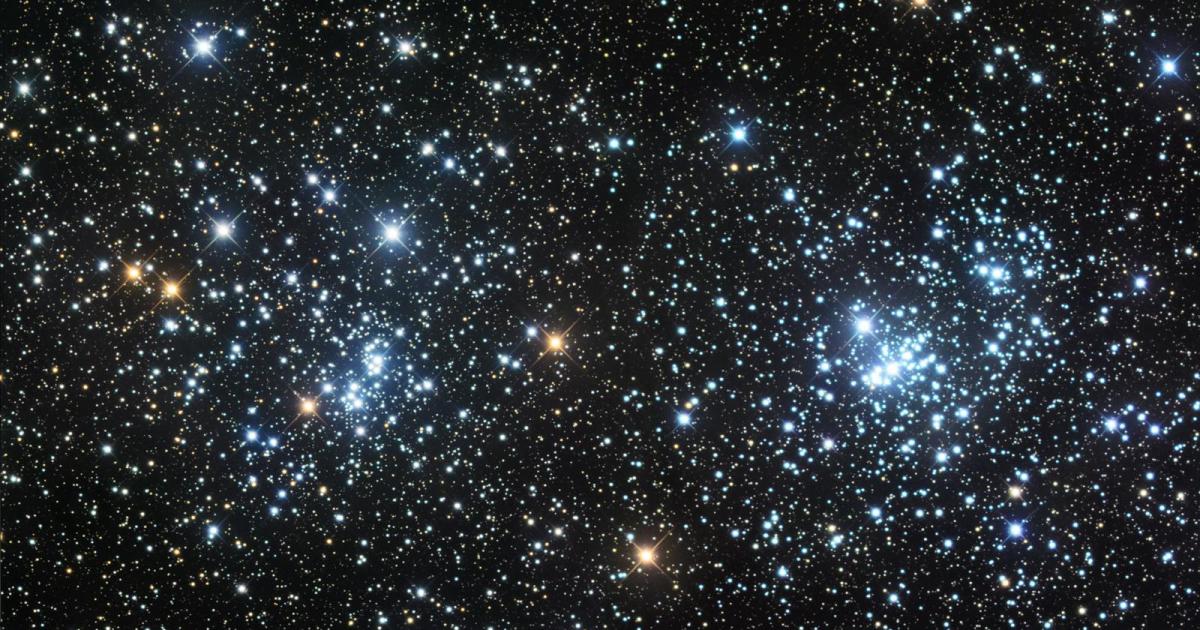
Tonight’s a two-for-one deal as the Double Cluster shines in Perseus’ northwestern corner, ready for wide-field or closeup viewing. | Published: October 1, 2026 Looking for a sky event this week? Check out our full Sky This Week column. September 30: Asteroid Nausikaa at opposition There’s time before the Moon rises this evening to get in some deep-sky observing — plus, our two-for-one targets tonight are bright enough that even once our satellite creeps above the horizon, it won’t ruin your view. By about 9 P.M. local daylight time, the entirety of Perseus the Hero is above the horizon for most U.S. observers. In Perseus’ far upper (northwestern) corner, you’ll find the famous Double Cluster: two bright open clusters only half a degree apart. Together, the pair spans roughly 1.5°, with each individual cluster stretching about the diameter of the Full Moon. Lying about 7,000 light-years away, these clusters are NGC 869 (west) and NGC 884 (east). They are sometimes called h and Chi (χ) Persei, respectively. On a clear, dark night, you can see the pair with the naked eye, both shining at 4th magnitude just 4.3° west-northwest of slightly brighter (magnitude 3.8) Miram (Eta [η] Persei). They are some of the most distant star clusters visible without optical aid. When you do opt to magnify them, binoculars or any small scope is all you’ll need. Wide-field views will show both at once, while zooming in will let you look at each cluster individually. Both show numerous hot (blue) young stars, but a generous smattering of cooler, older (red) stars appears across the view as well. Age studies show they were not born at exactly the same time: NGC 869 is roughly 5.6 million years old, while NGC 884 is just over half its age, around 3.2 million years old. Sunrise: 6:56 A.M.Sunset: 6:42 P.M.Moonrise: 9:46 P.M.Moonset: 12:51 P.M.Moon Phase: Waning gibbous (66%) *Times for sunrise, sunset, moonrise, and moonset are given in local time from 40° N 90° W. The Moon’s illumination is given at 10 P.M. local time from the same location. Alison Klesman is senior editor of Astronomy magazine. She holds a Ph.D. in astronomy and has studied a variety of topics, from minor planets to supermassive black holes.
The Sky Today on Thursday, October 1: Perseus’ Double Cluster
Full Article
Original Source
Read the full article at Astronomy →KhanList aggregates and links to publicly available news content. We do not host full articles from third-party sources. Always verify important information with original sources.