
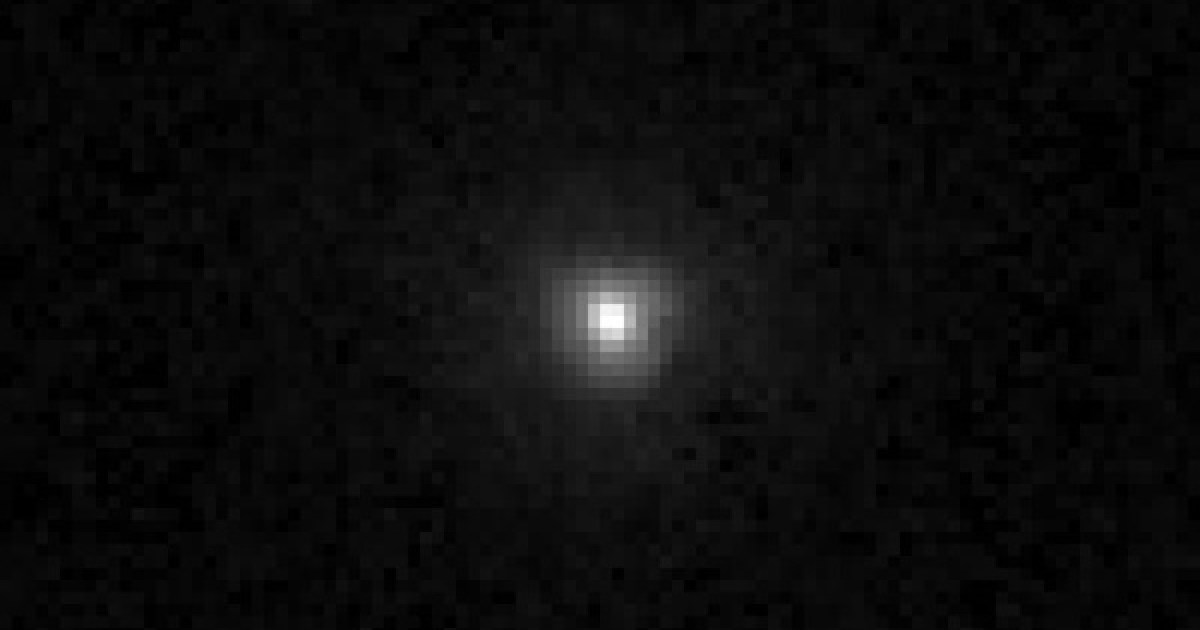
Today in the history of astronomy, the first Centaur is discovered. | Published: October 18, 2026 From the Hubble Space Telescope, Chiron is just a point of light. Credit: Hubble Space Telescope/Karen Meech On Oct. 18, 1977, Charles Kowal was at the 1.2-meter Schmidt telescope at Palomar Observatory in California – reportedly his favorite equipment at the facility to observe with – when he unwittingly discovered an entirely new class of objects. Kowal was conducting a survey for slow-moving objects beyond the Main Belt, taking two plates of the same location a few hours apart and searching them for differences using a blink comparator. He spotted one such difference – an 18th-magnitude object moving at a rate of only 3 arcminutes per day between Saturn and Uranus that was initially designated an asteroid, 2060. (Later, Kowal would name it Chiron, after a mythological centaur who was the son of Saturn and grandson of Uranus.) Chiron was a puzzle, with an orbit and size that didn’t fit its location. It would eventually be recognized as the first in a new class of cosmic objects: Centaurs. These travelers dislodged from the Kuiper Belt are the bridge between small planetesimals and full-fledged planets, making them a valuable evolutionary link for understanding planet formation. Elisa Neckar is senior production editor of Astronomy magazine, and the editor of the Today in the History of Astronomy feature on Astronomy.com.
Oct. 18, 1977: The enigma of Chiron
Full Article
Original Source
Read the full article at Astronomy →KhanList aggregates and links to publicly available news content. We do not host full articles from third-party sources. Always verify important information with original sources.