
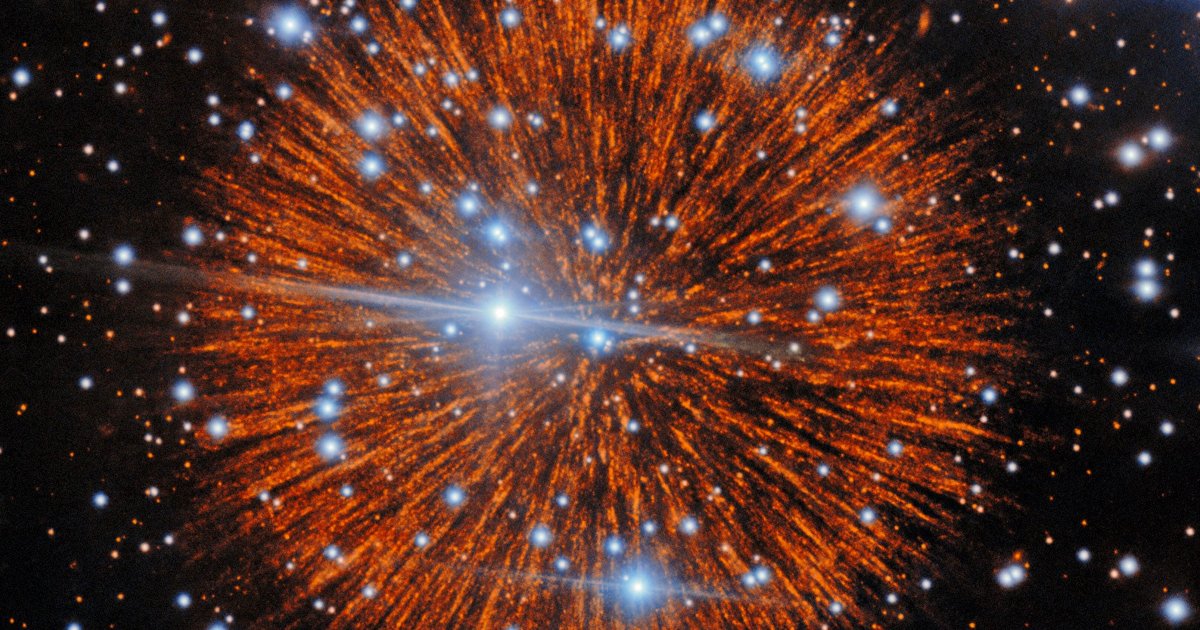
NSF NOIRLab In 1181 — during the early years of the samurai who would dominate Japan’s feudal period — astronomers there witnessed a spectacular sight in the night sky. They observed remnants of a star that had survived its own explosion, a bright object in the Cassiopeia constellation visible for at least 185 days. The supernova, independently documented almost a millennium ago by Japanese, Chinese, and Arabic astronomers, is just one out of five events like it recorded before the invention of the telescope several hundred years later. Now, thanks to breathtaking new images taken by NOIRLab’s Gemini North telescope — made up of two powerful telescopes in Hawaii and Chile — we get to see the debris field, dubbed Pa 30, in unprecedented detail. The astronomers were also left with a puzzle: the explosion perfectly preserved the surviving progenitor star at the dead center of perfectly uniform knots of ionized gases, bizarre conditions suggesting a perfectly symmetric, yet chaotically violent, event. The supernova remnant is located around 7,500 light-years from Earth, roughly a fourth the distance to the center of the Milky Way. “We can see this much detail because of Pa 30’s proximity to Earth,” said Institute of Science and Technology Austria assistant professor Ilaria Caiazzo, coauthor of a new paper about the latest observations published in The Astrophysical Journal, in a statement. “This proximity makes Pa 30 uniquely valuable for study.” Their Gemini North observations of Pa 30 resolve enormous strands of red ionized sulfur and blue-green ionized oxygen. The sulfur observations alone feature ten times as many filaments compared to previous images. The scale of the structure is hard to wrap one’s head around. “The planetary region of our solar system could fit in each knot about ten times with room to spare,” Caiazzo explained. “The knots are quite strikingly uniform. We are excited to try to model them.” Pa 30 is unique in the Milky Way as it’s the only known star in our galaxy to have survived an incomplete, Type Iax supernova. The class of explosion is far less energetic than other types of supernovae, typically allowing its white dwarf star to “survive” the blast, turning it into a so-called “zombie star.” Scientists believe that Pa 30 was the result of two white dwarfs, extremely dense, Earth-sized husks of former stars, colliding. Unlike many other supernovae, which are energetic enough to kick a star far away from the site of the explosion, Pa 30’s progenitor star remains exactly at the center. That left researchers with an enigma. “Explosions conserve momentum,” Caiazzo said. “If the explosion itself was perfectly symmetric, the ejecta should also be symmetric, and the surviving star should not receive a substantial kick.” However, “we practically don’t see the star moving away at all” in the case of Pa 30, she added. The team is now hoping to discover more Type Iax supernova survivors in the Milky Way as observations become more detailed. More on supernovae: Evidence Grows That One of the Largest Known Stars Is Poised to Explode in a Spectacular Blast
Scientists Discover Weird Conditions at Site of Star That Exploded During the Period of Japanese Samurai
Full Article
Original Source
Read the full article at Futurism →KhanList aggregates and links to publicly available news content. We do not host full articles from third-party sources. Always verify important information with original sources.