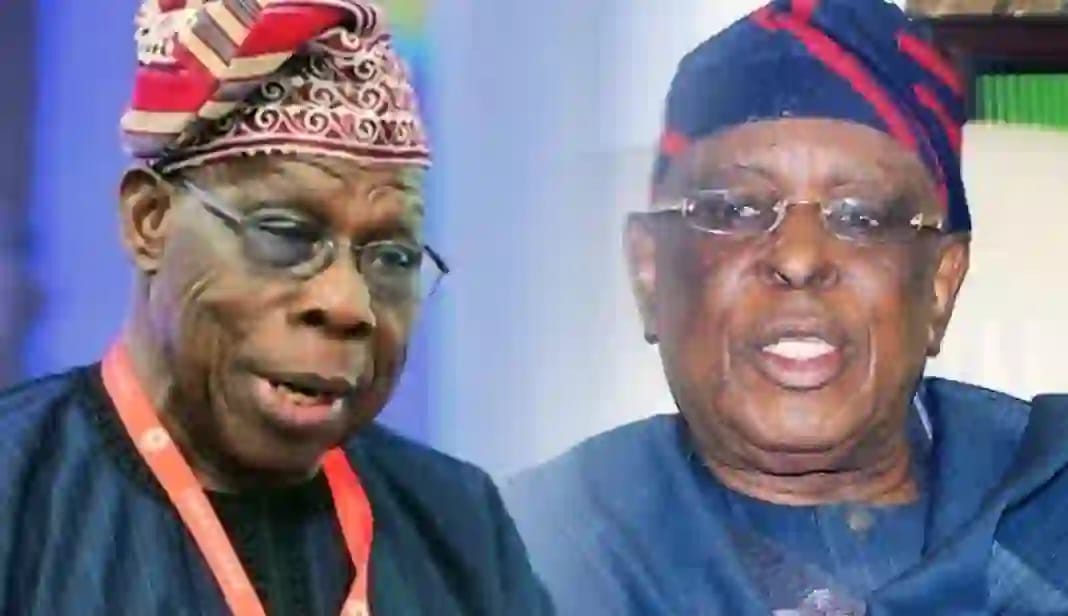
Apart from the D’Rovan Presidential Electoral College fiasco of AD in Ibadan, one other factor that led to the implosion of Afenifere and the AD was the pact we had with President Olusegun Obasanjo over the 2003 presidential election. Contrary to the impression in some quarters that the AD governors were solely responsible for the support for Obasanjo in the 2003 election, the truth is that it was the collective decision of the Afenifere/AD hierarchy. Everyone knew that there was no love lost between Governors of Afenifere/AD and President Obasanjo. Even though we did not want the relationship between the state and the federal government to be antagonistic, we were not Obasanjo’s friends in any way. I never had any one-on-one private meeting with him throughout the four years he was in office. All the AD governors too were not Obasanjo’s friends. The AD governors were committed strictly to implementing the programme of our party. It was the attempt by the House of Representatives under Right-Honourable Ghali Umar Na’Abba in August 2002 to impeach him that thawed the icy relationship between us and Obasanjo. That created an opportunity for Obasanjo to want to embrace us too. But we didn’t have a meeting with him on this crisis to support him. Out of our own volition, we decided that the democratic experiment in the country was too fragile for the kind of shock therapy that Na’Abba and the House of Representatives were planning to apply to it by impeaching Obasanjo. Our party caucus in the National Assembly and the leadership of the party decided to block the attempt at impeachment without any prompting from Obasanjo. Those of us who suffered under the military, unlike the likes of Na’Abba, were conscious of the implications of what they were doing if it led to a political crisis and military intervention. Therefore, we were more concerned about forestalling another military intervention in the polity. This is why the AD caucus in the National Assembly and the leadership of the AD opposed the impeachment plot. This was not about ethnic solidarity, as many people charged. We were the ones who fought for the restoration of democracy in Nigeria. Most of those who were causing the tension, including Obasanjo himself, were the ones standing in the way of democratic aspirations of Nigerians for so many years. The experiences of many of us in the AD, including our leader, Chief Adesanya who survived an assassination attempt, the Abiola family and the families who lost their loved ones on the streets of the southwest during the protest, taught us not to allow the military to ever return to power. I led the team of state governors to meet the Speaker of the House of Representatives, Ghali Umar Na’Abba. We pleaded with him to shelve the impeachment plot. After meeting with Na’Abba, we met with Obasanjo at the Villa to discuss with him too. In the course of our interaction, then Governor of Bayelsa State, Chief Diepreye Alamieyesiegha was nearly assaulted physically when he said something that was misconstrued by Obasanjo. “Oga (meaning Obasanjo), we (the governors) are in charge…” Alamieyesiegha said. Without waiting for Alamieyesiegha to finish his statement, Obasanjo jumped up and queried: “You, in charge where I am the president! In charge of what? I am fully in charge!” Incensed, he even moved towards Governor Alamieyesiegha in a menacing manner. I saw another terrible limitation of Obasanjo that day. What the governor of Bayelsa was going to say was that as governors we had strong leverage over most of our state’s representatives in the National Assembly and we could get them to thwart any attempt to impeach him, if only he worked with us and allowed us to do so. I had to douse the tension by intervening. I clarified Alamieyeseigha’s statement by adding that those of us who suffered for democracy and someone like him who had to go to jail for some other reasons, should understand why we needed to ensure the survival of democracy. I pleaded with him to show maturity as a statesman by stooping to conquer. I explained that he needed to let us take charge of the situation and douse the tension between him and the National Assembly. “Okay, I understand now. You want me to stoop to conquer” Obasanjo said. That was how we managed to save an ugly situation that could have resulted in an exchange of blows between him and Alamieyeseigha. Stooping to conquer As it turned out, unwittingly, we had handed Obasanjo a tool with which he later dealt with us too. I told him to “stoop to conquer.” After “stooping to conquer” the National Assembly and surviving the impeachment plot, he later “stooped to conquer” the AD governors and Afenifere. After he survived the impeachment plot, he never showed any sense of remorse. We could not believe his new bellicose approach when in a national broadcast he described the impeachment plot as “joke carried too far.” The attempt to impeach him eventually won him some sympathy in Yorubaland. It was after this experience that Obasanjo began a frontal attempt to woo the AD governors. He came to Lagos to attend the convocation at the University of Lagos and then invited all the AD governors to a meeting later in the night same day. Governor Bola Ahmed Tinubu of Lagos was the contact between us and Obasanjo over the arrangements for the meeting. We met him in the old office of the head of state at Dodan Barracks. The only person who accompanied him to the meeting was the Director of the State Security Services (SSS), Col. Kayode Are. At the meeting, he directly requested support from all the six AD governors. He said he wanted an understanding between us and himself because he faced some serious challenges that were likely to create some upheaval in the political terrain and in the country at large. Therefore, he wanted an understanding and a working relationship with us. We analysed the situation in the country and told him a few home truths. Firstly, we told him that even though we were heads of governments, we had leaders and elders in the party that he must discuss with, if he needed any kind of understanding with us. Secondly, we wondered what would be the basis of our understanding with him when his term was coming to an end with no prospect of his securing his party’s ticket for a second term. We made it clear that a working relationship between the two groups was beyond us. A decision of that magnitude would have to be reported to Afenifere leaders who had the authority to take a final position on it. We immediately reported the proceedings to Chief Abraham Adesanya who convened a meeting where it was debated with serious reservations amongst the leadership about fraternising with Obasanjo. The Afenifere and AD leadership were not going to give their heart and soul to support Obasanjo’s second term ambition without extracting some major political commitment from him. A meeting was held in Lagos where the conditions for negotiating with Obasanjo were agreed upon. After the meeting at his home, Adesanya led a team with Afenifere charter of demand to Ota to discuss with Obasanjo. The delegation to Ota included Chief Ayo Adebanjo, Senator Femi Okunrounmu and Cornelius Adebayo. Okunrounmu and Adebayo were mandated to speak on behalf of AD and Afenifere. Chief Adesanya called me and asked me to join them at Obasanjo’s Ota Farm, from my station in Abeokuta. The conditions presented to Obasanjo amongst others were: the restructuring of the Nigerian federation, devolution of power, including moving some items from the exclusive to the concurrent list and ensuring fiscal federalism. Obasanjo was to organize a credible and transparent national census. Merit must be followed alongside federal character and quota system in the recruitment to federal positions across the country. Obasanjo assured us that he identified with them. He explained that he had even started implementing the issue of merit in federal appointments indirectly through the privatization of many public enterprises which were run for many years without respect for merit. With the privatization and the enthronement of a culture of merit, he expected that many of Nigerian professionals abroad would return home to run the privatized enterprises. He affirmed that privatization was part of enthroning meritocracy. Obasanjo said arrangements had been completed to ensure a genuine, transparent and acceptable headcount. He told us the satellite mapping of all Nigerian cities, towns and villages was in the making. Even without a headcount, he explained that with satellite mapping, it was possible to count the number of houses everywhere in the land and with that get a rough idea of how many people live in the houses and in the country. He said he would lay the issue of census to rest in the second term. Through GOOGLE, the days of census inflation were over. On fiscal federalism, he said he would make the federal government respect and obey the decision of the court in the case instituted by Lagos and other states against the federal government. On the whole, Obasanjo sounded so eloquent and convincing. At the end of the meeting, we drove to the Gateway Hotel, Ota where I had arranged dinner for the leaders. It was also the place to debrief ourselves of what we gained from meeting with Obasanjo. Chief Adebanjo was the major speaker. “I sincerely cannot believe that Obasanjo has become such a changed man,” he said. “I am surprised but happy that he is ready to take fundamental actions to restructure Nigeria in his second term in office.” That was the impression most of us took away from the meeting. Consequently, we agreed to support him for the 2003 presidential election. On our part, we decided not to present a presidential candidate for our party in spite of resistance from some Afenifere leaders. It was later that we realized that we had been fooled. Obasanjo merely played along with us and ended up deceiving us by telling our leaders what he knew they wanted to hear but which didn’t come from his heart. Apart from reaching out directly to the A. D. governors, Obasanjo also reached out to other sources close to the governors to reinforce his professed desire for cooperation. From Ogun State, he enlisted all manner of groups–religious, traditional, professional, communal and familial, to pile pressure on me, his fellow Ogun indigene. Obasanjo pressures me through Royal Fathers, Friends and Groups The then Ooni of Ife, Oba Sijuwade, Olubuse II, was the first to discuss Obasanjo’s re-election plans with me. Ooni was superlative in his presentation to me. “The Yoruba nation has an assignment for you,” he said. “Yorubas don’t want disintegration; they want continuity and a smooth change of baton from one civilian government to another.” Then the real message: “We want your cooperation and assistance.” I responded that his message and idea were laudable but I was only a member of a large team with whom I need to discuss the subject. Alake of Egbaland, late Oba Oyebade Lipede was next. At a meeting in his bedroom one night, he told me, waxing sentimentally: “Akinrogun, this is where I will breathe my last to join my ancestors. Before I answer the call to transition I want you to join the Egbas in helping our Jagunmolu of Egbas (General Obasanjo) to execute a successful movement from one civilian to another.” Oba of Lagos, Late Oba Adeyinka Oyekan, a distant cousin and the grand-patron of our family, Osoba–George, also waded in. So did the Ataoja of Osogbo, Oba Iyiola Matanmi with whom I grew up in Osogbo. He threw his weight in to plead Obasanjo’s cause. The most compelling of all was from the paramount ruler of Ijebuland, Oba (Dr.) Sikiru Adetona, a respected royal father in Yorubaland. Having been on the throne since 1960, Awujale is deep and experienced. He can be firm and uncompromising in any noble cause he supports. Awujale had been an immense source of inspiration to me both in and out of office as Governor. He also provided succour when I was underground during Abacha’s reign. His daily telephone calls with prayers made my travails in hiding bearable and fortified my resolve to bear it through. A fair-minded leader who hates injustice in any form, he could become radical in search of justice. The Awujale too did not wholly trust Obasanjo, having had his own share of tension-soaked relationship with Obasanjo. I remember one incident in Ijebu-igbo after the church service for the 80th birthday ceremony of Chief Abraham Adesanya in July 2002. The Awujale and I were riding in the same vehicle with Obasanjo and Chief Bode George when the Awujale told Obasanjo frontally: “In the past, I could swear by you but in recent times, I no longer trust you nor can I put a bet on any promise you make.” Rather than get offended, Obasanjo simply laughed and said; “Kabiyesi, Kabiyesi that is not true.” Awujale, in his autobiography, called Obasanjo a “Judas”. A royal father that knows Obasanjo that much would therefore not throw his goodwill in Obasanjo’s favour frivolously. Sometime in 2002 the Awujale invited me to his place for a heart to heart discussion. “My Aremo,” he started, “we all know Obasanjo’s terrible weaknesses, but we have to overlook those so as to ensure a smooth civilian-to-civilian transition bereft of bloodshed and the subsequent collapse of the republic as it happened in 1966 and 1983. In light of this, it is better for us to support Obasanjo and let him finish his second term and go. I want to broker relative peace between you and Obasanjo.” We debated his suggestion at length after which Awujale volunteered to arrange a private flight from Ibadan to Abuja, for a meeting with President Obasanjo. We set out early on Saturday morning for the presidential villa where we had breakfast with the president, followed by a meeting in his inner study at the villa. The Awujale started the meeting by joking that as an Ijebu king, he should not be interceding between two Egba men. He then turned to me. “Mr. Governor, do you have any presidential ambition now?” “No, “I replied. He then turned to Obasanjo for his own royal quiz. “Mr. President, are you interested in contesting to be governor of Ogun State?” “God forbid!” Obasanjo replied, in what looked to him like an abomination. “How can I descend from being president to become a state governor?” Like King Solomon attempting to settle a case between two people, the Awujale asked the two of us: “So what do both of you have against each other?” Without waiting for a reply, he continued softening a serious matter with his jocular approach; “Ordinarily, as Awujale, I should not be happy to have an Egba as President and another Egba as Governor of Ogun State. Yet I cannot understand why two Egbas who have the two most important positions available for people from Ogun State would not be at peace with each other.” Let’s give it to experienced royal fathers! The wisdom with which these elders and custodians of tradition such as the Awujale put these things never ceases to amaze me. They have a way of dousing tension with their natural wisdom, experience, style and succinct manner of presenting their arguments. Even if you are not totally convinced about what they want you to do, the manner of presentation would make it almost impossible to demur. Obasanjo responded to the Awujale by saying that I was keeping my distance from him, which he claimed was affecting the federal government’s interest in Ogun State. According to him, it was also affecting Ogun State’s access to federal assistance. “I expected him to be meeting me regularly with request for Ogun State, but the governor is too arrogant to do so,” he said. “Well my relationship with you has nothing to do with pride”, I responded. “If it has nothing to do with pride, then what is responsible?” the president asked. “The thing is we belong to two different ideological, persuasions and political parties.” Secondly, I let him know that even if I needed any extra-budgetary assistance, it was usually not worth the trouble because of what the state would get by the time elements at the federal level and their political bosses take some percentage off it. Yet they will record the full amount in the books. This is a potentially destructive path that I couldn’t follow. I learned a lot of lessons from fellow governors of the class of 1992 who ran into problems after Abacha kicked us out over extra-budgetary allocations from the federal government that were not delivered in full to them. “In any case, why should I lobby you before you can do whatever you feel like doing for your home state?” I asked the president. “I am doing my part as governor. I challenge you to do your part, Mr. President.” The discussion was brutally frank and Obasanjo seemed not to be in a hurry to let us go. But the pilot eventually sent word that there was no night-landing facilities at the Ibadan airport and that we needed to leave soon. The preceding discussions and rapprochement between us probably weighed on the president’s mind when he paid a state visit to us in Abeokuta in October 2002. As to be expected, the government of Ogun State extended to him due courtesies. He was impressed. On his return to Abuja, he wrote a warm letter conveying his appreciation. “I was impressed by your administration’s effort towards the rehabilitation of infrastructure especially in roads and water supply. And I note with satisfaction the encouragement you have made in private Ogun-Osun Water irrigation scheme, and promised to accelerate work on the paper mill in Iwopin. “Let me reiterate my commitment to get Iwopin Paper mill operational within the shortest time possible,” he promised. Regrettably, he did not match his words with action as the paper mill, the only federal government project in Ogun State, remained comatose throughout the remaining five years of his tenure. There were others who also intervened on behalf of Obasanjo. They included the elite of Egbaland and Yorubaland in general. For instance, the “Hope Family” led by Chief Debo Akande also supported Obasanjo’s second term. They came to Abeokuta to plead with me. Members of the Hope Family included an old classmate, Chief Rasheed Gbadamosi, and other successful professionals like Chief Folorunso Oke, Chief Jide Sawyer, and Prince Supo Adetona. It was not that I didn’t have my doubts or I didn’t know President Obasanjo and his character enough. I had abundant experience of his character through previous personal encounters. In 1979, he stopped my appointment as managing director of the Sketch. Another example was when I was campaigning to be governor in 1990, a campaign of calumny was mounted against me that I sold my Egba origin by claiming to be a Kwaran in my desperation to be chief executive of Nigerian Herald. General Obasanjo who as Chief of Staff approved and caused the appointment to be heralded on radio, deliberately did not raise a voice to correct the misrepresentation. Then Apena Egba Chief Toye Coker was the one who gave me a hint that Obasanjo was present when the matter was discussed by some elders in Egba. Knowing that Obasanjo had full knowledge of the circumstances that took me to Kwara, I was disappointed that he did not clarify the issue at a meeting of Egba chiefs. At the earliest opportunity, I confronted him in the presence of Chief Kola Olumide with evidence of his instruction in writing on my appointment at the Herald. In spite of all this, I went ahead with the arrangement because I was convinced that we needed a successful civilian-to-civilian election for democracy to survive. Hints of what was in store for us were also coming to me from many sources. For instance, as we were coming out of one of the meetings at Obasanjo’s lodge in his Ota farm, Dr. Omololu Olunloyo, former Governor of Oyo State who was waiting to see Obasanjo called me aside and whispered in my ears: “Be careful. You and Lam Adesina are being spied upon; they are monitoring your activities as governor. Be careful and before you reach any agreement with Obasanjo, think twice and think well.” It was the second time within a month that Olunloyo was warning me about Obasanjo. He had earlier done so at the 70th birthday celebration of Senator Biyi Durojaiye in Ijebu-Igbo. Olunloyo’s wife, Ronke, is from Ijebu-Igbo and a distant relation of Senator Durojaiye. The president of the Nigerian Bar Association (NBA) Chief Wole Olanipekun (SAN) came to Abeokuta in the heat of the 2013 elections campaign to admonish me to be wary of any collaboration with President Obasanjo. Many longstanding friends like General Emmanuel Abisoye expressed serious reservations. My son, Olumide, never believed in the alliance. He exhibited his revulsion openly on December 26, 2002 when Obasanjo barged in on me and family to pay an unsolicited Christmas courtesy call on the Osoba family. We received President Obasanjo at 9a.m. in our house in Abeokuta. On hand were Beere, Fadekemi, Oluyinka, Tobi and Prince Segun Adesegun. Olumide who drove in from Lagos that morning refused to join the welcoming party. Noticing Olumide’s absence, Obasanjo requested to wait for him to come down. After first refusing my entreaties, Olumide agreed but requested to take his bath first. Obasanjo still accepted to wait. Obasanjo chose to address the family, standing, having rejected my offer to speak while sitting. Obasanjo pleaded with my family to see his and mine as one united family. He asked that they should treat all those altercation between me and him as purely political and not personal. When Olumide prostrated in Yoruba culture to respond on behalf of the Osobas, Obasanjo lifted him to address the house standing. He thanked Obasanjo for the honour and wished him a peaceful and successful tenure in office. We both left for his Olusomi Family House for his family Christmas party. While there he begged to have lunch in my house before returning to Ota. I had to mobilize Gateway Hotel to help for the unscheduled lunch. Two weeks before the first election, Papa Adesanya summoned us to Ota for another meeting with Obasanjo. Some independent witnesses were also invited. They included the Awujale of Ijebuland, Oba Sikiru Adetona who came with Oba Olu Adekoya, Dagburewe of Idowa. Also invited were Bishop Emmanuel Gbonigi of the Anglican Communion and Bishop Ayo Ladigbolu of the Methodist Church. To our shock, Chief Adesanya opened fire at Obasanjo, shooting straight from the hips. “Mr. President, we hear you are planning to use military tactics to ambush us during the election,” he said. “From our intelligence gathering, we have learnt that you are planning to run us all aground and rig us out of power in the south-western states. By doing that you would have betrayed our trust and support for you.” Bishop Gbonigi also added credence to Adesanya’s information, firing more shots in the direction of Obasanjo. “Mr. President, what Chief Adesanya is saying is true,” he said. “We also hear that your people are in Ondo State training some people who are expected to wear fake police uniforms on the day of the election with a view to rig the elections for the PDP, your party.” A visibly angry Obasanjo had to fire back asking the bishop: “What’s your source of information?” “My source of information? I got the intelligence information from my friend, Governor Adefarati.” “Governor Adefarati is lying.” Obasanjo said. “He is not lying. We grew up together from childhood; Adefarati has not been known to be a liar,” Bishop Gbonigi replied. The whole meeting was running into stormy waters with the exchanges between Obasanjo and Gbonigi. “I swear to God that the allegations are untrue and unfounded,” Obasanjo said. “I can never be part of such a betrayal.” “Mr. President, I still insist you are deceiving us,” Adesanya chipped in. “And I know that no betrayer would go unpunished. As our people say, he who betrays the earth would end up being swallowed by the earth.” It was the intervention of the Awujale that calmed the frayed nerves. He intervened and said that what was needed was for the president to assure us about what he intended to do to allay the fears of the Afenifere/AD leaders. “This matter before us is more than just throwing insults around,” the Awujale said. “What we need is for the president to explain and convince us about what he would do to prevent rigging and violence during the election and ensure that we are guaranteed free and fair elections.” He should explain what actions he intends to take on all allegations made against him and his men. Bishop Ladigbolu also spoke in the same vein to calm things down, adding that any form of rigging, cheating and lying is against God’s wish and is punishable by God. Obasanjo jumped at that opportunity to make a solemn promise that he will do everything possible to make sure that the elections were conducted well, to the satisfaction of all that parties. It was on this note that the meeting ended. Events subsequently proved Adesanya right. Before we held the first round of elections, which was for the National Assembly, the results had been forged. Throughout the southwest in particular, and generally nationwide, the PDP had brazenly manipulated the elections. Senate seats were being won and lost in rapid succession. I know of two examples of notable physicians from Adamawa and Kaduna states, who being honourable men had conceded defeat only for their names to be announced later on radio as winners. The gubernatorial and presidential elections were to follow. In the days after the National Assembly election, I had information from highly placed sources in the intelligence community and the electoral commission that the “results” of the gubernatorial and presidential elections in Ogun State were also ready. Fictitious figures were already available to declare the gubernatorial candidate of the PDP in Ogun State, Gbenga Daniel, as winner. My then current and former deputies, Alhaji Gbenga Kaka and Alhaji Rafiu Ogunleye who went for a pre-election meeting at Ogun State INEC reported that some people in INEC revealed to them confidentially that the elections were “a foregone conclusion” Kaka and Ogunleye tried to convince me to withdraw from the race. I rejected their advice, even though I accepted the conclusion about what was in store for me and our party. I was able to confirm from other sources the planned rigging of the elections and all the shenanigans planned by the PDP in Ogun State. Yet, I went ahead with our preparations for the elections. I instructed party chiefs to pay our party agents and pay for the necessary logistics. Some of them asked me why I was “wasting” money in what was a lost battle. I told them that if we don’t put all energies into the election, some would turn round to say “if only we had done this or that” we would have won. By 8pm on the Election Day, a total of one million, three hundred and sixty thousand, one hundred and seventy (1,360,170) votes had been announced for Obasanjo. Gbenga Daniel was declared winner of the gubernatorial election with four hundred and forty-nine thousand, three hundred and thirty-five (449,335) votes. The sheer shamelessness of the PDP and its candidates was revealed even by the Federal Appeal Court. In the judgement, the judges cancelled Ogun State results and noted that the presidential election received 615,873 votes over and above the votes cast for all the governorship candidates. The judges queried the “yawning gap” between the votes recorded for Obasanjo and those assigned to gubernatorial candidates of all the parties in the state. The court concluded that the difference was “indefensible” especially when both the presidential and gubernatorial elections were held simultaneously. In the lead judgement, Justice F.F. Tabai even added that “all allegations in Ogun State were criminal in nature. They ranged from violence, fingerprinting, official intimidation, bias and falsification of results.” Waziri Onibiyo Adio, a perceptive and investigative journalist, was the first to raise a “STAR QUESTION” on the criminally rigged elections in Ogun State. Adio, presently the Executive Secretary of Nigeria Extractive Industries Transparency Initiative, wrote a story reproduced below in Thisday on April 25, 2003. “What Happened in Ogun Polls? News Review By Waziri Adio A close study of results released by the Independent National Electoral Commission, INEC, seems to have supported allegations of irregularities in last weekend’s polls. The result from Ogun State, the president’s home state, shows a wide discrepancy between the total number of votes cast for the gubernatorial and presidential candidates. The total number of votes cast for all the presidential candidates exceeded that of the gubernatorial candidates by 618,071 votes. This staggering difference has set many eyebrows askew. During the elections voters were given two ballot papers: the shorter one for the gubernatorial poll and the longer for the presidential. From results cross-checked on INEC’s website yesterday, 1, 576, 875 names were on the voters’ register in Ogun State. The total number of ballots cast (both valid votes and rejected ballots) for the gubernatorial candidates was 747, 296. However, the total number of votes cast in the presidential category was 1, 365, 367, a difference of 618,071. Out of the total votes cast, President Olusegun Obasanjo polled 1, 360, 170 (99.92%), while General Muhammadu Buhari (rtd.) scored 680 (0.05%). The discrepancy in the figures has thrown up a number of questions. Is it that thousands of voters in Ogun State were not interested in who becomes their governor? Is it that they were only interested in returning their kinsman to the presidency? Did thousands of voters refuse to take the ballot paper for the gubernatorial candidates? If so what did they do with the ballot papers? Did they drop them at the polling stations or did they take them home? Or did they forget to vote in the gubernatorial category? Were there more than 600, 000 voided yet unrecorded votes in the gubernatorial category? Are these figures from actual voting or are they cooked figures? Is there an honest mistake somewhere? Or a deliberate manipulation of figures? These and many other questions are crying for answers. It is also noted, however, that though Ogun State posted the most staggering difference in the votes cast simultaneously, the trend is not peculiar to it. In 10 other states with full results on the INEC website, the differences ranged from 1,000 to 94,000. In Adamawa State the difference is 94,143; in Akwa Ibom, 68,861; in Ebonyi, 1,457; in Edo, 24, 197; in Ekiti, 2,675; in Enugu, 70, 922; in Jigawa, 55, 740; in Kwara, 3, 325; in Oyo, 46, 336; and in Niger, 31, 850. Whether they are in a few thousands or in hundreds of thousands, the differences point to the fact that something is amiss somewhere. There are also questions about Rivers and Bayelsa states where the president and incumbent state governors scored almost 100 per cent with 97 per cent turn-out. This reminds us of elections held in Saddam’s Iraq. The expired maximum dictator, Saddam Hussien, almost always scored 99 per cent in a vote where turn-out is akin to that of Rivers State. This leaves several questions unanswered especially when some local government areas like Brass recorded 100 per cent turn-out and 99 per cent vote for the incumbent. The doubts engendered by the turn-out in Rivers which the PDP national chairman, Chief Audu Ogbeh, called “historic” cast a question mark on the credibility of the elections. Already, the president’s opponents have alleged gross manipulation of the polls. Both local and international observers have complained of lapses, irregularities and manipulation in a few states. According to the European Union observer group, “the elections were simply not credible.” One of the notable political journalists and columnists of that era, Eziuche Ubani of THISDAY, also commented on the Ogun State elections of 2003 in his column on Friday, December 24, 2004, after the judgement of the Presidential Election Petition Tribunal. Ubani asserted that the tribunal had “confirmed to the world, a truth that all know—that the 2003 general elections were marred by the irregularities. All sorts of malfeasance, and criminality, as the justices confirmed, were deployed to return President Olusegun Obasanjo to a second term.” Continued Eziuche Ubani: “Stalwarts of the People’s Democratic Party (PDP), who owe their positions in the party and government to the massive fraud, were relieved (by the judgement which confirmed Obasanjo’s victory in the presidential election) but they were nonetheless worried. What ruined it for them was the confirmation that the President’s men caused to be awarded to him 600,000 votes that were non-existent in the voters’ register. And that, the presidential poll in Ogun State-the President’s home state, where he supervised during the polls-was unanimously annulled by the justices. It sounds incredible, but that is the truth. 600,000 votes were manufactured and added to the tally that returned the President to office. That is to say that our Commander-in-Chief benefitted from a vote fraud that took place in his home state. The implications are very grievous (grave) for it impairs the moral foundations on which the power of the President to wield the red ink and deploy troops is built.” The perceptive journalist asked very critical questions about what happened in Ogun State and Olusegun Obasanjo’s role in the electoral theft. This requires a long quotation: “What did the PDP do? Prior to the polls, the authorities of the University of Agriculture, Abeokuta (UNAAB) were instructed to forward a list of lecturers, who would act as returning officers. In the past, university lecturers were custodians of social morality, but not anymore. And these persons lived up to the infamy of their generation. They were “instructed” that since President is a ‘son of the soil,’ he needed all the advantage from the ‘soil’. It was decided that a 1.3 million vote will put him on good pedestal. The results were prepared in advance before they headed to the local government collation centres. The large number of soldiers ensured no one had access to them at the collation centres. “But as usual in all fraud, there is always (a) loophole, a clue that will give away the plot. Since they prepared the President’s result ahead, they failed to realize that they would also have to deal with the result of the governorship polls, which held at the same time. They wrote the results but forgot that what was returned for the President ought to mathematically tally with what was returned as total votes for the governorship candidates-Gbenga Daniel, Segun Osoba and four others. That was their first error. “The second error flows logically from the first. The 1.3 million voters returned were far in excess of the number in the voters’ register. What that figure suggests is that the state recorded about 120 percent voters’ turnout…” “There is also another error. Those who conjured the figures must have been blind to statistics and demography. The population of Ogun State is 2.5 million. To say that 1.3 million people voted, means more than 50 percent of the entire population is above 18 years. “This narrative gives a clue to who and who are responsible for the fraud in Ogun State. The President was in Ogun State all through the polls. All this happened (under) his watch. As beneficiary of the malfeasance, it is not on record that anybody had been queried for the embarrassment. Again, what happened in Ogun happened in so many other states…” Eziuche concluded poignantly: “…on whose shoulder is a moral burden hanging now? Is it Chris Ngige of Anambra State, or the President who a superior court has declared that all the votes he got in Ogun were obtained by fraud, and were annulled? Nobody will answer this question, and nobody will resign. But we know, for sure, on which page of history these ignoble records will be written.” Eziuche’s last sentence could be used to compose a most fitting epitaph for Obasanjo’s role in Nigeria’s democratic history. The word “ignoble” will stand out in that epitaph. *Culled from BATTLELINES: Adventures in Journalism and Politics, Diamond Publications (2018) chapter 17, pp 277 to 300.
Obasanjo, Ogun State And The 2003 Elections
Full Article
Original Source
Read the full article at Thisdaylive →KhanList aggregates and links to publicly available news content. We do not host full articles from third-party sources. Always verify important information with original sources.