
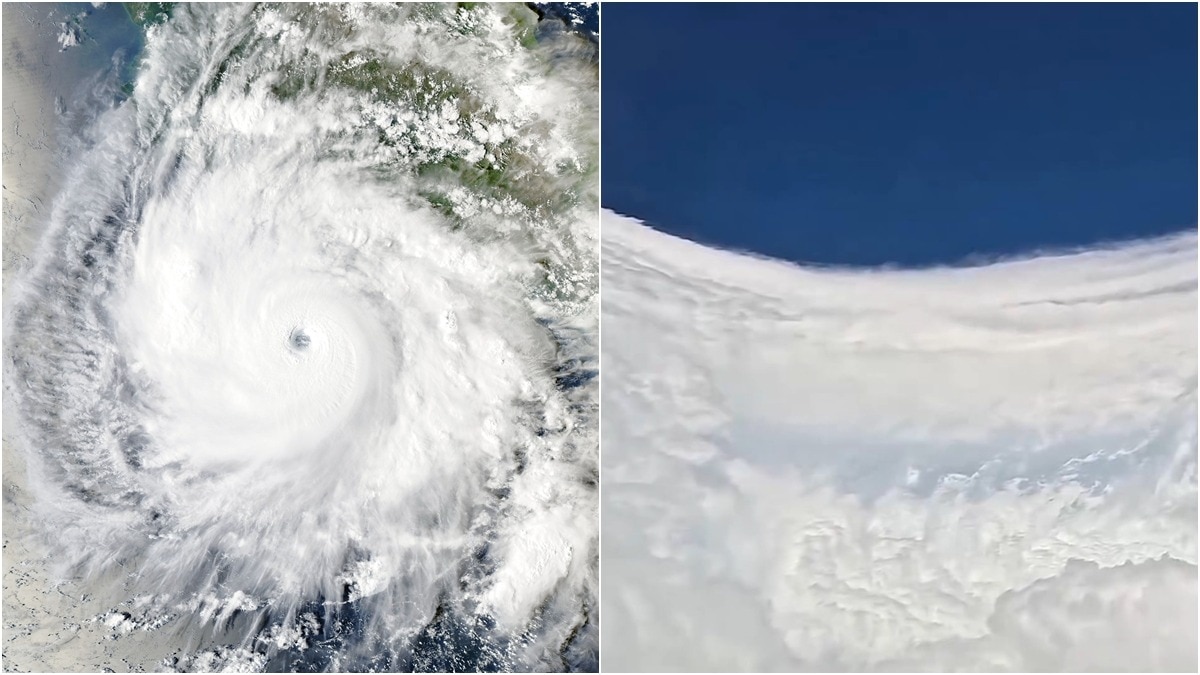
What happens when a plane flies into a hurricane? Noaa's flight through Hurricane Polo provides a peek inside one of the strongest storms of 2026.An aerial view of Hurricane Polo from space, and a view from inside the hurricane captured by Noaa. (Photo: Nasa/Noaa)New Delhi,Sep 25, 2026 12:51 ISTNoaa has captured a breathtaking view from inside Hurricane Polo, flying directly through the storm's eyewall and into its eye.Video from the mission showed the aircraft passing through a wall of dense white cloud before emerging into the eye, where towering clouds form a near-circular ring around a patch of clear blue sky.The footage was recorded by Noaa's WP-3D Orion during a September 22 flight into Polo.HOW DOES THE HURRICANE-HUNTING PLANE WORK?The aircraft is a Lockheed WP-3D Orion, one of Noaa's specialised weather aircraft used to fly directly into tropical cyclones. One of the two WP-3D aircraft is nicknamed “Miss Piggy.” Rather than simply observing a hurricane from above, the aircraft carries instruments that measure conditions inside the storm.Scientists collect information on wind speed, air pressure, temperature and humidity, while expendable sensors known as dropsondes are released into the storm to measure conditions as they fall through the atmosphere. These direct measurements provide information that satellites cannot obtain in the same way and are fed into hurricane analysis and forecasting systems.Join us in the flight station to see what it's like flying into a hurricane!This morning @NOAA WP-3D Orion #NOAA43 "Miss Piggy" flew a critical mission into Hurricane #Helene ahead of its landfall later today. Data collected will help improve intensity forecasts and support pic.twitter.com/WSVnCSZH4X— NOAA Aircraft Operations Center (@NOAA_HurrHunter) September 26, 2024WHAT DID THE PLANE SEE INSIDE POLO?Polo had an exceptionally powerful core when the Hurricane Hunters flew into it.The National Hurricane Center (NHC) said the hurricane had reached Category 5 strength, with maximum sustained winds of about 260 kmph on September 24.Aircraft observations later found winds near 240 kmph as Polo underwent changes in its eyewall.The storm's structure was also changing.NHC reported that an eyewall replacement cycle was nearly complete during one aircraft mission, with the inner eyewall dissipating while the outer eyewall contracted.It also turned out the best view of the hurricane is only from above.HURRICANE POLO SEEN FROM SPACEAs the hurricane continues to churn, Nasa astronaut Jessica Meir captured a breathtaking view of Polo from the International Space Station (ISS), providing a close-up look at the storm's clearly defined eye from hundreds of kilometres above Earth.Looking through the station's Cupola windows, Meir said Polo appeared “massive” and shared a close-up of its eye. An image of Hurricane Polo captured from the ISS. (Photo: Nasa/@Astro_Jessica) Meir had happened to spot the hurricane and said that she would try to photograph it again during the next suitable pass, she wrote in a social media post.Meir's latest photographs offered a different perspective on a storm that has been rapidly changing in strength and expected to do so further.WHERE IS POLO HEADING?As of the latest Thursday-night, Polo was a Category 4 hurricane with winds of about 240 kmph, roughly 315 km southwest of Manzanillo, Mexico, moving westward.The NHC expected it to regain Category 5 strength on Friday before gradually weakening.The hurricane's core remained offshore, but had already brought heavy rain to southwestern Mexico, creating risks of flooding and mudslides.The rare footage offered a view of what a powerful hurricane actually looks like from inside its eye, and shows why Hurricane Hunters are an important part of understanding storms that satellites can only observe from above.- Ends
Noaa flies plane inside Category 5 Hurricane Polo. Watch flight footage
Full Article
Original Source
Read the full article at Indiatoday →KhanList aggregates and links to publicly available news content. We do not host full articles from third-party sources. Always verify important information with original sources.