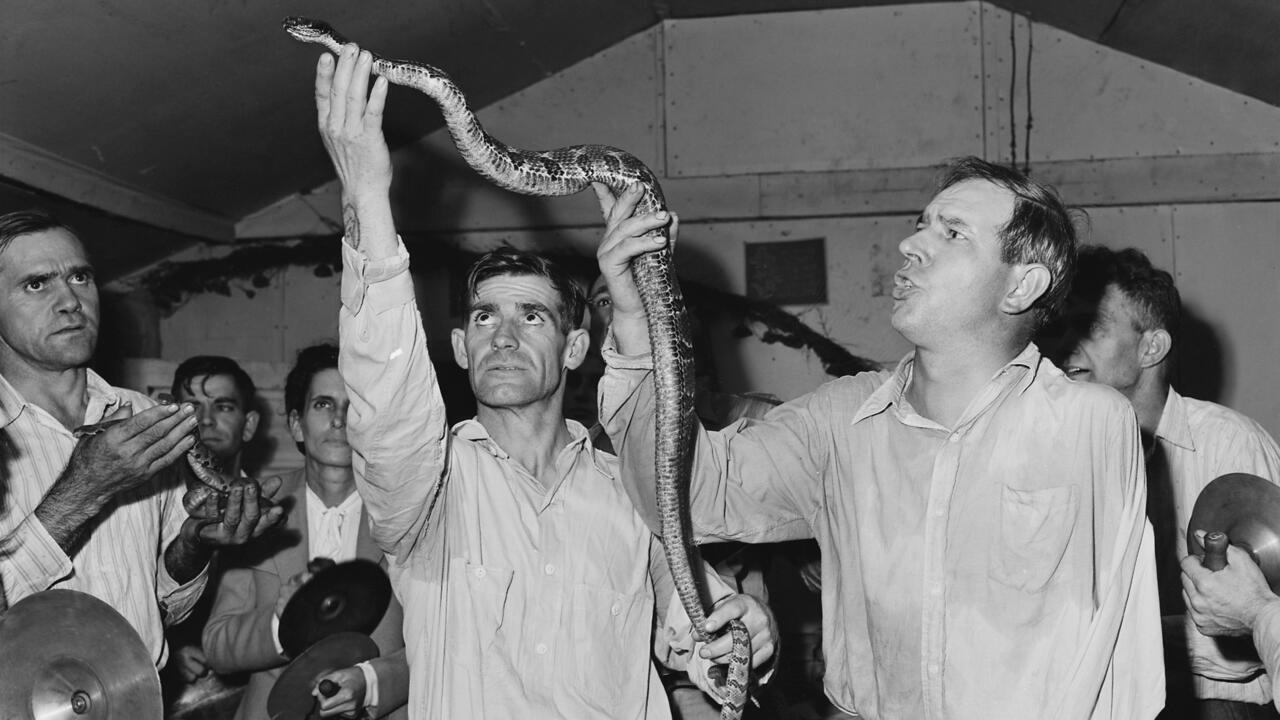
A few keywords in a search engine will bring up any number of strange laws involving animals in the United States. Many are urban myths: there is no law specifically prohibiting driving a car in Massachusetts with a gorilla in the back seat, although no one would dispute that would be a questionable idea. Others, however, are very real. Issued on: 26/07/2026 - 21:21 3 min Reading time If you’re planning a trip to Atlanta, bear in mind you won’t be allowed to tie your giraffe to a lamp post. This rule dates back to the early 20th century, when a giraffe named Elsie was tied to a telegraph pole in a small town in Georgia by workers from a travelling circus. Left to her own devices, Elsie broke free and set off up the high street. The state subsequently decided legislation to prevent such a scenario was necessary. Similarly, the city of San Francisco banned any processions along Market Street involving an elephant, unless the animal was kept on a lead – in order to regulate parades by the Ringling Brothers Circus, founded in 1871. The company shut down in 2017 following decades of campaigning by Peta and other organisations over its abuse of animals, and reopened in 2023 with animal-free shows. The law regarding elephants on Market Street, however, remains in force. Also in California, Section 2 of the state's Fish and Game Code states that any number of live frogs may be used in frog-jumping competitions. However, should any of them die during the competition, "they must be disposed of as soon as possible and must not be eaten". The frogs, it turns out, are kept in unsanitary conditions which could facilitate the spread of disease. France approves tough new laws targeting animal cruelty, banning wild animal entertainments Snakes on a (spiritual) plane Since 1999, by order of the municipal authorities of New Orleans, Louisiana, "no reptiles shall be permitted within 200 yards of the route of a Mardi Gras parade for at least two hours before the parade’s scheduled and announced start time, nor within 200 yards of the parade’s actual end point for at least one hour after the parade has actually ended, measured from each of the parade’s end points". It's a law that isn't always adhered to either: in 2024, the Miami Herald reported that local police had seized several snakes in public spaces during that year's carnival, including a boa constrictor more than 4 metres long. Snakes are unwelcome at some churches as well as carnivals. In Kentucky, it has been illegal since 1940 for anyone to "display, handle or use" any kind of reptile in connection with religious services, after this practice emerged in the mining towns of the Appalachian mountains within Pentecostal Christian movements in the early 20th century. It stemmed from a somewhat literal interpretation of the Gospel of Mark, which states: "These are the signs that will accompany those who come to believe: in my name they will drive out evil spirits; they will speak in new tongues; they will pick up snakes with their hands." Monkey business: artist chimps paint in their own style, study shows Elsewhere in the realm of the supernatural, while it remains debatable whether the yeti exists, that didn't stop Skamania County in the State of Washington passing a law in 1969 that stated "any premeditated, wilful and senseless killing of this creature shall be deemed a crime". In 1984, the same county established a "Sasquatch sanctuary" and on 11 June 1991, a neighbouring county declared itself a "yeti protection and sanctuary zone". According to the minutes of the meeting at which the decision was made, the aim was in fact to protect people wearing a yeti costume – ahead of the following weekend's Bigfoot Festival. While those who don yeti costumes are well protected in Washington, the town of Blythe in California has little truck with those who treat traditional dress as fancy dress. It is illegal there to wear cowboy boots unless you own at least two cows. This article has been adapted from the original version in French by Olivier Favier.
No snakes in church and don't eat the frogs: the weird world of US animal laws
Full Article
Original Source
Read the full article at Rfi →KhanList aggregates and links to publicly available news content. We do not host full articles from third-party sources. Always verify important information with original sources.