
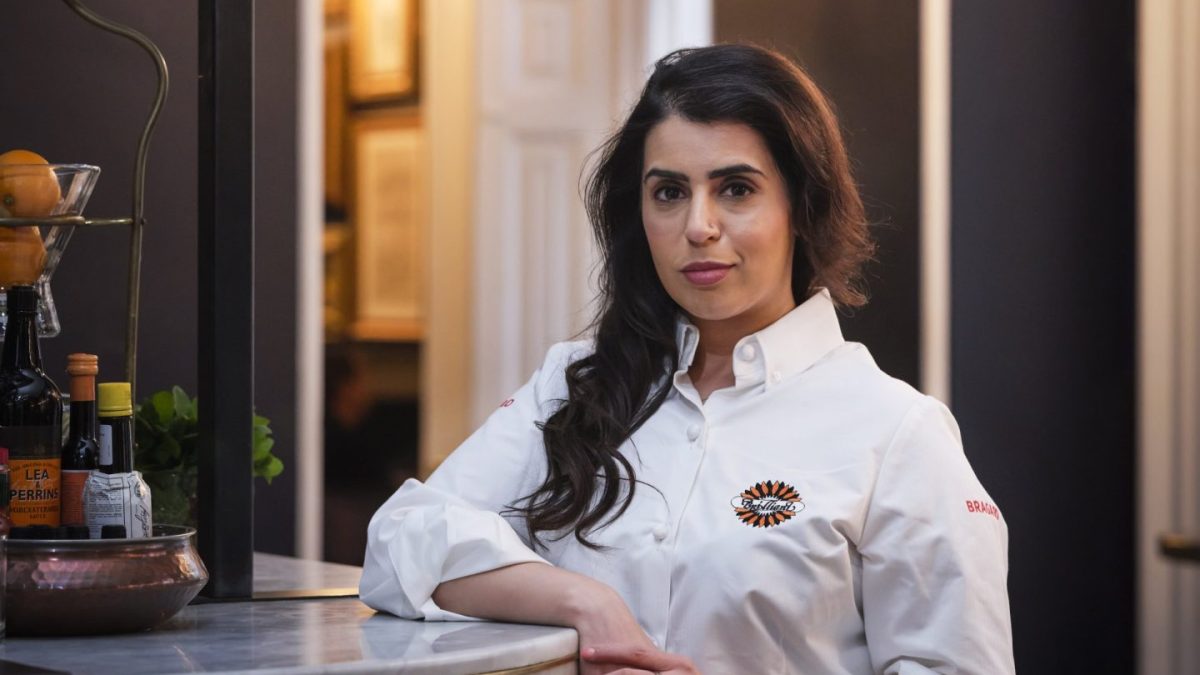
As she smiled for the cameras, TV chef Dipna Anand appeared just as bubbly as ever. But inside, she was breaking, knowing that she was having yet another miscarriage. Dipna, 42, and her husband Satpal, 51, have been trying for a baby for the last four years. In that time, she has endured 13 pregnancy losses and a further three failed rounds of IVF. “I’ve heard the words: ‘Dipna, I’m really sorry’, so many times,” she says. Dipna is a regular on shows like the James Martin’s Saturday Morning on ITV and BBC’s Saturday Kitchen. She has gone through at least three miscarriages while presenting on television – but has always kept her fertility struggles private before now. “I had planned to wait until we had a baby to tell our story,” Dipna explains over a video call from the home she shares with her parents in West London. “But I think it’s important women talk more openly about miscarriage. In Indian culture, particularly, it’s taboo – you are not supposed to talk about pregnancy failures. But the more I speak to other women, the more they open up about their own struggles. We need to support each other.” Shorts Dipna’s first miscarriage happened after an unplanned pregnancy in autumn 2022. It was a “joy and a shock” to discover she was pregnant, though she knew her father – fellow TV chef Gulu Anand – would disapprove because she and Satpal were not yet married. “I’ve always loved children and I knew I wanted to have this baby,” she says. So when she started bleeding around a week later, it felt like her “dreams were crashing down”. A scan revealed an empty sac without a developing embryo. “We told Dad and he was heartbroken. He’s changed so much as a person because of all we’ve been through – he used to worry about what people would think, now he cares about what’s really important in life.” When she got pregnant again a few months later, in early 2023, a scan revealed the bad news that it was another empty sac. Then, as she and Satpal prepared to marry in June that year, she tested positive for another pregnancy but again it didn’t develop. The couple conceived again on their honeymoon – “I could always get pregnant very quickly,” she explains. An early scan showed Dipna was expecting twins. “I was so excited,” she says. “In my mind I thought now that we were married and it was the ‘proper’ way of doing things, this had to be our time.” But another scan two weeks later, in August 2023, showed there were no heartbeats. Dipna chose medical management, where medication triggers the process of miscarriage. But within hours she was in unbearable pain and bleeding heavily. “I had never seen so much blood in my life,” she says. “We went to A&E and I went to the toilet but I was worried about the blood going everywhere, so I was on my hands and knees on the floor, trying to wipe it up, sobbing. I will never forget that moment.” Dipna was rushed into emergency surgery to stop the haemorrhage. Afterwards, her husband said: “We’re never doing this again. I’m not putting you through this.” But she wanted to keep trying: “All I had ever wanted was to hold my baby in my arms – to me, that was everything.” After conceiving for the fifth time towards the end of 2023, scans showed her latest pregnancy was ectopic – a potentially life-threatening complication where an embryo develops in a fallopian tube instead of the womb. Two weeks later, she miscarried naturally. “I’m a believer that what’s written for you will happen,” says Dipna. “By the time I’d lost five pregnancies, I had accepted that when my child was destined to be here, they would be. It gave me strength to carry on.” In the first half of 2024, Dipna experienced four further pregnancy losses. “I was going into every scan like a robot, just waiting to hear the words: ‘Dipna, I’m really sorry’,” she says. “I was pregnant almost all the time, but never past nine or 10 weeks. None of the doctors could give us any real answers and we were discharged from NHS care. There’s a shocking lack of understanding around what causes recurrent pregnancy loss.” Dipna during IVF treatment. Despite several attempts, she continued to suffer miscarriages Then, in July 2024, Dipna began IVF in Prague. After an unsuccessful first round, the clinic recommended trying an egg donor. “I was willing to try anything,” she adds. The first attempt failed but a second attempt, in February 2025, led to a positive pregnancy test – only for it to turn negative a few days later. It was the tenth time Dipna had experienced pregnancy loss. “It doesn’t get any easier,” she says. During this time, Dipna also struggled with the side-effects of the hormonal treatment. “The IVF hormones changed me,” she explains. “I didn’t want to be around people or talk with customers at our gastropub. I told my husband I didn’t want to be a chef or be on television any more – that was not me. The hormones had taken over.” As she put on weight due to the treatment, people started commenting on her looks on social media, saying things like: “You must be eating too much of your own food” and “Girl, you need to get to the gym”. “I’m quite strong-minded and usually it doesn’t bother me, but I didn’t feel great about myself because of the IVF,” she says. “I wish people thought more before making comments – you never know how much harm they might do.” In 2025, the couple travelled to India to start IVF using an embryo formed with a donor egg and donor sperm. In January 2026, their second transfer attempt worked. “At the scan, I burst into tears when the sonographer pointed out the heartbeat – I had never seen one before,” says Dipna. The couple were due to have twins but, a few weeks later, a scan showed one had stopped growing, although the other was fine. “I felt distraught at losing yet another baby but my cousin told me: ‘You’ve got the strongest baby coming to you’ – it helped me to accept it,” she says. But on Mother’s Day this year, Dipna knew something felt different: “I tried to speak to the baby but I couldn’t feel any connection. A few days later I started bleeding. I tried to tell myself it wasn’t going to go wrong again, but at the scan I heard those words: ‘Dipna, I’m really sorry’. We were heartbroken.” This time, she had surgical management – where pregnancy tissue is removed via a short operation – and went straight back to work, having experienced her 12th pregnancy loss. “This one has hit the hardest,” she says. Dipna has always carried on working, helped by supportive family and colleagues. “It’s my way of handling the pain,” she adds. “Some people prefer to stay home but I need to keep busy. No one who saw me on TV or came to my gastro-pub or pop-ups had any idea what was going on – I just kept on going. Work was the only thing keeping me sane and feeling like myself.” In recent months, Dipna has been pregnant again. For the first time with a natural conception, she saw a heartbeat on an early scan. But by the next scan it was gone. “They said: ‘Dipna, I’m really sorry’,” she says. “I had no tears left to cry.” The couple, who have spent around £30,000 so far on treatment, are researching options like adoption and surrogacy, and have got information and resources from the baby loss charity Tommy’s. “I’ve come to accept that our journey might not end how I wanted it to,” she says. “But if sharing our story helps someone else feel less alone, then I’ll be happy.” For advice and support on baby loss visit www.tommys.org
No one knew I was having miscarriages on TV
Full Article
Original Source
Read the full article at Inews →KhanList aggregates and links to publicly available news content. We do not host full articles from third-party sources. Always verify important information with original sources.