
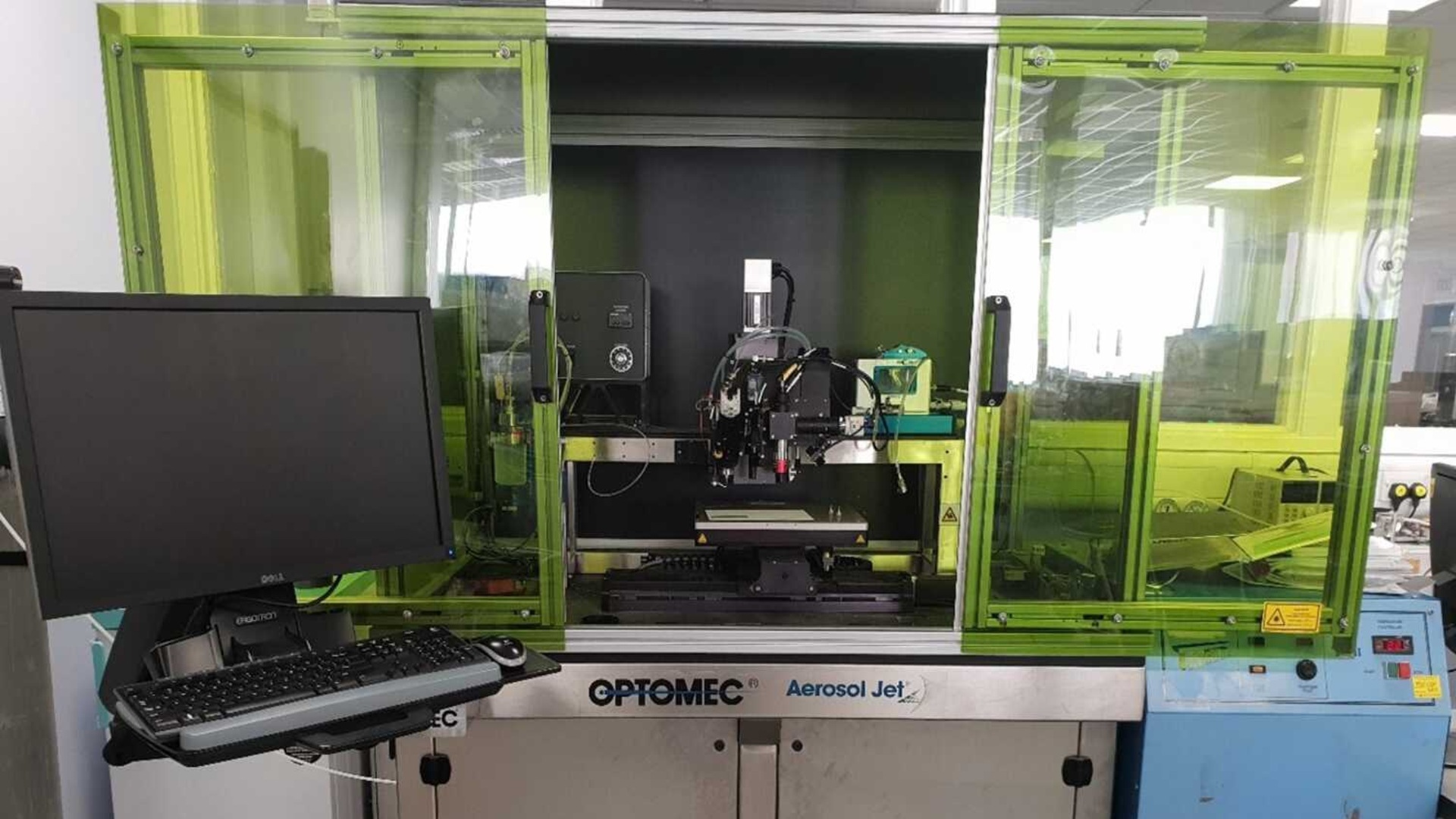
A new printing technology could put electronic circuits directly onto curved and three-dimensional surfaces, opening a path toward sensors and other electronics that cannot be made using conventional flat manufacturing. The work comes from a research group led by Ethan Secor, an associate professor of mechanical engineering at Iowa State University and co-founder of startup Contour Circuits. The team is developing ways to use aerosol jet printing to deposit electronic materials with high precision on complex surfaces. Unlike a conventional inkjet printer, aerosol jet printing turns liquid ink into a fine mist. A gas stream carries the aerosol through a nozzle, allowing the system to print patterns as small as 10 to 100 microns. The researchers are now combining that printing process with robotics, software and real-time monitoring to control how circuits are deposited on curved surfaces. Printing circuits on curves One of the team’s systems mounts an aerosol jet printer on an articulated robotic arm. The setup allows the nozzle to move across surfaces that are not flat, but it also creates new challenges in positioning and motion planning. The goal is to make the process precise enough to produce reliable electronic circuits on complex three-dimensional shapes. “Right now, the work that’s getting me excited is the conformal printing,” said Secor. “For the next two to three years, that’s going to be a big effort. We’ll be pushing to develop applications for the technology.” Potential applications span energy, healthcare, manufacturing, aerospace, communications and security. Making printed electronics tougher Reliability also depends on whether the printed electronics can continue working after manufacturing. Secor is studying new ink materials designed to withstand extreme conditions, including the temperature swings encountered in space. The research is supported by a recent grant from the US National Science Foundation. The team is particularly interested in failures that occur where silicon-based semiconductors connect with larger electronic circuits. “Electronic systems that can function in extreme environments are highly relevant for energy, infrastructure, aerospace, and space applications,” the researchers wrote in a project summary. NASA is also backing commercialization efforts. Contour Circuits, founded by Secor and former graduate student Jeremy Rurup, received a $150,000 Small Business Technology Transfer contract to advance the technology. The company is developing its work at the Roy J. Carver Co-Laboratory on Iowa State’s campus. The team is also exploring ways to print multiple materials during the same deposition process. Secor compares the concept to moving from black-and-white printing toward grayscale, where the composition of the printed material could be varied across a surface. That could give engineers greater control over the electrical and physical properties of printed components. From ink to working hardware Secor’s interest in printed electronics began during graduate school at Northwestern University, where he initially worked on graphene inks. His research later expanded into flexible electronics, liquid metal electronics, microsupercapacitors, and lithium-ion batteries. He eventually began building and modifying printing hardware rather than relying only on commercially available systems.“I learned how to build a printer and that opened up a lot of research directions,” Secor said. “Now we build and customize our own hardware. So, while other research groups are playing with a black box, we can open it up, understand how it works and improve on it.”Get the latest in engineering, tech, space & science - delivered daily to your inbox.With over a decade-long career in journalism, Neetika Walter has worked with The Economic Times, ANI, and Hindustan Times, covering politics, business, technology, and the clean energy sector. Passionate about contemporary culture, books, poetry, and storytelling, she brings depth and insight to her writing. When she isn’t chasing stories, she’s likely lost in a book or enjoying the company of her dogs.
New mist-based printing method builds precise circuits on complex curved 3D surfaces
Full Article
Original Source
Read the full article at Interestingengineering →KhanList aggregates and links to publicly available news content. We do not host full articles from third-party sources. Always verify important information with original sources.