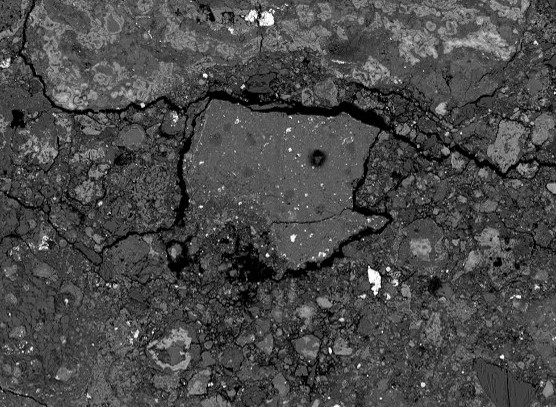
When a meteorite tore through a New Jersey home, the homeowner quickly preserved the fragments. Now, they’re giving scientists a look at Earth’s early history. Photos show a daytime meteor (left), the hole left in the roof (center images), and a fragment of the Hillsborough meteorite (right). SETI Thanks to the quick thinking of a New Jersey homeowner, there’s new evidence for salty oceans in ancient asteroids, and new clues to the ingredients in Earth’s primordial soup. A daytime fireball streaked across the sky over northeastern U.S. on July 16, 2024. Its final flare produced numerous meteorites detected by Newark Airport Doppler weather radar, but only one of them was found. It crashed through the roof of a house in Hillsborough, New Jersey. (Incidentally, another meteorite also crashed through a New Jersey home the previous year; the asteroid belt has it out for New Jersey, it seems.) The 2024 find was summarized in a recent paper published in Science Advances by Peter Jenniskens (SETI Institute) and colleagues: The owner of the home heard a loud crash at approximately 15:20 UTC and found a hole in the ceiling of the master bedroom accompanied by black matter that covered the bed, carpet, and surrounding areas. The meteorite had broken into many fragments (Fig. 1D), including dust, and a strong sulfur-like odor was present in the air. Immediate care was taken to preserve and document the entire scene using disposable gloves and aluminum foil, with fragments placed in glass jars. The total recovered mass was ~1.35 kg. The homeowner’s rapid response preserved the meteorite from Earthly contamination beyond what it suffered in its entry through the atmosphere, the house’s roof, and the final capture on the carpet. Analysis was challenging because the meteorite was so delicate: no fluid-cooled methods could be used to cut or polish it, or it would disintegrate. The meteorite turned out to be a CM1 carbonaceous chondrite. CM chondrites were already known to be water-rich, but all previous known CM1 chondrites were found long after their falls, likely altered by exposure to humid or wet conditions. Thanks to the quick preservation of this fall, there’s no doubt that its water-containing minerals originated in the asteroid belt, and not through water-enabled alteration on Earth. Scientists discovered that this bit of the Hillsborough meteorite is rich in salts and came from near the surface of the parent body asteroid.SETI Among the meteorite’s grains are evaporites, minerals that crystallized out of a salty brine as the water either evaporated away or froze out. The team also found serpentine, a mineral produced by interaction between volcanic minerals and water. The minerals suggest the meteorite was once a part of a water-rich rocky world, where subsurface water dissolved mineral grains and facilitated chemistry. As the water evaporated or froze out, it left behind salts and hydrated minerals. The salty minerals in the Hillsborough meteorite contain something else within their crystals: carbon-rich organic molecules, some of them quite large, with chains of up to 11 carbon atoms. Brines can facilitate chemistry that builds larger carbon chains out of smaller ones. Other CM1 meteorites have also yielded organics in similar abundance, but the organic molecules are generally much smaller, with chains of five carbons or fewer. Quick storage preserved the abundance of larger organic molecules in the Hillsborough find, revealing contact with the salty brine in its ancient parent body. Falls like this one would have delivered a wide variety of organic building blocks to Earth’s primordial oceans. This meteorite is new evidence for what kinds of molecules would have been available — born in the asteroid belt and landed on Earth — to seed life.
New Jersey Meteorite Offers Early Solar System Clues
Full Article
Original Source
Read the full article at Skyandtelescope →KhanList aggregates and links to publicly available news content. We do not host full articles from third-party sources. Always verify important information with original sources.