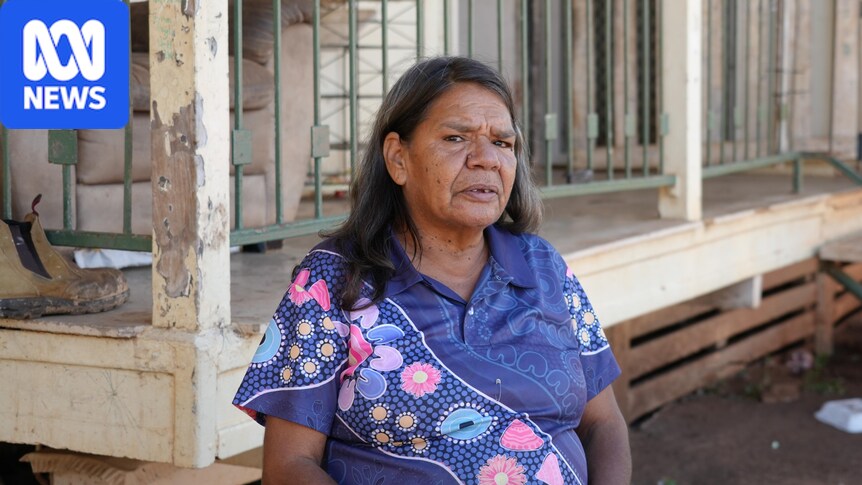
Under the vast outback sky of Mount Isa, community leader Corina James is a familiar face at the local courthouse, a place she visits weekly out of a deep-seated commitment to supporting her young relatives and other local children."I go there every week; I'm still going to the courthouse because I worry," she said.Corina also heads to the local police station when she gets a call that someone she knows has been arrested. Those visits are tough on her heart."I just broke down and cried for the little fella. It makes you feel really sad for them," she said.With 30 grandchildren and seven great-grandchildren, Corina's home serves as an open-door sanctuary for many young people in the community seeking guidance.Corina James believes the youth justice system is broken. (ABC News: Abbey Halter)"I support … anyone else that wants to come along and ask for a bit of support … I point them in the right direction," she said.While families like Corina's work to keep kids out of trouble, First Nations children continue to be over-represented in the criminal justice system.The latest Closing the Gap data shows little progress to reach the nationally agreed target of at least a 30 per cent reduction in the number of Indigenous children behind bars by 2031.The Productivity Commission's annual data compilation report found that First Nations children nationally have been held without a sentence on average for 57 days while they await trial, sentencing or a bail decision.Over the past five years, the rate has increased from 69 per cent to 76 per cent.Queensland has the highest proportion of children detained without a sentence, ranging from 80 to 90 per cent, with an average of 96 days, the highest in the country.Corina opens her Mt Isa home as a safe place for youth. (ABC News: Abbey Halter)Corina keeps detailed records about the children she supports who are navigating the youth justice system.She knows one child who recently spent 48 days unsentenced in the Cleveland Youth Detention Centre in Townsville, followed by a 24-hour curfew upon release."[He] was in custody for a very long time because he had to wait for a lawyer," Corina said."They kept chopping and changing his lawyer, and it's really sad because they had to deal with lawyers from Brisbane."She said he was "really sad and frustrated" while in custody.At home, families are doing what they can to stop kids ending up behind bars.Christine says she is often out on the streets looking for her grandchildren in the middle of the night. (ABC News: Abbey Halter)Christine Doyle, Corina's sister, said it is often the exhausted grandparents and parents who take to the streets to track down the kids."When we go to bed at night, we all go to sleep here, [but] our kids are sneaking out the door," said Christine."Then when we wake up at like three o'clock in the morning, the kids are all gone … I drive around and look for my grandsons."Target to reduce youth in detention not on trackThe Closing the Gap National Agreement is a formal commitment by all Australian governments to work in partnership with Indigenous communities to achieve equal life outcomes.But the latest Productivity Commission assessment released today found there has been no significant improvement since the target to reduce young people in detention was established, and it is not on track to be met.Indigenous young people continue to make up more than half of all people held in juvenile detention.Sue-Anne Hunter says it is easier to demonise children than to deal with the root problems. (ABC News: Danielle Bonica)National Commissioner for Aboriginal and Torres Strait Islander Children and Young People Sue-Anne Hunter said the picture was damning."These numbers should worry every Australian; this is active harm, and it's compounding every year," she said."Most First Nations young people sitting in detention today have not been sentenced; they have not been found guilty of anything."She said the detention figures reflected how governments respond to children in contact with the justice system, rather than a simple measure of youth offending."We see a demonisation in this country of youth, it's easier to lock them up."A rise in unsentenced detentionThe data highlighted how limited access to secure housing could be a factor contributing to Indigenous children being exposed to longer periods of incarceration.Katherine Hayes, the CEO of Youth Advisory Centre in Brisbane, said unstable homes were just one of the reasons why young people are detained without a sentence.Katherine Hayes is working to reduce the number of children in custody through early intervention and diversionary programs. (Supplied)"They don't have an appropriate bail address, so they don't have a permanent home or a safe home, and so they're held on remand," she said."[But also] it takes a really long time for their matters to get to the trial stage and that can be multifaceted … but also the way that defence lawyers conduct the matter or the police prosecutors can be slow to provide briefs of evidence."Of all the states and territories in Australia, the highest number of children incarcerated are in Queensland.More children are being held in unsentenced detention, with Queensland holding kids for more than 90 days. (ABC News: Abbey Halter)Ms Hayes said detaining children in custody was not the solution fit for all youth crime."Give them a safe home, engage them in education, address all the mental health concerns and make sure that they have a safe home that is free from domestic and family violence," she said.A spokesperson for Queensland's Department of Youth Justice and Victim Support told the ABC the state was prioritising "the rights of victims"."The Queensland government is addressing youth crime and restoring safety where Queenslanders live by introducing tough new laws to prioritise the rights of victims and deliver consequences for actions for youth offenders," the spokesperson said."The Queensland government is also investing in early intervention and rehabilitation to reduce offending and reoffending and break the cycle of crime."Experts say that prison is not rehabilitating for children. (ABC News: Marcus Kennedy)Anne Hollonds, spokesperson for Justice Reform Initiative and former National Children's Commissioner, said incarcerating children without a sentence was "completely unacceptable"."These are children who have not been found, at this stage, to have been guilty of any crime, [and] some of them are as young as 10," Ms Hollonds said."To deprive them of their liberty in these places of incarceration … is really punishing them for circumstances that are beyond their own control."The data also revealed more than one in 10 First Nations young people who completed a community-based sentence in 2022-23 were back in detention within a year.Community supervision is intended to keep young people out of detention by allowing them to serve court orders in the community.Ms Hollonds said governments were failing to stop vulnerable children from becoming entrenched in the justice system once they have come in contact with it."The recidivism rates in Australia are extraordinarily high, and what that's demonstrating is that incarcerating children, whether on remand or sentenced, is doing no one any good," she said."It's not keeping the community safer, but it's certainly harming these children who just go on to commit more serious crimes."The emotional toll of remandSkye Cooney, a youth service coordinator at Darwin's CAAPS Aboriginal Corporation, works closely with vulnerable adolescents aged 10 to 17.Many of her clients are navigating the aftermath of juvenile detention.Skye says she has seen the negative impacts that holding children in unsentenced detention can have. (ABC News: Marcus Kennedy)"When they get released to us, they participate in our Youth Service AOD program, so our goal is obviously to support them and try and give them a bit more of a positive life while they're still either serving [a] sentence or they have coming court dates," she said.Skye frequently supports youth who have been held in unsentenced detention. She said these types of cases exacerbate substance dependency as a coping mechanism for confinement."If a client has been on remand in prison for two months or three months for committing a crime, [and] if they are not found guilty of that crime, then they're trying to cope with what's just happened," she said.A 'blueprint' for successThe Productivity Commission updated nine out of the 19 Closing the Gap targets with new data.Out of the nine updated targets, child protection continues to worsen, as well as suicide rates and adult incarceration.The target for preschool enrolment has been met for the first time.Employment, land rights and sea rights are on track to be met, while youth detention and babies born with a healthy birth weight have seen no significant change from the baseline.Indigenous young people make up more than half of all people held in juvenile detention. (ABC News: Marcus Kennedy)The minister for Indigenous Australians said in a statement it was an "encouraging" result that the gap in preschool enrolments had officially closed."This is a significant milestone and shows that collective efforts can drive meaningful and lasting change," Senator Malarndirri McCarthy said.But she noted it was "very concerning" that other critical targets for early childhood development, children in out-of-home care, suicide and adult incarceration continued to worsen.Senator McCarthy urged states and territories that have primary responsibility for prisons, youth detention and child protection systems to do more."State and territory governments must also back in their commitments under the National Agreement with investments and policies that improve outcomes for First Nations people," she said.The commissioner, Sue-Anne Hunter, said handing over power to community-controlled organisations was the way forward.Ms Hunter wants to see the government use the successful targets as "blueprints" for addressing youth crime and child protection targets, with more funding into early intervention and support for family services."We've got to break these cycles … and look at the systems that aren't supporting our children, they're causing more harm."
New data shows Indigenous children face lengthy periods on remand
Full Article
Original Source
Read the full article at Abc →KhanList aggregates and links to publicly available news content. We do not host full articles from third-party sources. Always verify important information with original sources.