
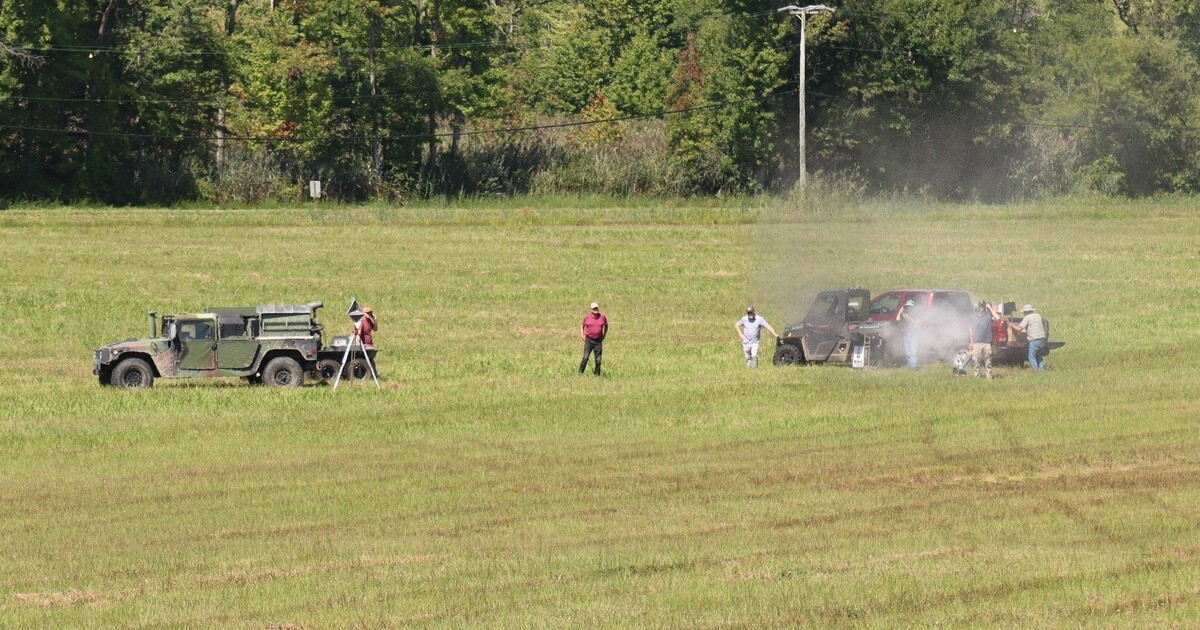
Hiding on the battlefield is becoming easier as the US Army Combat Capabilities Development Command Chemical Biological Center (DEVCOM CBC) tests a new smokescreen designed to shield soldiers from visual inspection, night vision, infrared sensors, and radar beams alike.Historically, the "fog of war" has been incidental rather than deliberate. When visibility on the field of conflict degraded, it was usually due to weather or heavy smoke from cannon fire, which generals often regarded as a nuisance, preferring a clear view of the battle in order to better deploy and move their resources.That attitude was swept away by the time the First World War broke out. By that time, weapons had become so precise and deadly in their effect that it was far better not to be seen, so an arms race developed between the observer and the observed. During the conflict, methods were developed to create thick clouds of impenetrable chemical smoke by burning heavy oil, titanium tetrachloride, and chlorosulfuric acid to hide trenches, infantry, and ships from enemy eyes.By World War II, obscuration techniques became standard operating procedures. Vaporized petroleum oils – known as "fog oil" – and engine exhaust systems protected entire fleets, seaports, and cities against enemy attack. The Cold War saw the development of vehicle-integrated smoke generators like the US M56 Coyote and M58 Wolf, as well as grenade launchers firing red phosphorus or hexachloroethane smoke mixtures.That was all well and good. However, though these chemical smoke screens could blind the eye and other devices using the visual or infrared spectra (and believe me, when a military smoke grenade goes off in your vicinity, you are really blind), radar beams could still see right through it. This is because radar operates on the millimeter scale of the spectrum and the smoke particles are simply too small to interfere with the beams.The US Army's Millimeter Wave Screening Obscuration Module (SOM) changes all that by mixing in thousands of specially coated carbon filaments or fibers. When these disperse into the air, they act as passive electrical dipoles on the same frequency as military radar systems. As the beam passes through the smoke cloud, the fibers absorb, scatter, and deflect it, causing the return signal to blur and drop below detection levels. Dr. Jill Harland (Left) and Michael Smith (Right) brief leaders during a recent live field demonstration on the development and functionality of the Millimeter Wave Screening Obscuration Module (SOM) and potential for integration with other technologiesPatrick Rodeheaver Field demonstrations of the SOM in August at the Aberdeen Proving Ground in Maryland were conducted in the open air using designated target signalers beaming fixed radar signatures to simulate battlefield radar reflections. The portable module dispersed about 30 lb (13.6 kg) of fibers, to evaluate how rapidly the cloud could suppress active radar tracking."Several targets or signatures were set up, and we had to obscure those targets," said Michael Smith, a mechanical engineer at DEVCOM CBC. "We used radar to observe the cloud formation and show the degradation of the radar signatures of each of those targets. As the cloud formed, the signature dropped, and we got our obscuration that way."Smith added: "Watching the radar screens during the live dissemination was a defining moment for the entire development team. Our objective is to buy Soldiers critical time on the battlefield; improving survivability directly accomplishes our core mission."Following successful technical validation, DEVCOM CBC officially transitioned the system to the Portfolio Management Executive for Chemical, Biological, Radiological and Nuclear Defense (PME CBRND), marking a key milestone toward delivering the capability to warfighters.The exact nature of the fibers is still classified, as is their toxicity, due to security protocols. That being said, protocols require such obscurants to undergo a full toxicological evaluation by the US Army Center for Health Promotion and Preventive Medicine (CHPPM) or the National Research Council (NRC) to set safety guidelines for military personnel during training and operations.Source: US Army
New Army smokescreen disables radar tracking, infrared and more
Full Article
Original Source
Read the full article at Newatlas →KhanList aggregates and links to publicly available news content. We do not host full articles from third-party sources. Always verify important information with original sources.