
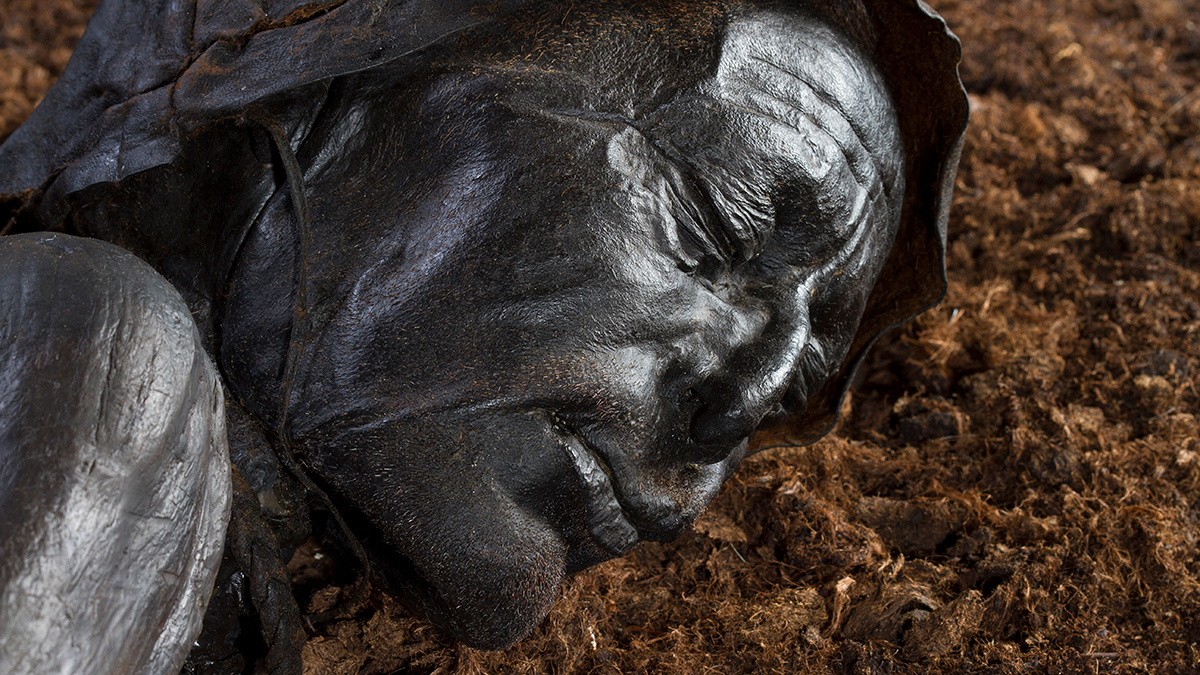
Content Warning: This feature contains discussion and images of ancient human remains. The study and display of mummies are deeply entangled with the history of colonialism and the commodification of human remains. Please proceed with discretion. On the frozen, windswept peaks of the Andes, conditions are not great for survival—not for humans or any other living things. Much of the mountains’ small amount of water is locked up as ice. High-speed winds present a physical pressure against easy movement. Each breath carries a fraction of the life-giving oxygen abundant at lower altitudes. The reduced volume and density of the entire atmosphere above mean the Sun’s damaging ultraviolet (UV) rays are more directly absorbed by everything they touch. When found by later generations, natural mummies seem to have a second life. Questions are asked, observations are made. Materials are sampled and analyzed. Traditions are remembered. History is uncovered. Conversations about cultural autonomy and legacies of colonial exploitation are deepened. Conditions are harsh but create a geophysical space where the rapidly ticking clock of biological decomposition is slowed and the sweeping clock of geology keeps time. The phenomenon of mummification has been encountered both knowingly and unknowingly by cultures around the world. Mummification is generally defined as the process in which extreme physical conditions such as aridity, freezing temperatures, or exposure to preservative chemicals slow the process of decay for biological remains—corpses. Like their more well-known siblings anthropogenic mummies (like those from ancient Egypt), ancestral remains preserved as natural mummies, sometimes called spontaneous mummies, preserve human stories. These unintentional mummies are part of the landscape, physically as well as culturally. When found by later generations, natural mummies seem to have a second life. Questions are asked, observations are made. Materials are sampled and analyzed. Traditions are remembered. History is uncovered. Conversations about cultural autonomy and legacies of colonial exploitation are deepened. Children of Llullaillaco As the oceanic Nazca Plate is subducted beneath the South American Plate, the folding landmass, captured ocean water, and molten magma contribute to the creation of the towering mountains and volcanoes of the Andes. The lower elevations of the Andes are richly habitable zones where people have made their home for more than 10,000 years. Near the summit of a dormant stratovolcano on the border between Argentina and Chile, some of the world’s best-preserved natural mummies have been found—the Children of Llullaillaco. Discovered and excavated from their burial site in 1999 by archaeologists Johan Reinhard and María Constanza Ceruti, the Children of Llullaillaco now rest in cryogenic preservation at Argentina’s Museo de Arqueología de Alta Montaña (MAAM). These three Incan children (between the ages of 5 and 13) were intentionally killed as part of a ritual sacrifice in the late 1400s, but their bodies were accidentally preserved by the geophysical idiosyncrasies of their burial site. In shallow graves, the bodies froze before significant dehydration occurred—in fact, researchers reported that their hearts still contained frozen blood. Llullaillaco abuts the Atacama Desert, one of the driest places on Earth. Additionally, the bodies were surrounded entirely by volcanic ash. This combination of cold temperatures and dry conditions preserved the bodies by freezing tissues as ice, wicking away any additional moisture, and preventing the rapid growth of microbes both inside and outside the remains. Study of the Children of Llullaillaco contributed to a better understanding of ancient but still-remembered ceremonies called capacocha. In these months-long Incan rituals, children were selected to be sacrificed for an afterlife in which they would look down from the mountains to protect and guide their community. From these summits, some of the most consequential natural phenomena arise—snows and rains, rockslides, shade and light, and habitats for plants and animals. “It is important to note that, although the Capacocha ceremony took place during the Tawantinsuyu or Inca Empire, Andean culture transcends the Inca Empire itself and remains alive to this day,” wrote Mario Bernaski, director of MAAM, in an email to Eos. Indigenous communities initially objected to the extraction of the Children of Llullaillaco. Local archaeologists and anthropologists were generally not involved in the expedition, and the Indigenous Colla communities were not consulted. One Colla community filed a lawsuit alleging that their rights had been violated. Before the Children of Llullaillaco went on display at MAAM in 2005, Argentina’s Indigenous community continued to voice their opposition. “Llullaillaco continues to be sacred for us,” said Rogelio Guanuco, the late leader of the Indigenous Association of Argentina. “They should never have profaned that sanctuary, and they should not put our children on exhibition as if in a circus.” Even Reinhard seemed to begrudgingly agree at the time, telling the Washington Post, “I’d much prefer that they not be displayed, just because of all of the headaches.” The remains are displayed, however, and to ensure they are handled in a culturally respectful way, the museum says it has built relationships with different Indigenous communities in Argentina, particularly the Collas Unidos Community of San Antonio de los Cobres and other organizations active in the Salta–Puna region of the country. “Today, the communities actively participate in numerous cultural initiatives at the museum,” Bernaski wrote, “contributing their music, languages, stories, ceremonies, experiences, and traditional knowledge. They also share knowledge related to weaving, pottery, singing with a caja drum, copla (traditional folk songs), and other artistic expressions that form part of the Andean cultural heritage.” Expanded space for the Colla community at MAAM does not address the core concern for many in that community, however: The display itself is a form of desecration. Many Indigenous leaders advocate for cultural representation without the display of human remains. The place itself is the heart of the Andean cultural experience, Bernaski wrote. “The extreme environmental conditions that made the extraordinary preservation of the Children of Llullaillaco possible…continue to characterize the lives of many communities in the Puna region.” “The extreme environmental conditions that made the extraordinary preservation of the Children of Llullaillaco possible—the high altitude, low temperatures, low humidity, and stable climate—continue to characterize the lives of many communities in the Puna region,” he explained. “This environment influences their production methods, ways of living, migration patterns, celebrations, beliefs, and cultural practices that persist to this day.” “Our goal [at MAAM] has never been to speak on behalf of the communities,” he wrote, “but to create spaces where scientific knowledge respectfully engages with Andean traditions, memory, and worldview.” European Bog Bodies Unlike the Children of Llullaillaco, northern Europe’s so-called bog bodies were preserved not through the absence of moisture, but through its overwhelming presence. Hundreds and even thousands of these accidental mummies have been found throughout Scandinavia, as well as the British Isles, Denmark, Germany, and Poland. “The typical sequence [of bog formation] is sort of a pond or a lake that’s filled in by wetland vegetation,” explained Merritt Turetsky, an ecosystem ecologist at the University of Colorado Boulder and author of the new book Bogland: The Secret World That Defies Death and Protects Life. “Then come sedges, rushes, bracken grasses, shrubs, and willows, and then come the mosses, and that’s what forms these bogs.” Peat will form, said Turetsky, as long as plant productivity is greater than microbial decomposition. Peat is “an organic soil largely consisting of dead organic matter and visible plant remains,” explained Line Rochefort, director of the Peatland Ecology Research Group at Université Laval in Canada, to the New York Times in 2022. “Peat accumulates, and is not deposited by water or ice or wind.” Peat bogs are naturally acidic, and many are anaerobic—they lack sufficient oxygen to support a community of microbe decomposers. This makes them an excellent medium for preserving organic material. Peat, the first step in the formation of coal, is also a long-familiar source of fuel in places like County Galway, Ireland, where peat is being harvested in this bog. Credit: Peter Gorman/Flickr, CC BY-NC-SA 2.0 As peat itself decomposes, it releases humic acid, also known as bog acid. Humic acid inhibits the growth of bacteria, mold, and other microbes that would otherwise contribute to the process of decay. Many bog bodies were discovered in bogs dominated by sphagnum moss in particular. The thick abundance of these tiny plants prevents almost any circulation of water, contributing to the preservation of organic material. In addition to being acidic, many peat bogs are anaerobic—they lack sufficient oxygen to support a community of microbe decomposers. The oldest bog body in Europe (Denmark’s Koelbjerg Man) is a collection of skeletal bones dating to the end of the last ice age, but most bog bodies date to the Iron Age and include startlingly well-preserved flesh and facial features, discernible quaffs of hair, animal skin and textile clothing, wood and metal jewelry, and wood, stone, bone, and iron tools. Grauballe Man is a bog body dating to the 2nd century BCE and unearthed in a Danish peat bog in 1952. His hands were so well-preserved that scientists were successfully able to fingerprint him. Credit: Malene Thyssen/Wikimedia Commons, CC BY-SA 3.0 Scientists who have carefully excavated and analyzed bog bodies have found that like the Children of Llullaillaco, bog bodies preserve the remains of men and women who often met a violent end: hanging, strangulation, blunt-force trauma, or stabbing. They may have been sacrifices, but these bog bodies were often buried with care, attention, and respect. Some were buried with grave goods, including metal jewelry and wood and metal weapons. Though the context of their deposition is not known, their very presence attests to the importance of peat bogs from prehistoric to contemporary use. “Peatlands have taught us perhaps more about human history than any other. They’re storytellers about Earth’s history. They’re storytellers about early human societies.” “What I’ve learned from colleagues who call themselves bog archeologists,” said Turetsky, “is that bogs were actually working landscapes. People maybe didn’t live in the bogs, but they lived in the drier forested areas, islands interspersed with bogs. They raised their cattle and their animals by foraging in the bogs.” Throughout the industrial era, of course, peat bogs have continued to be working landscapes: Peat—the earliest step in the formation of coal—has been consistently harvested as a source of fuel. Today, as more nations work to reduce their carbon emissions, peatlands are still important to communities and businesses. On a global scale, they are a key site of carbon sequestration: Accounting for only 3% of the world’s landscape, they store twice as much carbon as all the world’s forest biomass combined. For industry, peat has become a lucrative soil additive that helps soils increase moisture. “Peatlands have taught us perhaps more about human history than any other [landscape],” Turetsky said. “They’re storytellers about Earth’s history. They’re storytellers about early human societies.” Windover Bog Bodies Peatlands exist far beyond Europe. They can be found in tropical climates such as Southeast Asia and Africa’s Congo Basin, as well as subtropical ecosystems like the peat swamps of Florida—the site of American bog bodies. While Europe’s peat bogs are largely dominated by sphagnum moss, Florida’s peat swamps have more varied vegetation, including cypresses (inland) and mangroves (coastal). They are usually less acidic than bogs, as they are fed by mineral-rich surface and groundwater as well as precipitation. Like bogs, however, forested wetlands are poorly drained. Organic material, such as leaves, wood, and roots, is unable to fully decompose and instead accumulates as peat at the bottom of swampy ponds. Scientists think the more than 150 bog bodies discovered at the Windover site in eastern Florida are part of an ancient cemetery. Unlike most European bog bodies and the Children of Llullaillaco, the remains at this site are of people who seem to have died from accidents or natural causes, not intentional harm. They were carefully buried with grave goods, including bone tools and woven fabrics. The Windover remains are generally much older than other accidental mummies, dating to the North American Archaic Period, about 8,000 years ago. “To us, this is where our ancestors were laid to rest,” said Tina Marie Osceola, the historic preservation officer of the Seminole Tribe of Florida. “It was a pond cemetery,” said Ben Brotemarkle, executive director of the Florida Historical Society, to WFTV news earlier this year. “They cared for their loved ones and buried them with care….They were wrapped in the oldest woven cloth found in North America.” The Windover remains were discovered in 1982. In the following years, the swamp was drained, and the bodies were extracted and examined. Although the remains are skeletal, many retain brain tissue, which underwent an early form of DNA analysis. The scientific analysis preceded the landmark 1990 Native American Graves Protection and Repatriation Act (NAGPRA). NAGPRA requires that Indigenous communities be a part of any extraction or analysis of human remains or cultural items. It also requires agencies to repatriate or transfer Native American remains to the appropriate parties (to be determined by consultation with “lineal descendants, Indian Tribes, and Native Hawaiian organizations”). NAGPRA is not an administrative requirement, nor is it a hindrance to science. It is a recognition of tribal sovereignty and stewardship. As such, the Seminole Tribe of Florida is pursuing repatriation of the ancestral remains at Windover under the auspices laid out by NAGPRA. The tribe is working with Florida State University on a plan for preservation and research as well as, ultimately, a return of the bodies to the tribe. The cooperative effort reflects a larger movement among the Seminole community, one using the motto “no more stolen ancestors,” which seeks the repatriation of thousands of Seminole artifacts from museums such as the Smithsonian Institution. The Iceman The peaks of the southern European Alps rise kilometers and ecosystems away from bogs and swamps. The mountains’ temperature, elevation, rockiness, and impassibility occasionally allow for an icy state of preservation, however. In fact, the Alps are home to one of the best-known natural mummies in the world: Ötzi, the Iceman. Although he was initially thought to be the victim of either an accident or an extreme winter storm, later analysis revealed he was, in fact, the victim of severe violence: shot in the back by a flint arrow. His body had endured other injuries (a blow to the head, a cut to the hand), but ultimately, he likely bled to death within a matter of minutes and came to rest in a rocky gully in the Ötzal Alps. Ötzi, who died at around 45 years old around 3250 BCE, was famously discovered by tourists hiking in the Alps in 1991. This life-size reconstruction of the Iceman shows some of the associated material that was unearthed with his body: leather clothing; leather shoes insulated with grasses; a belt with a pouch (visible on his behind) that contained a scraper, drill, flint flake, bone awl, and dried fungus; and a flint dagger. The weapon in his right hand is an unfinished longbow. Credit: © South Tyrol Museum of Archaeology The unusual site of Ötzi’s discovery allowed for preservation. The location of the site was vigorously debated between Austria and Italy, and the conditions of his preservation remain a subject of debate. One theory is that Ötzi died in early autumn where he was found—a rocky, nearly snow free gully. Freezing temperatures and dry winds quickly dehydrated his corpse. A relatively short time later, a glacier blanketed the mountain, but the protective walls of the gully prevented Ötzi’s body from being crushed or transported. His positioning allowed his body to remain intact and his goods close by. “The preservation of the body is based on the fact that he was found at 3,200 meters altitude, in a cold and also dry climate—because the Schnalstal Valley is one of the driest valleys in the Eastern Alps,” explained Andreas Putzer, curator at the South Tyrol Museum of Archaeology in Bolzano, Italy, where Ötzi’s body and gear are preserved and displayed. Another theory holds that Ötzi died much earlier in the year, when the gully would almost certainly have been filled by snow. This theory posits that Ötzi died in a nearby valley and his body and goods were transported by a thin ice field (not a basally sliding glacier) in a centuries-long series of freeze-and-thaw processes. “What we discovered is that the body was first dried out, and then he lay in water. [And] he has melted up completely a few times in the last 5,000 years,” Putzer explained. “That’s what we know from the analysis on the tissue of the Iceman, but how this happened and why it happened, it’s difficult to glean.” “If you have an emotional connection to what happened a few thousand years ago, you are able to connect these people that lived thousands of years ago in the area.” Alpine hikers famously stumbled upon Ötzi’s remains peeking out of the ice in 1991. Weather prevented the body’s extraction for nearly a week, but his gear (leather clothing, iron and wooden weapons, containers, and a copper ax) hinted that the remains may not be that of a modern mountaineer. Scientists were quickly able to deduce that the remains dated to Europe’s Copper Age, and later genetic analysis revealed that a handful of living Austrians are related to the Iceman. Moreover, the traditions preserved in Ötzi’s 5,000-year-old remains are startlingly recognizable to contemporary Alpine communities. “The geomorphology of the valley is very particular,” Putzer explained. “It’s a very steep terrain, and it’s still today worked by farmers under these hard conditions. So the connection to this Alpine area of the local people is alive still today as it was in the past.” Although genetic analysis revealed that he himself was lactose intolerant, it is likely that Ötzi was part of a goat-herding community. His well-preserved cloak and leggings are made of goat leather, and analysis of his stomach contents revealed that his last meal likely contained goat jerky. The dairy industry remains a vital part of Alpine communities today. Putzer initially excavated close to an Alpine farm, “and the farmer was interested,” he said. “When we discovered that the find site was connected to Alpine dairy and to Alpine farming, he was very proud of that—that we were excavating on his ground the first settlers of the valley. So, if you have an emotional connection to what happened a few thousand years ago, you are able to connect these people that lived thousands of years ago in the area.” Putzer believes Ötzi holds relevance beyond the Alps. Much like modern cultures, Copper Age peoples were forced to respond to a changing climate. “In the past, it was other factors that changed the climate,” Putzer noted. “But that’s why we are still on Earth, we are able to adapt very fast to changes in a global view, but also in a small territory.” The Saltmen of Iran Thousands of kilometers from Ötzi’s icy mountaintop, Iran’s Chehrabad salt mines have created a different sort of natural mausoleum. For millennia, miners excavated the crystal rock salt of the Douzlākh salt deposit near Chehrabad. What had once been an exposed outcropping of salt became a recess of salt, then a cave of salt, and, ultimately, a network of deep salt tunnels and centuries of debris. Chehrabad is in a tectonically active region of Iran, and these salt tunnels are especially unstable. Intermittent tunnel collapses killed workers trapped there, and the hygroscopic nature of salt whisked moisture from their bodies, killing internal bacteria that would otherwise have broken them down. The mummies are not as intact as other examples; some are skeletal, some were damaged in the initial mining accidents, and all were continually crushed over centuries. Still, from the hair of their beards to the leather of their shoes, the “Saltmen” (which include at least one woman and one teenager) are nearly as recognizable as when they set out to work thousands of years ago. Saltman 1, whose desiccated head still has flowing hair and a beard, was presumably killed in an accident at the Chehrabad salt mine in what is now Iran in the 8th century BCE. Credit: Haleh Brooks, CC BY-NC-SA 4.0 The Saltmen represent the continuity of Persian salt mining traditions, not a single community. The oldest body dates from the Achaemenid Empire, and the youngest dates to the Sasanian Empire nearly a thousand years later. The mummies were discovered during the first mechanized excavation processes at Chehrabad in 1994. Prior to that, excavation at the site was largely carried out using handheld tools similar to those found with the Saltmen: woolen ropes, iron picks, adzes, chisels, and knives. The Saltmen’s clothing was also familiar, most notably durable leather trousers and boots. One of the Saltmen still wore a gold earring. Another carried a leather bag of salt. Salt, originally used as table salt but primarily used for deicing roads in the last century, continued to be mined at Chehrabad until the mid-1990s, when the site became protected under Iranian cultural heritage laws. Serendipitous Preservation Natural mummies, whether discovered on mountaintops or in murky depths, are a testament to the fundamental relationship between the human experience and the conditions of our planet. The question of stewardship of ancestral remains continues to evolve. The United Nations Educational, Scientific and Cultural Organization (UNESCO) considers remains to be part of a region’s “moveable cultural property” and includes some naturally preserved remains as part of its World Heritage List. The United Nations Declaration on the Rights of Indigenous Peoples maintains that Indigenous communities have the full “right to the repatriation of their [ancestors’] remains” and that countries “shall seek to enable the access and/or repatriation of ceremonial objects and human remains in their possession through fair, transparent and effective mechanisms developed in conjunction with Indigenous peoples concerned.” Communities are informed by their geography—“geography is destiny,” according to one aphorism. Natural mummies make this adage practical if not pretty. The International Council of Museums’ Code of Ethics for Museums outlines several ways museums and other cultural institutions should engage with ancestral remains, always considering the “interests and beliefs of the community, ethnic or religious groups from whom the objects originated.” The Vermillion Accord on Human Remains, adopted by the World Archaeological Congress in 1989, forced archaeologists to reconsider the Western tradition of so-called mummy studies and influenced the passage of NAGPRA. The accord calls for “respect for the wishes of the local community and of relatives or guardians of the dead,” as well as respect for scientific study. Unlike NAGPRA, these accords and codes are largely unenforceable guidelines, not rules. The UNESCO document is a recommendation, for instance, while the Declaration on the Rights of Indigenous People is, like all UN declarations, not a legally binding treaty. Communities are informed by their geography—“geography is destiny,” according to one aphorism. Natural mummies make this adage practical if not pretty. Hundreds if not thousands of Incan traditions were defined by the Andean landscape and survive in the Children of Llullaillaco. The Seminole believe that “if the land dies, so will the Tribe,” making conservation and repatriation of the Windover skeletons a vital concern. Mines that yielded salt for Cyrus the Great continue to provide for the people of Iran. European bogs are reservoirs of an agrarian past as well as an ongoing legacy of fossil fuel. And occasionally icy Alpine hillsides have provided agricultural sustenance for centuries. Earth’s dynamic nature creates countless worlds in which life can thrive and occasional ones in which life can’t. Natural mummies reveal how humans have adapted to a remarkable range of natural environments, creating cultures as distinctive as the landscapes they inhabit. —Andrew Howley, Science Writer; and Eos Citation: Howley, A., and Eos (2026), Natural mummies hold memories of life and land, Eos, 107, https://doi.org/10.1029/2026EO260309. Published on 1 October 2026. Text © 2026. The authors. CC BY-NC-ND 3.0Except where otherwise noted, images are subject to copyright. Any reuse without express permission from the copyright owner is prohibited.
Natural Mummies Hold Memories of Life and Land
Full Article
Original Source
Read the full article at Eos →KhanList aggregates and links to publicly available news content. We do not host full articles from third-party sources. Always verify important information with original sources.