
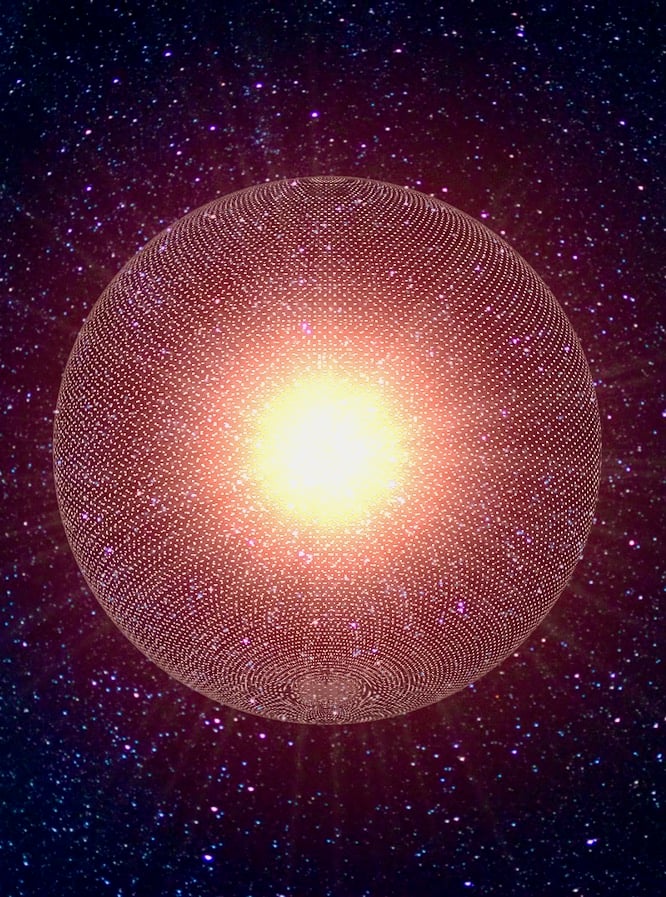
The latest Swedish-led search for technosignatures in the form of Dyson Spheres has again come up empty-handed. The two latest stellar candidates in the hunt for such hypothetical extraterrestrial technology have been eliminated as Dyson Spheres. Project Hephaistos, an Uppsala University-led initiative, used NASA's James Webb Space Telescope to observe two new Dyson Sphere candidates. The Webb telescope took imaging and spectroscopy of two M-dwarf stars, as noted in two papers recently submitted to the journal Monthly Notices of the Royal Astronomical Society (MNRAS). Dyson spheres are hypothetical megastructures constructed around stars to harvest radiation energy, possibly for the purpose of powering habitats, vessel propulsion, computing or transmitting long-range signals, the MNRAS authors note. The primary technosignature of such structures is the waste heat emitted, usually assumed to be detectable as excess radiation in the infrared, they write. Most of such putative waste heat emissions would show up in the mid-infrared spectrum. We find that the infrared excess does not originate from Dysonian megastructures, or other radiation mechanisms close to these stars, but from background galaxies projected to be within an arcsec of the M dwarfs, the MNRAS papers’ authors write. One has a mid-infrared spectrum consistent with being a Hot Dust Obscured Galaxy (Hot DOG), they note. The other galaxy has what the authors call an extended morphology with bright knots and a spectrum consistent with a dusty starburst, they note. These latest results point out the extreme difficulty of looking for techno signatures of any sort. That is, whether they be from super advanced Kardashev III or IV-type civilizations capable of harnessing whole galaxies, or a Kardashev I- or II-type civilization, capable of harnessing the energy of a single star. This is follow-up with the Webb telescope to observe two stars that we identified in a survey of some one million stars within about 1000 light years of Earth, Andreas Korn, a senior lecturer in astrophysics at Uppsala University in Sweden and a Project Hephaistos team member, told me in Stockholm. That survey was first conducted with the European Space Agency’s Gaia satellite as well as NASA’s WISE (Wide-field Infrared Survey Explorer) mission. The aim was to look for stars that have surprisingly low fluxes in the optical and surprisingly high fluxes in the infrared. As Korn notes, such a combination is seen as a potential technological signature of an extraterrestrial civilization, referred to in general terms as a Dyson Sphere. The two stars that were initially the most promising were an estimated few billion years old; relatively faint M dwarfs stars of around 15th magnitude. Nothing that you can observe with the naked eye, says Korn. Eventually, even if you are using this Dyson Sphere energy to do computing, the energy will be transformed and emitted in the infrared as waste heat, says Korn. But this is the signature that we were looking for: a star that is a little bit too faint in the optical and has substantial amounts of waste heat in the infrared, he says. But what they found was a superposition of run-of-the-mill M dwarfs and two background galaxies. WISE gives us just a coarse image, and that's why the photons from the background galaxy and the M dwarfs were blended together so we couldn't tell them apart, says Korn. But with the Webb, we can tell the two apart and do a separate analyses, either from the galaxy or from the foreground M dwarf, he says. What’s Next? The most immediate problem in any future search is as the MNRAS papers’ authors note, a substantial fraction of the Project Hephaistos Dyson Sphere candidates appears to be contaminated by background galaxies. But proposed mid-infrared telescopes in the 2030s could provide higher-resolution data over wide areas, the authors write. So, there will be infrared surveys that have better spatial resolution coming online in the 2030s that may eventually solve that problem, says Korn. Another example of a partial Dyson Sphere. Credit: Kevin Gill/via Wikipedia As for the handiwork of civilizations capable of modifying whole galaxies? On a galactic scale, astronomers would look for objects that again are unexpectedly fainter than expected in a manner that can’t be explained by known, completely natural astrophysics. The idea of Dyson Spheres around main sequence stars remains an intriguing concept. But would a planetary system even have enough raw material to build such monstrosities? A Dyson Swarm You don’t have to build a solid structure; a Dyson swarm of satellites could fulfill the same purpose, says Korn. It would collect less energy than a solid sphere, but it could still collect more energy than available on a planetary scale, he says. If such hypothetical Dyson satellites were orbiting the star in a manner that would be detectable, this would lead to some variability in the target star’s luminosity. The Bottom Line? There are many sources of variability in the physical world, but if you see that there was a periodicity to the variability, then you could potentially constrain the morphology of an artificial mega structure, says Korn. Sources: Andreas Korn MNRAS paper MNRAS paper
NASA’s Webb Telescope Rules Out Two New Dyson Sphere Candidates
Full Article
Original Source
Read the full article at Universetoday →KhanList aggregates and links to publicly available news content. We do not host full articles from third-party sources. Always verify important information with original sources.