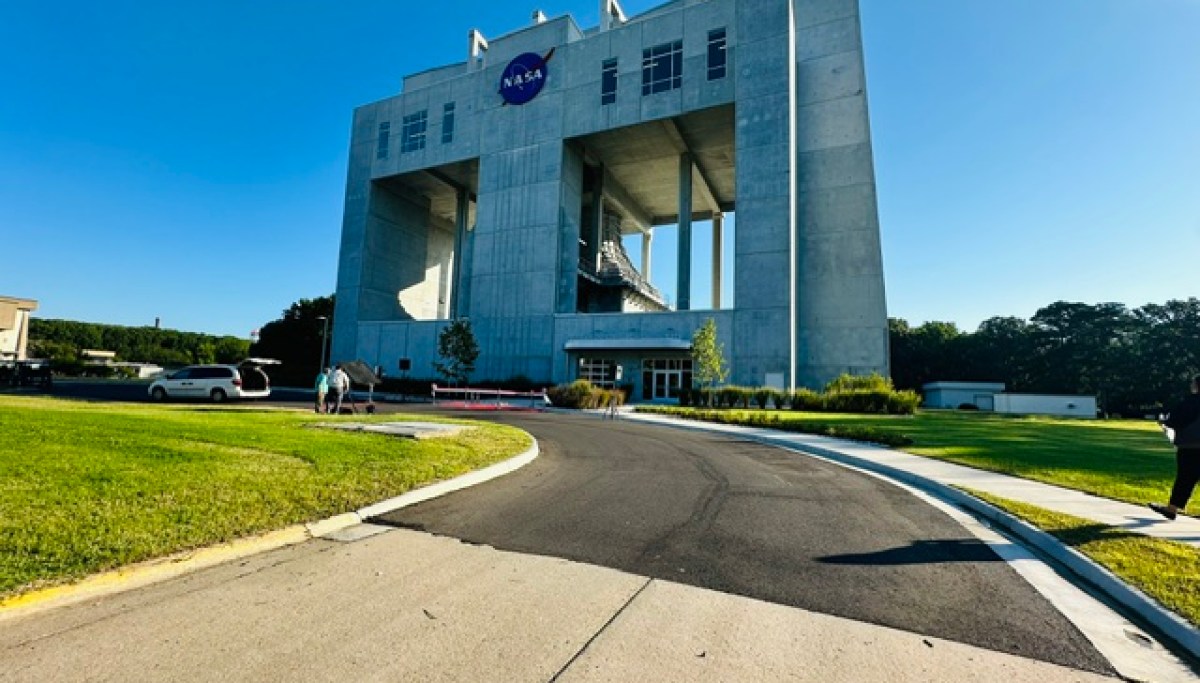
HAMPTON, Virginia — NASA ushered in a new era of flight research Friday with the opening of a state-of-the-art wind tunnel at its Langley Research Center in Hampton, Virginia, marking the agency’s first major new wind tunnel facility in more than four decades.NASA Administrator Jared Isaacman and other federal and local leaders, including Virginia Democratic Lt. Gov. Ghazala Hashmi, Sens. Mark Warner (D-VA) and Tim Kaine (D-VA), Rep. Bobby Scott (D-VA), and U.S. General Services Administration Administrator Edward Forst, were among those who attended a ribbon-cutting ceremony marking the completion of the 25,000-square-foot Flight Dynamics Research Facility.The $57 million facility is designed to support a broad range of research, from autonomous drones and experimental aircraft to spacecraft returning from the moon and future missions to Mars and beyond. “The Flight Dynamics Research Facility, the first NASA wind tunnel in over 40 years, makes a revolutionary step forward in how we test everything from aircraft to spacecraft,” Trina Dyal, director of NASA Langley Research Center, said during the ceremony. “The researchers right here at NASA Langley Research Center will use this tool to ensure that we can have safer flight and continue to push the boundaries of exploration into the next century.”The FDRF replaces two aging facilities at Langley: the 20-Foot Vertical Spin Tunnel and the 12-Foot Low-Speed Tunnel. By combining the capabilities of the two facilities into a single structure, NASA says the new wind tunnel will provide greater performance while reducing maintenance and operating costs.Isaacman said the facility represents a broader effort to make sure NASA’s resources are directed toward future missions rather than maintaining aging infrastructure.“You don’t want to have so much of your budget maintaining the past that comes with the expense of the mission of today and tomorrow,” Isaacman said. “This is a perfect example of doing the right thing, consolidating a handful of capabilities that we have into a brand-new facility.”Langley has been at the center of NASA’s wind tunnel research for nearly a century. The center once housed seven of NASA’s 12 wind tunnels, and its work in aeronautics dates to 1929, when the agency’s predecessor, the National Advisory Committee for Aeronautics, built a 5-foot vertical wind tunnel at the facility.That early work established a foundation for decades of research into aircraft design, flight dynamics, and aeronautical technology at Langley.But the center’s wind tunnel infrastructure and workforce have faced uncertainty in recent years. The Trump administration in 2025 proposed closing five unspecified wind tunnels and significantly reducing Langley’s workforce as part of a broader plan to cut NASA’s overall budget by roughly one-quarter. Congress largely restored the agency’s funding in January.Warner, who has been critical of the Trump administration, praised Isaacman’s leadership but said NASA also faces the challenge of rebuilding expertise lost as employees have left or been laid off.“It’s been rough the last year-plus for federal employees, and we lost too many folks at NASA, some of the best colleagues,” Warner said. “The fact that we are now rebuilding that, bringing more people in, is, I think, an enormous benefit.”Isaacman also demonstrated the facility during the ceremony, donning black safety goggles and launching a scaled-down model of the Artemis program’s Orion spacecraft into the tunnel to showcase how researchers can study a vehicle’s behavior in flight.NASA Administrator Jared Isaacman launching a scaled-down model of the Artemis mission’s Orion space capsule into NASA’s newest wind tunnel, demonstrating its operation at the Flight Dynamics Research Facility in Hampton, Virginia, on July 31, 2026. (Barnini Chakraborty/Washington Examiner) The FDRF is a large, subsonic vertical wind tunnel designed to allow researchers to study how aircraft and spacecraft behave in flight, including their stability, controllability, free-fall characteristics, spins, and spin recovery.Its vertical test section measures 20 feet in diameter and 24 feet high, and the tunnel can generate airspeeds ranging from 0 to 117 mph. That range gives researchers the ability to test a variety of vehicles and flight concepts under controlled conditions before they are put to the test in the real world.One of the facility’s most important roles will be supporting NASA’s return to the moon and its longer-term goal of sending humans to Mars.Researchers will use the FDRF to test technologies associated with entry, descent, and landing — some of the most challenging and consequential phases of any space mission. The facility will allow NASA to evaluate how vehicles behave as they descend through an atmosphere, helping researchers identify potential problems and reduce risks before those systems fly.For NASA, that could mean testing technologies needed for future spacecraft returning to Earth from the moon, as well as concepts that could eventually support human missions to Mars.But the FDRF is not just about space travel.The facility is also intended to help NASA address a rapidly changing aviation industry, as researchers pursue new aircraft designs and increasingly autonomous flight systems.Researchers will use the tunnel to study advanced aircraft concepts, autonomous flight vehicles, drones, and experimental X-planes. It will also support research into advanced air mobility, including emerging concepts such as air taxis.NASA CHIEF SAYS AGENCY AIDING BLUE ORIGIN EXPLOSION INQUIRY: ‘WE CAN’T SLOW DOWN’The facility’s opening comes as NASA and the broader aerospace industry face growing demands to develop aircraft that are safer, more efficient, and increasingly capable of operating with limited or no direct human control.By bringing capabilities once spread across multiple aging facilities under one roof, NASA Langley officials say the FDRF will give researchers a modern platform for testing the next generation of aircraft and spacecraft — from drones flying over Earth to vehicles designed to carry humans deeper into the solar system.
NASA cuts ribbon on first new wind tunnel in more than 40 years
Full Article
Original Source
Read the full article at Washingtonexaminer →KhanList aggregates and links to publicly available news content. We do not host full articles from third-party sources. Always verify important information with original sources.