
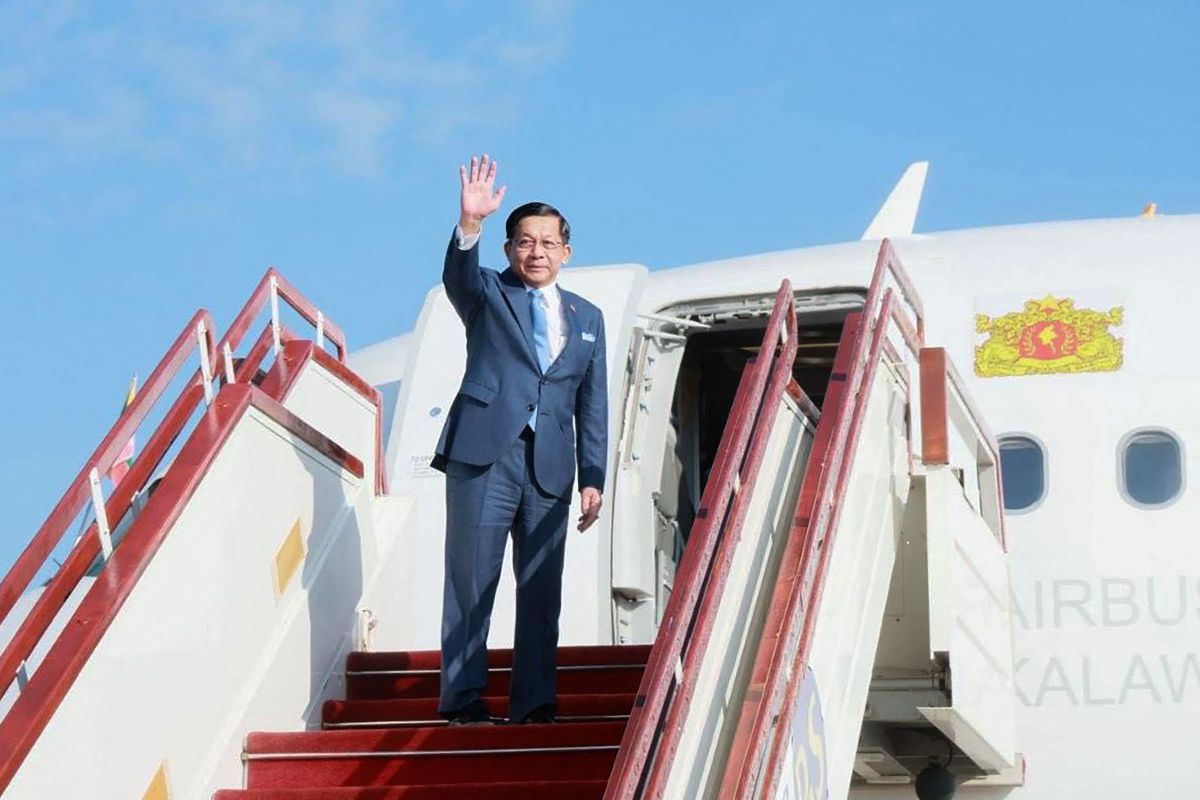
Myanmar’s coup regime leader Min Aung Hlaing will head to Malaysia on Wednesday for a two-day visit, officials said, following Kuala Lumpur’s plan to return thousands of Myanmar immigrants. The visit comes after a group of nearly 1,500 returnees reached Myanmar on Sunday, with rights groups warning Rohingya refugees could be among those sent back. Malaysia said about 5,000 Myanmar nationals have agreed to “voluntary” return, but authorities have not commented on the ethnicities of those who have returned. Prime Minister Anwar Ibrahim “will hold talks with President Min Aung Hlaing on key bilateral issues, including the voluntary, dignified and safe repatriation of Myanmar nationals of all ethnic groups who have been in Malaysia illegally,” Malaysia’s Foreign Affairs Ministry said on Tuesday. “The Leaders are also expected to review the ongoing efforts undertaken under the ASEAN mechanisms” for peace in Myanmar, the ministry said in a statement. Earlier on Tuesday, Anwar told the Malaysian parliament he and other top Malaysian officials “will raise issues towards a solution.” Growing hostility Naypyitaw has repatriated nearly 10,000 migrants from Malaysia this year, its state media said on Monday. Anwar said Myanmar had to “guarantee proper treatment to their own people so that there is no abuse, oppression and violation of human rights.” “But for me, any country that wants to bring back their people from our country, we welcome that,” Anwar said. The Malaysian visit will be among Min Aung Hlaing’s most diplomatically significant since ASEAN leaders froze out Myanmar’s junta following the 2021 coup and ensuing civil war. But Anwar said last month he would welcome the Myanmar leader to expedite migrant repatriations. “I want to tell him that we can be friends and trade. We can accept Myanmar, but they must accept [their refugees] back,” Anwar said during a podcast interview. The repatriation plan follows what Malaysia’s human rights commission has called “growing hostility, discriminatory rhetoric and online attacks” against the Rohingya in Muslim-majority Malaysia. Malaysia hosts more than 215,000 refugees and asylum seekers registered with the United Nations refugee agency, including more than 126,000 Rohingya from Myanmar—its largest refugee community. The UN and rights groups have raised concerns about the repatriations, with monitors fearing the Rohingya could face a new wave of abuses in Myanmar, where they are denied full citizenship. Rights advocates view Min Aung Hlaing as the primary architect of a crackdown against the group, starting in 2017, which is being weighed by the International Court of Justice as potential genocide. ‘No time to return’ Myanmar this month pledged “safe and dignified” returns for its citizens displaced abroad. Myanmar is also riven by violence, with 50 killed last week in a military airstrike on a marketplace in western Rakhine State. “This is no time to return anyone forcibly to a country plagued by egregious human rights violations and abuses,” UN rights chief Volker Turk said last week. Min Aung Hlaing ousted the elected government of Nobel laureate Aung San Suu Kyi in February 2021, plunging Myanmar into a civil war that has killed more than 100,000 people, according to monitor ACLED. Since elections that were widely dismissed as a charade, Min Aung Hlaing became civilian leader and launched a drive for regional recognition. ASEAN has frozen Myanmar’s top leaders out of its summits since the coup over a lack of engagement with its roadmap to end the civil war. After 2021, the bloc presented a united front, demanding Myanmar engage with its five-point plan to bring peace through dialogue between all sides. But analysts have warned the consensus is now fracturing, with some ASEAN nations now welcoming Min Aung Hlaing. Malaysia will be the fifth nation of the 11-member ASEAN bloc—following Thailand, Laos, Vietnam, and Cambodia—to welcome him since taking up the presidency. He has also visited China—which previously backed him behind the scenes, according to analysts—as well as India and Russia. A decade of reporting at a cost In 2025, we marked the 10th anniversary of Myanmar Now. In Myanmar’s history, journalists are often the first targets during political repression. We founded this outlet during a brief window of stability, starting with a small team in a modest office in downtown Yangon. Our goal was simple: to report on injustices that had been silenced for decades. In many countries, justice is sought through courts and police. In Myanmar, these institutions have historically been instruments of oppression. From the start, we committed to reporting without discrimination—regardless of ethnicity, religion, or citizenship. We believe our work should be accurate, deeply sourced, and strong enough to serve as a historical record. We also believe journalism should be a force for positive change, and that our primary readers should be the people of Myanmar. That belief came at a cost. Members of our team and others associated with Myanmar Now have endured long legal battles, physical assaults, arrests, and torture. Despite these hardships, Myanmar Now continues to report the news—thanks to the resilience of our team, the courage of our sources, and the trust of our readers. Please subscribe to support a free press in Myanmar.
Myanmar junta leader to visit Malaysia after migrant returns begin
Full Article
Original Source
Read the full article at Myanmar-now →KhanList aggregates and links to publicly available news content. We do not host full articles from third-party sources. Always verify important information with original sources.