
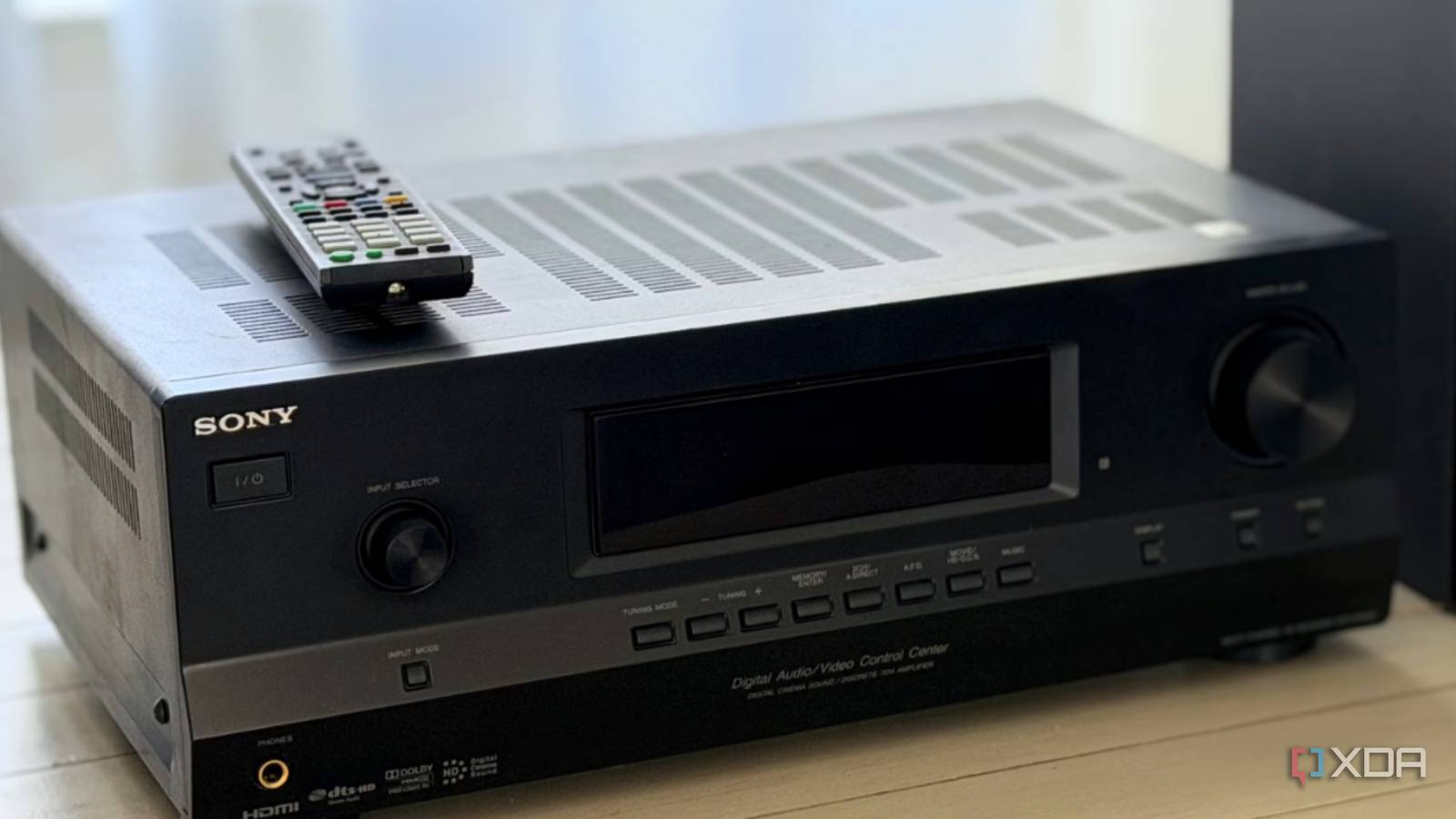
Published Sep 24, 2026, 6:00 PM EDT Maker, meme-r, and unabashed geek, Joe has been writing about technology since starting his career in 2018 at KnowTechie. He's covered everything from Apple to apps and crowdfunding and loves getting to the bottom of complicated topics. In that time, he's also written for SlashGear and numerous corporate clients before finding his home at XDA in the spring of 2023. He was the kid who took apart every toy to see how it worked, even if it didn't exactly go back together afterward. That's given him a solid background for explaining how complex systems work together, and he promises he's gotten better at the putting things back together stage since then. I've had a Sony STR-DH520 driving the same pile of speakers since 2011, and every time I test a new soundbar, I land on the same conclusion. It's not even close, and you can buy a used AV receiver for the price of a cheap soundbar to hear it for yourself. A real center channel, real surrounds, and a subwoofer I can park wherever the room likes. It beats beamforming tricks and up-firing drivers. But something has been quietly going wrong with that setup, and it isn't the amplifier. Put a modern TV in the middle of it, and suddenly Netflix sounds like stereo, DTS vanishes, and your console insists it's outputting 2.0. The easy answer is to blame eARC, plug everything into your TV's eARC port, and move on. That's part of it, but the real problem starts a step earlier. Modern TVs have made themselves the center of your home theater And ARC was never built to carry that much Fifteen years ago, the receiver was the hub. The Blu-ray player, console, and cable box all plugged in; it decoded the audio, and it passed the video along to the TV. That still works, right up until you want 4K. Receivers from that era have HDMI 1.4 ports and an old version of HDCP, the copy protection every device in the chain has to support, so they can't pass protected 4K content at all. HDR, 4K at 120Hz, and VRR are out too, so if your console runs through an old receiver, your PS5 is probably plugged into the wrong HDMI port. So you do what everyone does. The sources go into the TV, and the audio comes back to the receiver over HDMI ARC. Sound & Vision recommends that exact workaround, and it's where the compromises begin. ARC eARC Introduced HDMI 1.4 (2009) HDMI 2.1 (2017) Multichannel PCM No, stereo only Up to 8 channels, 24-bit/192kHz Dolby TrueHD, DTS-HD MA No Yes Dolby Digital, DTS, DD+ Yes (lossy) Yes ARC can carry two-channel PCM, compressed Dolby Digital and DTS at 5.1, and Dolby Digital Plus on TVs that support it, but nothing lossless. eARC fixes that, but both ends need to support it, and a 2011 receiver doesn't. My STR-DH520 at least has plain ARC. Some receivers from that era don't, which leaves you on optical, a 40-year-old AV standard that's killing your surround sound with the same lossy ceiling and no CEC. The kicker is that the STR-DH520 already decodes Dolby TrueHD and DTS-HD Master Audio over its four HDMI inputs. It was a $229 receiver in 2011, and it can handle lossless formats just fine. The formats aren't the problem. The return path is. Your TV is quietly deciding what your receiver gets to hear It's not only an eARC problem If ARC's bandwidth were the whole story, you'd at least get a solid lossy 5.1 out of everything. You often don't, because the TV sits in the middle and decides what to pass along. DTS is the obvious casualty. LG dropped DTS in 2020, brought it back in 2023, and removed it again from 2025 models like the C5 and G5, whose EDID no longer lists DTS. Samsung owners have been complaining about the lack of DTS since the 2018 Q9FN. If the TV doesn't accept DTS, your player falls back to something else, and your receiver never sees a track it could have decoded just fine. Dolby Digital Plus is sneakier. My STR-DH520 happens to decode it, but most receivers sold before 2012 can't. When a streaming track has a standard Dolby Digital core, the TV can pass it through as 5.1. When it doesn't — which is increasingly common with Atmos streams — the TV decodes it and downmixes it to stereo PCM. That's the likeliest reason your favorite show suddenly sounds flat. Consoles have their own quirks. A PS5 set to Linear PCM gives you stereo over ARC. Switch it to Dolby Audio, and you get real 5.1, but compressed to around 640 kbps. An Xbox can encode Dolby Digital or DTS on the fly for ARC, which is better, but it's still lossy. And then there's the setting where almost nobody checks. If the TV's digital audio output is set to PCM, it downmixes everything to two channels, regardless of what the source sends. Some TVs also pass 5.1 from their built-in apps but only stereo from external HDMI inputs, which can feel random. It isn't random. It's the TV. You don't need a soundbar to fix this; you need a small box The receiver was never the weak link Soundbar makers love this situation, because their answer is eARC in one box with one cable. To be fair, that's a real advantage. A modern soundbar decodes Atmos, handles CEC volume control, and pulls lossless audio out of the TV without any fuss. My STR-DH520 can't do Atmos; it has no room correction, and no adapter changes either. But it still pushes 100W into each of seven channels, with a proper center channel, real surrounds, and a separate subwoofer, and a soundbar has to fake at least one of those. The fix is to grab the audio before the TV mangles it. An eARC audio extractor connects to the TV's eARC port and hands the audio to one of the receiver's regular HDMI inputs, so the receiver treats it like any other source. The OREI BK-927 is $80 on sale and passes 7.1 PCM, TrueHD, and DTS-HD MA untouched. The HDFury Arcana 2 costs $349, but its COPY output feeds older receivers a downscaled 1080p stream with full audio and adds CEC volume control. If you'd rather not buy anything, set the TV's output to passthrough or bitstream, set your console to Dolby or DTS, and accept lossy 5.1. It's the same compromise as optical, but it beats stereo by a mile. You can also plug a Blu-ray player directly into the receiver and enjoy 1080p for movie night. Your old amplifier is still good, but the connectivity standards changed The amplifier didn't age out. HDMI did, and TVs took full advantage. If your receiver still sounds great, don't let a TV's audio menu talk you into a soundbar. Check that output setting, spend $80 on an extractor, and keep the speakers you already love.
My 15-year-old AV receiver still outperforms every new soundbar, but modern TVs broke something
Full Article
Original Source
Read the full article at Xda-developers →KhanList aggregates and links to publicly available news content. We do not host full articles from third-party sources. Always verify important information with original sources.