
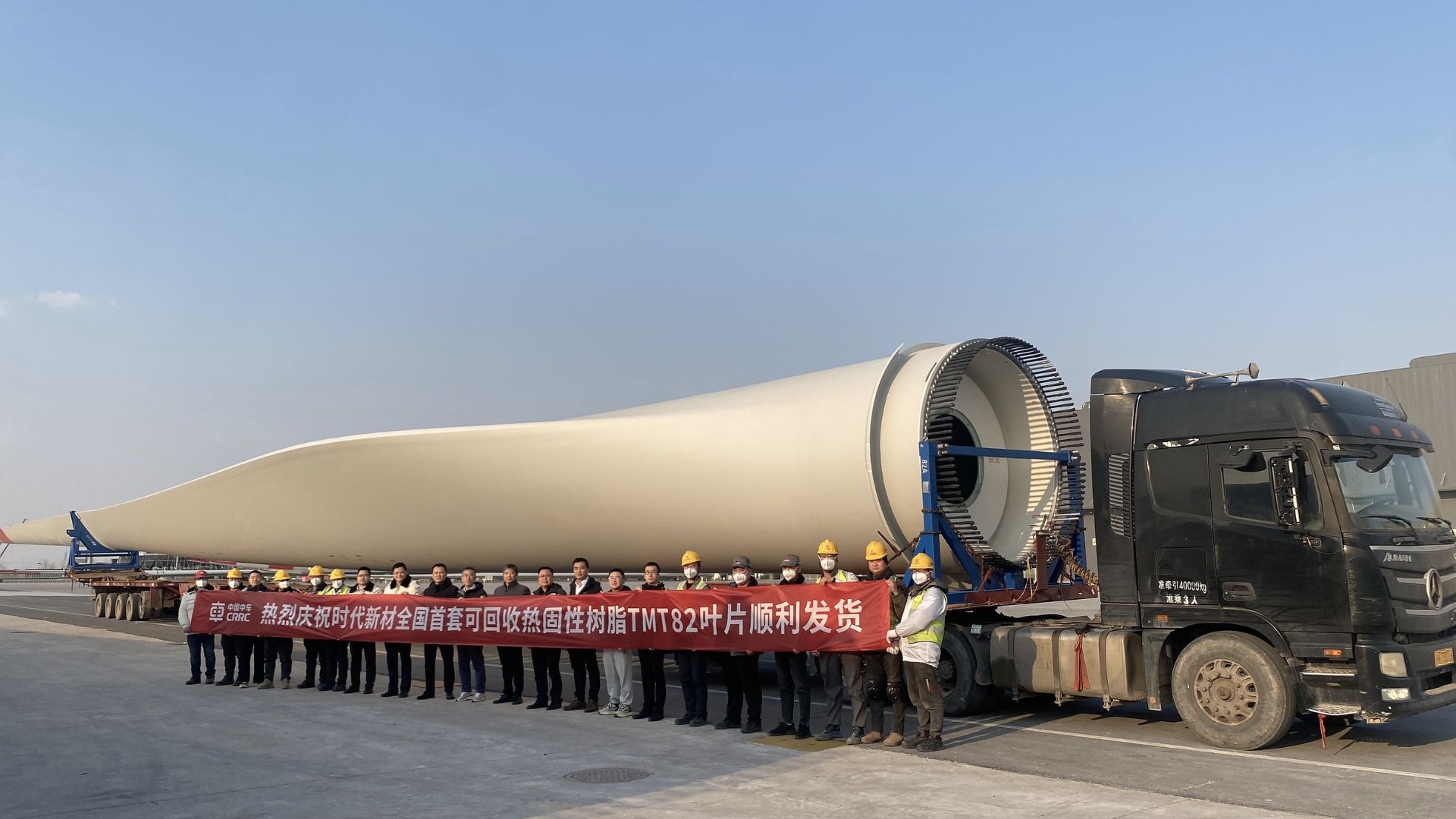
A Chinese company has completed production of a 360 feet recyclable wind turbine blade. Developed by CRRC, the blade achieves a recovery rate exceeding 95% for key raw materials.The milestone marks a significant step toward the commercial-scale recycling of ultra-large wind turbine blades and provides a solution for managing blades at the end of their service life. Blade represents breakthrough in both materials and recycling technology CRRC revealed that the blade represents a breakthrough in both materials and recycling technology. It uses a recyclable material system centered on a high-efficiency, debondable infusion resin. While fully meeting the demanding performance requirements for high strength, stiffness and fatigue life, the blade uses reversible chemical debonding technology to separate the resin efficiently from the reinforcing fibers. Once recovered, materials including the resin and fibers can be reused in wind equipment, automotive manufacturing, infrastructure construction and other high-value applications. This moves wind turbine blades beyond the traditional “single-use” model, enabling closed-loop recovery and high-value reuse of their constituent materials, according to CRRC. Recyclable blade system can support efforts to meet sustainability The recyclable blade system can support customers’ efforts to meet international sustainability objectives and reporting obligations, including those under the EU’s Corporate Sustainability Reporting Directive (CSRD). It is also well suited to high-capacity offshore wind turbines and combines safety, environmental performance and cost-effectiveness. Together, these advantages strengthen CRRC’s position as it brings its offshore wind equipment to international markets and competes in the global renewable energy sector, according to a press release.CRRC claims its new blade uses a recyclable material system based on a high-efficiency, debondable infusion resin. The technology is designed to allow the resin to be separated from reinforcing fibres through reversible chemical debonding.This approach is significant because conventional wind-turbine blades rely heavily on composite materials that are engineered for strength and durability. Those characteristics make the blades suitable for decades of operation but can also make them difficult to dismantle and recycle once they reach the end of their useful lives.CRRC estimates that more than 470 GW of new onshore and offshore wind installations could be added in the coming years. At the same time, the company says that more than 30,000 wind turbines in China could be retired by 2030, representing approximately 44.73 GW of capacity and generating about 947,900 metric tons of wind-related solid waste.Last year, CRRC said it had developed China’s first TMT82 recyclable thermoset-resin blade. The company described the technology as using reversible chemical bonds to facilitate the depolymerization and separation of resin and fibres while maintaining the mechanical properties required for wind-turbine operation.The 360 feet blade is also aimed at the requirements of high-capacity offshore wind turbines.Offshore projects increasingly use larger turbines because greater rotor size can increase electricity generation from each installation. However, transporting, maintaining and eventually decommissioning components of this scale presents additional logistical and environmental challenges.Get the latest in engineering, tech, space & science - delivered daily to your inbox.Prabhat, an alumnus of the Indian Institute of Mass Communication, is a tech and defense journalist. While he enjoys writing on modern weapons and emerging tech, he has also reported on global politics and business. He has been previously associated with well-known media houses, including the International Business Times (Singapore Edition) and ANI.
360 feet recyclable wind turbine blade built, achieves 95% recovery rate for key raw materials
Full Article
Original Source
Read the full article at Interestingengineering →KhanList aggregates and links to publicly available news content. We do not host full articles from third-party sources. Always verify important information with original sources.