
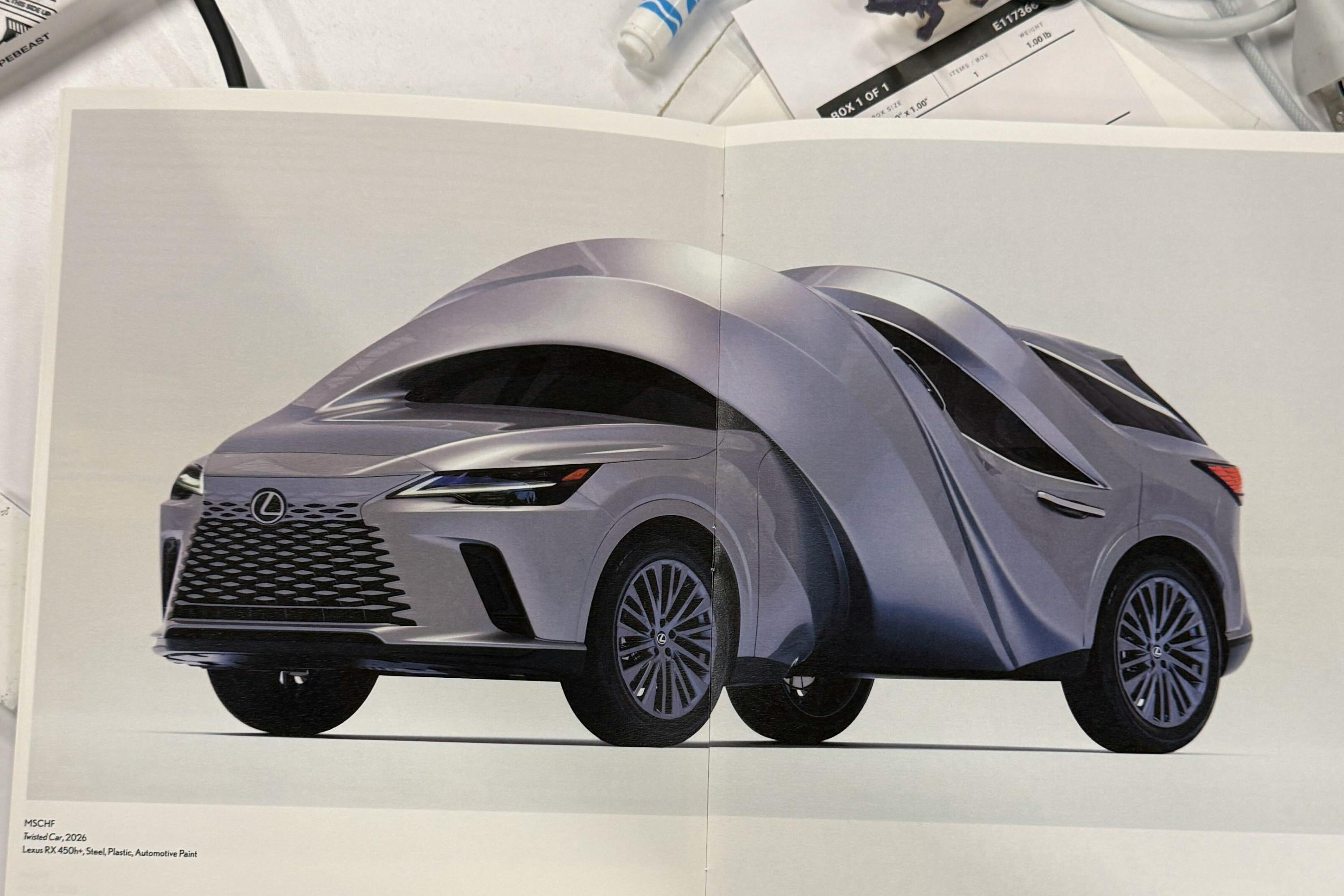
The Brooklyn-based art collective MSCHF knows how to stunt. Its massive red rubber boots made Astro Boys out of all who wore them, while its literally microscopic handbag — smaller than a grain of salt, and modeled on a Louis Vuitton Speedy (with Pharrell’s blessing) — felt fit for Zoolander. Each product that the group puts out is tailor-made to disrupt, but there’s more to MSCHF than a tendency toward virality. The group may be cheeky, sure, but it takes a masterful understanding of form to break every rule it bends. Just look at its literally bendy Motomorphosis collaboration with Lexus as proof. The collective got hold of the automaker’s electric RZ 450e and RX 450h+ models, then twisted, stretched, and bent them into sculptural forms fit for a museum. The end result — appropriately, if dryly, titled Twisted Car and Circle Car — is exactly what you might expect from an entity as subversive as MSCHF.Ahead of the public unveiling of the sculptures at Chelsea Industrial this Thursday as part of New York’s Armory Week, we caught up with MSCHF’s Chief Creative Officer and founding member, Kevin Wiesner, to talk form, function, and the backward-facing 1973 car on their moodboard. This interview has been condensed and edited.Your Highsnobiety privacy settings have blocked this Instagram post.How many rounds did it take to land on these two specific shapes for the cars?MSCHF's work often features the formal vernacular of shapes and transformations native to digital processes. In this case, operations like twisting, stretching, and bending are part of a standard 3D program language that results in impossible objects: digitally native, but physically absurd.Within the automotive industry, you have a recognizable format: the “Concept Car”— sometimes quite far from reality — as future-casting or exploration. We had the idea of inverting the Concept Car and taking a purely Formalist approach to the object. There’s a rich history of car-as-medium artworks in the US, so works like Pippa Garner’s Backwards Car also inspired us.What was the production process like? Even though the shapes are unorthodox, car customization takes a lot of expertise. The finishing, paint, and overcoat on the sculptures follow the same kind of process you'd see in most auto body shops — thank god for Bondo! The sculpture's shape, of course, diverges heavily from a standard car. Starting with a steel armature, we then join thousands of individual pieces like LEGOs to form the skin.As with so many things MSCHF does, we’re consciously trying to use existing processes — but to make a different type of object than the industry norm. The biggest challenge is joining these processes at scale and making the final sculptures transportable for installation.Are they functioning cars, so to speak?Some pieces in Twisted Car and Circle Car use actual Lexus car parts, but they’re sculptures, not cars. The Lexus philosophy of Electric Made Art treats electrification as an artistic medium. In our everyday lives, electricity is a basic utility — from overhead lighting to toasters — that recedes into the background and is taken for granted. Lexus seeks to redefine this and pursue the polar opposite mission: What if electricity could make us feel something? What effect are you aiming for with these sculptures? Pure shock and awe?Part of what makes this fun is we’re able to show MSCHF’s sculptures alongside the actual Lexus cars — the viewer understands the before and after. Taken together, the show becomes about reinvention, defamiliarization, and the willingness to experiment. Highsnobiety has affiliate marketing partnerships, which means we may receive a commission from your purchase. Want to shop the products our editors actually love? Visit our SHOPPER page and subscribe to the newsletter for recs on all things fashion, footwear, and beauty.
MSCHF’s Next Hot Product? A “Physically Absurd” Lexus (Exclusive)
Full Article
Original Source
Read the full article at Highsnobiety →KhanList aggregates and links to publicly available news content. We do not host full articles from third-party sources. Always verify important information with original sources.