
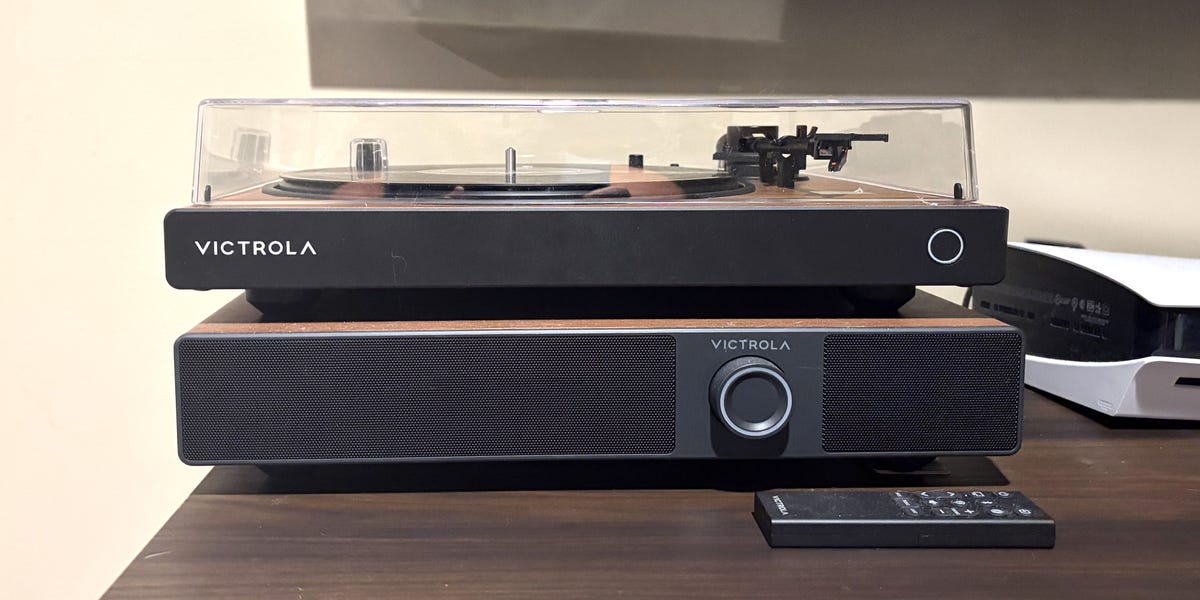
4 min readVictrola’s latest release, the Soundstage, is effectively a hybrid soundbar you can stack your turntable on. The space-saving design makes it easier to use a classic record player in tight spaces. We got a chance to test the Soundstage to see if it’s worth the over-$300 price tag. Victrola has been around forever. It’s probably one of the more well-known turntable brands out there, though not necessarily the best. Many other brands in the space have been more than disruptors—they’ve overtaken it altogether. But Victrola is still a major player, and even more so, an innovator. This is especially true with its Bluetooth models, which are among the best in the biz. But that’s not where it ends.While audiophiles will sing the praises of vinyl, one obvious issue has always been their bulk, especially in the 21st century. This has led to the natural evolution of music listening: boomboxes, Walkmans, iPods, etc. But a good record player still provides the purest sound, and there’s a reason they’re still in millions of modern homes. Finding the requisite space isn’t always easy, especially in a smaller apartment like mine, but Victrola recently released something that seemed to at least mitigate a generally unfixable flaw: the soundstage.The soundstage works just as it “sounds.” It supplements a pair of speakers and acts as a “stage” for your turntable; the name says it all. You can stack the devices to save space, or connect it wirelessly in a separate location. In essence, it’s the turntable version of a TV soundbar. But it’s a little pricey—$329, to be exact. The real question, though: does it work as intended? Let’s find out.First Impressions of the Victrola SoundstageIts design certainly stands out, especially its legs, in particular. They help keep the stage from slipping, which matters if you do choose to stack it. Anyone with a record player knows this also serves a pretty critical performance function; if your turntable isn’t stable, your record will skip. I learned this the hard way. Still, it was about as sturdy as you could imagine. It also features a walnut finish (the style I went with) or a sleek, all-black colorway. Both give off old-school home theater vibes.Tim KohutThe speaker has a digital display on the front and a single knob for volume control that doubles as a one-click on/off button—simple enough. Most of the plug-ins are in the back, and the device does a great job of making it look as clean as possible. That said, you don’t have many connections to worry about. You’re looking at a standard AC power adapter, a standard RCA connection, a USB-C port, a dedicated subwoofer output, and some optical inputs. Since my turntable has a built-in pre-amp, I have two connections going right now—the RCA wires connecting the two devices and the power cord. That’s it.You can go even more minimalistic—the Soundstage features Bluetooth wireless streaming and Auracast if you want to go full wireless. This is especially relevant if you want to put your speaker somewhere other than your turntable. I also didn’t realize it at first, but not only can the Soundstage work with virtually any type of turntable (it doesn’t have to be a Victrola, but there is a bundle deal that allows you to save $100 on the highly compatible Wave), you can connect it to your PC, TV, laptop, or phone.Surround Sound Quality PerformanceThe space-saving angle was basically the whole selling point for me, but if the sound quality isn’t great, then the product is pointless. Since I was stacking the two, I stuck with the classic RCA connection. Two wires are included: a shorter RCA connector and a longer one with a ground wire. When I used the shorter wire, the background music was dull and nearly inaudible. When I switched to the longer one, everything returned to normal. It might have been a faulty wire, but at least I confirmed it wasn’t an output issue.Tim KohutAs for the actual sound quality, I was genuinely impressed. The sound traveled well. Like a typical TV soundbar that mimics surround sound, I got crystal-clear, 360 audio that filled the room without two separate bookshelf speakers for adequate coverage. The device uses what’s called Balance Mode Radiators (BMR) to disperse audio in all directions at once, modeled after natural stereo sound. At the same time, the Soundstage’s down-firing Symmetric Drive Woofer (SDW) uses two opposing subwoofers that cancel out the other’s vibrations and double down on bass. The stereo-quality sound was further amplified (pun intended) with simple three-level bass and treble settings. I like to go a little heavier on the bass, and it worked like a charm without affecting sound quality.And while I don’t plan on using the Bluetooth connectivity in my current setup, I did give it a test run. I didn’t really have room to place them far apart, so I switched modes via the remote (I later found out you can also do this with a quick click of the main power button). I’m not a true audiophile, but from a layman’s perspective, the sound quality didn’t suffer. Admittedly, I didn’t get a chance to play around with its Auracast function, which would require additional speakers to create a pseudo-localized sound network. I was pretty confident, though, based on its Bluetooth component, that it would be a similarly seamless process.Final ThoughtsAll things considered, the Soundstage was a hit. I do think it’s a little pricey for what it is, but it’s worth the investment if you’re sorely lacking space for a full wired record player setup. A pair of high-quality bookshelf speakers will probably run you around $300 anyway, so there’s not much downside there. It’s pretty versatile and even looks great as a standalone decorative piece if you go wireless. If you are looking to go full-on Bluetooth, I’d probably suggest getting a smaller, portable Bluetooth speaker for about half the price. But for me, I have it on my dresser, underneath my TV, and without it, there’d be no way I could listen to any of my records the old-fashioned way—a tragedy in and of itself.Shop the Victrola Soundstage SoundbarTim Kohut is the Deals and Trends Editor for Popular Mechanics, Men’s Health, Best Products, and Runner's World. He has extensive product review and gear coverage expertise, particularly in tech, home, auto, and health. Tim was previously the Deputy Commerce Editor of The Drive and a Commerce Editor at BGR. He’s also overseen gear coverage and strategy at Popular Science, Bob Vila, Outdoor Life, and Field and Stream. He has a strong affinity for cats, Batman, and early 90’s Nicolas Cage films, in that order.
Victrola’s New Soundstage Is a Space-Saving Alternative to Classic Bookshelf Speakers, But Does It Warrant a $300 Price Tag?
Full Article
Original Source
Read the full article at Popularmechanics →KhanList aggregates and links to publicly available news content. We do not host full articles from third-party sources. Always verify important information with original sources.