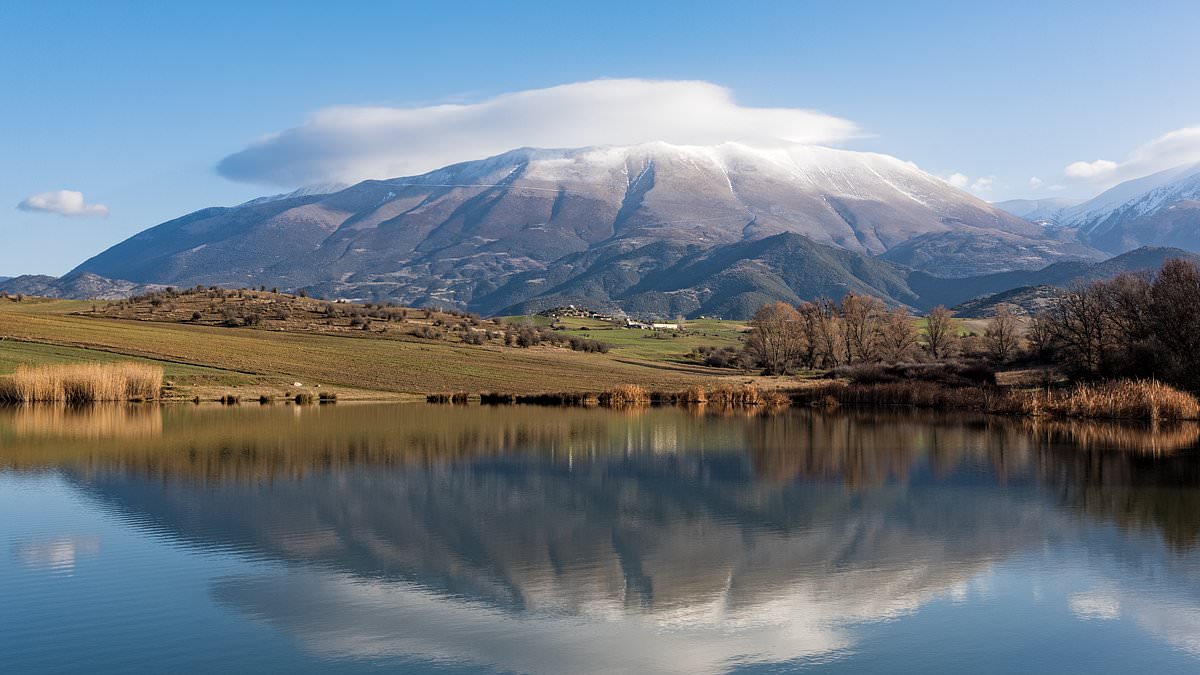
From the Taj Mahal to the Great Wall of China, there are plenty of jaw-dropping Unesco World Heritage Sites across the globe. Now, some impressive newcomers have managed to secure the prestigious status including Mount Olympus in Greece and the D-Day landing beaches in Normandy.Known for being the legendary home of the 12 Olympian ancient Greek gods, Mount Olympus has been crowned after a 12-year wait.The highest mountain in the country has been under consideration for the classification since 2014 and is central to Greek mythology.King of the gods Zeus was said to have made it his abode alongside other major figures like Hera and Athena.Aside from the mountain's mythical history, it stands as an impressive landscape in its own right – with glacial cirques, limestone cliffs, karstic sinkholes, among other features. Greek politician and head of Greece's Unesco delegation Georgios Koumoutsakos said: 'It reaffirms our unwavering commitment to safeguarding Mount Olympus for the benefit of present and future generation[s]. 'As Greek mythology wisely reminds us, it is always best to remain on good terms with the gods.' Mount Olympus, the legendary home to 12 Greek Gods, has been classified as a Unesco World Heritage Site Normandy's D-Day beaches, including Utah beach (pictured) also made the listAround 80km (50 miles) of Normandy's coastline has been included among the new Unesco World Heritage properties. Beaches including Utah, Omaha, Gold, Juno, and Sword, as well as Pointe du Hoc, are all vital sites associated with the D-Day Landings on June 6, 1944 and have been collectively recognised. The famous operation involved more than 156,000 Allied troops arriving on Normandy's beaches to carry out the largest seaborne invasion in history. Their brave actions began the liberation of Nazi-occupied France and helped turn the tide of the Second World War, ultimately contributing to the defeat of Nazi Germany in 1945.Nowadays, there are 'significant remains of the German Atlantic Wall, including casemates, artillery batteries, fire‑control posts, and resistance nests, alongside battlefield traces, original wartime equipment', according to Unesco.Other important landscapes include the American Cemetery at Colleville‑sur‑Mer.'Together, these elements form an exceptional cultural landscape shaped both by the events of 1944 and by their enduring remembrance,' Unesco stated.A total of 25 new properties have been added to the list, and others include the Ancient Capitals of Asuka and Fujiwara in Japan as well as the village of Sidi Bou Saïd in Tunisia. The Mount Amel Castles in Lebanon (pictured, Beaufort Castle) was one of the sites Unesco warned was 'facing major threats'However, Unesco has warned that six World Heritage sites are facing major threats. Three sites – the Boma-Badingilo Migratory Landscape in South Sudan, Mount Amel Castles in Lebanon, and Sebastia in State of Palestine – were inscribed following an emergency procedure. The Boma-Badingilo Migratory Landscape holds significance for being the largest known terrestrial mammal migration site in the world. 'Several ethnic groups' have also been custodians of the land for 'centuries and even millennia' according to Unesco.But the site has been inscribed on an emergency basis due to the threat of 'infrastructure development, commercial poaching, and wildlife trafficking and trade, which directly affect the large populations of migratory mammals'.The Mount Amel Castles in Lebanon are made up of five castles that were developed between the medieval period and 19th century. Despite being granted enhanced protection in 2024 by Unesco's Committee for the Protection of Cultural Property in the Event of Armed Conflict, the organisation has warned that the site 'is currently suffering heavy damage'.'According to the Committee, the ongoing conflict directly jeopardizes the site's conservation and requires urgent intervention,' Unesco said. Sebastia holds archaeological records of successive occupation from the ninth century BCE. Sebastia, in the State of Palestine, was also inscribed following an emergency procedureUnesco has raised concerns over the planned creation of the 'Samaria' national park which it said 'could divide the property,' as well as ongoing conflict in the Middle East. Another three sites that were already on the World Heritage List have also been moved onto the List of World Heritage in Danger.These include the Ancient City of Tauric Chersonese and its Chora in Ukraine.'The Committee noted with the deepest concern that, due to the Autonomous Republic of Crimea (Ukraine) being temporarily occupied by the Russian Federation, the State Party is unable to ensure the site’s protection or guarantee its conservation or management,' Unesco said. The Historic Inner City of Paramaribo in Suriname was another site, which was highlighted due to some construction projects being carried out without consideration of recommendations or the impact on the heritage of the area.Tyre, in Lebanon, is one of the oldest cities in the world and Unesco raised concerns over ongoing hostilities in the country 'posing a threat to the property'.'The Committee urged all parties involved in the hostilities to refrain from any action that could further damage the property and to respect their obligations under international law,' Unesco said.
Mount Olympus and D-Day beaches among new Unesco World Heritage sites - as six locations face 'serious threats'
Full Article
Original Source
Read the full article at Dailymail →KhanList aggregates and links to publicly available news content. We do not host full articles from third-party sources. Always verify important information with original sources.