
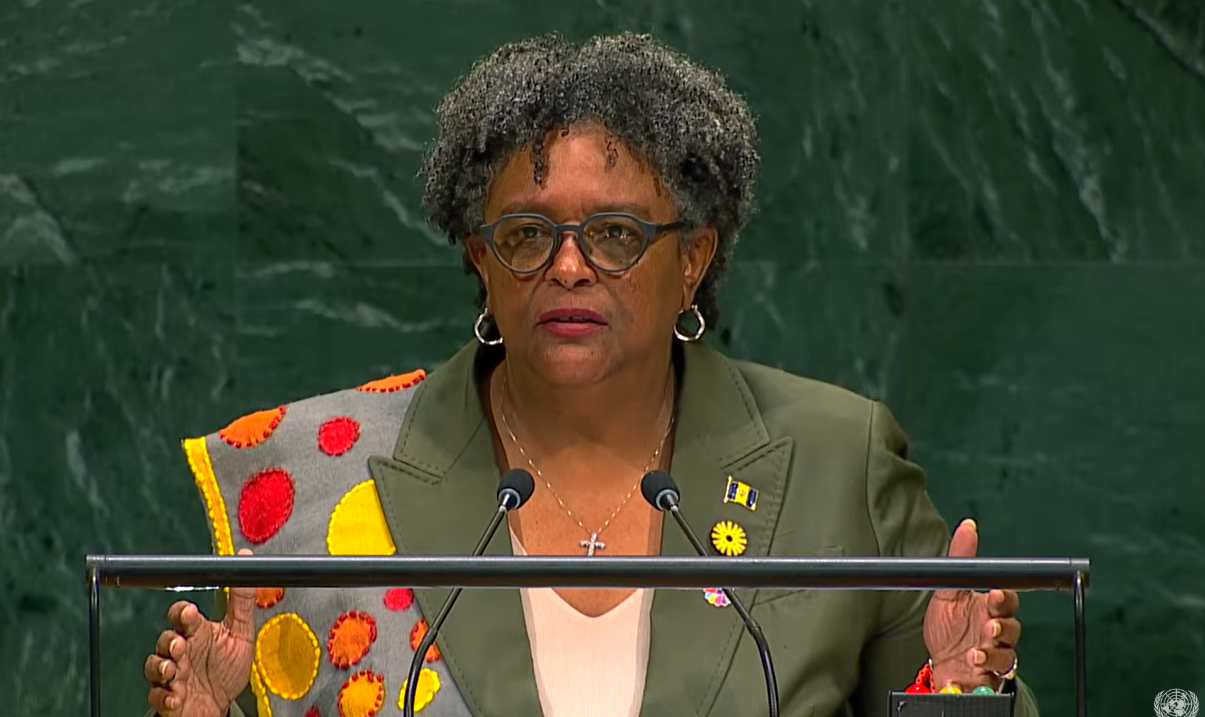
Prime Minister Mia Mottley addressing the UN General Assembly on Thursday. (Photo Credit: File photo) Climate-vulnerable countries face an annual financing shortfall of about US$400bn by 2030 while being forced to pay billions more in borrowing costs because of their exposure to climate shocks, Prime Minister Mia Mottley has warned. Addressing the UN General Assembly, Mottley said vulnerable countries needed to mobilise approximately US$490bn annually by the end of the decade, compared with current financial flows of US$9bn. “As the young people in Barbados would say, the math simply ain’t mathing,” she declared. The Prime Minister said the financing gap was being compounded by the higher cost of borrowing faced by countries already struggling with the effects of climate change. “We must also correct the inequity of the borrowing costs that these countries face,” she said. “It is almost 1.2 percentage points higher for climate-vulnerable countries than for advanced economies. You Might Be Interested In “Now that figure seems small to you, but that actually generates an estimated $62bn more a year in excess interest payments each year. “This cannot be fair.” The Prime Minister used the figures to reinforce her argument that the international financial system continued to disadvantage vulnerable countries, particularly when they sought financing to strengthen resilience and invest in development. Against that backdrop, she noted efforts being undertaken through Barbados’ presidency of the Climate Vulnerable Forum and its V20 group to improve access to affordable, long-term financing. Among them was the Vulnerability to Viability Compact, developed with the OPEC Fund for International Development and launched with the involvement of 74 countries and 16 development finance institutions. The initiative aims to expand access to affordable, long-term capital for projects in areas including education, health and water infrastructure. Mottley also highlighted the Lifeline Fund, which she said would “shortly be operationalised”. “It seeks to provide rapid liquidity when climate shocks create balance of payments pressures for countries,” she explained. “So we are moving to help ourselves.” Mottley said access to longer-term financing was critical if vulnerable countries were to make the investments necessary to strengthen their economies rather than repeatedly struggle to recover from shocks. “We have been resolute, and the reason for it is that we know that you cannot build hospitals and schools and water infrastructure with 10- and 15-year money, “It crowds out critical investments for our people and leaves you flat-footed, and that is why this important initiative represents real progress.” But the Prime Minister cautioned that neither the compact nor other new financing mechanisms could solve the wider structural problems confronting vulnerable economies. “Mechanisms such as this one cannot on their own address the underlying flaws of the international financial architecture.” That argument has been central to the Bridgetown Initiative, through which Barbados has pushed for changes to the international financial system and greater access to affordable financing for vulnerable developing countries. Mottley said the past five years had reinforced the need to treat climate vulnerability, debt and financing as interconnected issues. “I repeat that for almost five years the Bridgetown Initiative has consistently argued that climate resilience, debt sustainability, and access to affordable finance cannot be treated separately. “For many vulnerable countries, the problem is not simply the availability of capital, but whether we have the fiscal space to borrow and to invest on reasonable terms.”
Mottley: Climate finance ‘math simply ain’t mathing’
Full Article
Original Source
Read the full article at Barbadostoday →KhanList aggregates and links to publicly available news content. We do not host full articles from third-party sources. Always verify important information with original sources.