
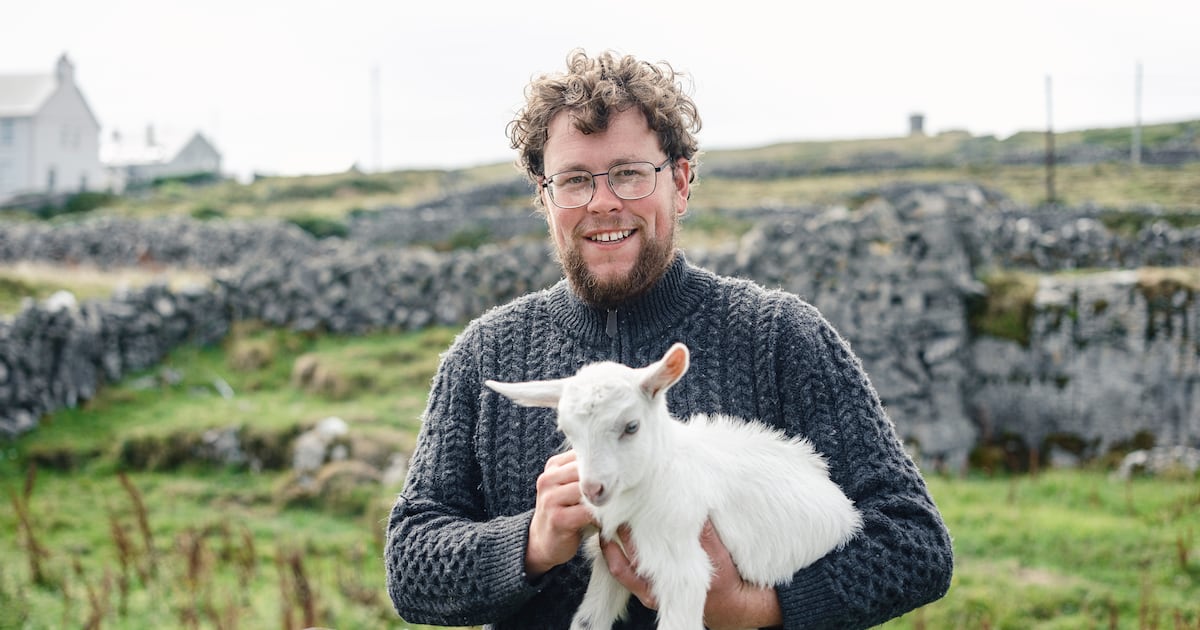
Under an agricultural scheme, Fionn Ó Flaithearta can be paid for targeted grazing and thriving wildflowersFionn Ó Flaithearta returned to Inis Mór in 2023, determined to make a go of it on his 100-hectare family farm. Photographs: Ciarán MacChoncarraige An enterprising Aran islander is combining ancient farming techniques with cutting-edge technology to make an income from renting out goats to protect the biodiversity of the island.Fionn Ó Flaithearta left his job on the mainland and returned to Inis Mór in 2023, determined to make a go of it on his 100-hectare family farm.Farming on the Aran Islands has never been easy. The harsh terrain, fragmented holdings and logistical challenges of island-living combine to make turning a profit on any farm almost impossible. However, Ó Flaithearta has a creative spirit and the willingness to try something different. Having previously built an on-farm cafe and sauna, this year he turned to goats as the next step in his plan for farm diversification. READ MOREGoats were once common on the Aran Islands and on small farms all over the west of Ireland. While they were useful on the farms, keeping briars, hazel and other nuisance plants at bay, they were often kept in horrible conditions.Inis Mór farmer Fionn Ó Flaithearta's goats. Photograph: Ciarán MacChoncarraige To prevent them from running away, goats were tied together with heavy ropes, which led to extreme discomfort and sometimes injuries. Due to animal welfare concerns, the practice of keeping the animals had almost completely died out on small farms over the past 30 years.This has led to a number of unintended consequences, including the proliferation of scrub in grasslands, which is threatening some of the most biodiverse meadows in the country.[ Howth Head becomes home to several kid goatsOpens in new window ]As they have not been exposed to intensive farming and the heavy machinery used on the mainland, the grasslands on the Aran Islands are among the most biodiverse in the country. Under the Acres agri-environmental scheme, introduced in late 2022, some farmers can be paid to use goats to eat the hazel, briars and other species threatening many wild flower-rich natural grasslands.Photograph: Ciarán MacChoncarraige To manage the goats without harming the animals, Ó Flaithearta has introduced the use of state-of-the-art GPS collars to his flock.These collars, which were developed in Scandinavia, allow him to create a virtual paddock for his goats using an app on his mobile phone.The virtual fence works in a similar way to many pet fences, with the goats receiving an audio warning when they get close to the fence line and a small electric shock if they go past it. “With these collars, they are happy out. They are so easy to use, whereas before [when ropes were used] you could see the goats were pulling at their legs and making it all worse for themselves. This is a lot better.”Photograph: Ciarán MacChoncarraige Under the Acres scheme, Ó Flaithearta can receive up to €1,768 per year for the targeted grazing of scrub with goats on his farm. He will also receive an increased payment for his fields should the goats succeed in promoting the growth of more wildflowers.He is taking the process even further by developing a second herd that he can rent out to his neighbours to help them control scrub without using herbicide. “I started with four goats a year ago, a puck [male goat] and three goats, and I have had a few kids over the course of this year. So I am expanding,” he says.“I have a good bit of scrub and briars to keep up with myself, so the plan is to keep two herds on the go, one for my own briars and one that I can rent out to the neighbours.“Goats are clever animals, so the newer ones pick up what to do from the older ones really quickly. The older ones teach the others.”Donal Hogan is the regional manager for Acres Burren Aran. He believes the reintroduction of goats in this way could significantly boost biodiversity in some of Ireland’s most sensitive and pristine habitats.“Out on the Aran Islands they have really species-rich grasslands, so we want to push the bushes back so the grasses and all the wildflowers can bloom and seed,” he says.“The problem is that, once the hazel takes over, the area slowly turns into woodland over time. Woodland is a habitat too but, when we can, we really want to protect and promote the species-rich grassland.“The goats don’t kill the scrub, but they fully defoliate it. So rather than the briar using all of its energy to spread and put out seed, it has to put all of its energy into growing leaves again. So that keeps it under control.Like many farmers in environmentally sensitive areas, Ó Flaithearta is considering transitioning to organic farming. The goats will be an essential part of that transition, as he will no longer be able to use herbicides to control nuisance plants on his land. “No one has the time of day to be cutting back briars with strimmers,” he says.“I am noticing changes on my land but it will take a bit of time.” The goats are reducing the scrub but Ó Flaithearta knows it is a slow process. It could take three to five years to fully see the results. “The goats can be working away in the background keeping [the scrub] under control, instead of me spending three weeks a year cutting and burning and trying to keep on top of them.”IN THIS SECTION
No scrub: Aran Island goats for hire to combat nuisance plants and protect biodiversity
Full Article
Original Source
Read the full article at Irishtimes →KhanList aggregates and links to publicly available news content. We do not host full articles from third-party sources. Always verify important information with original sources.