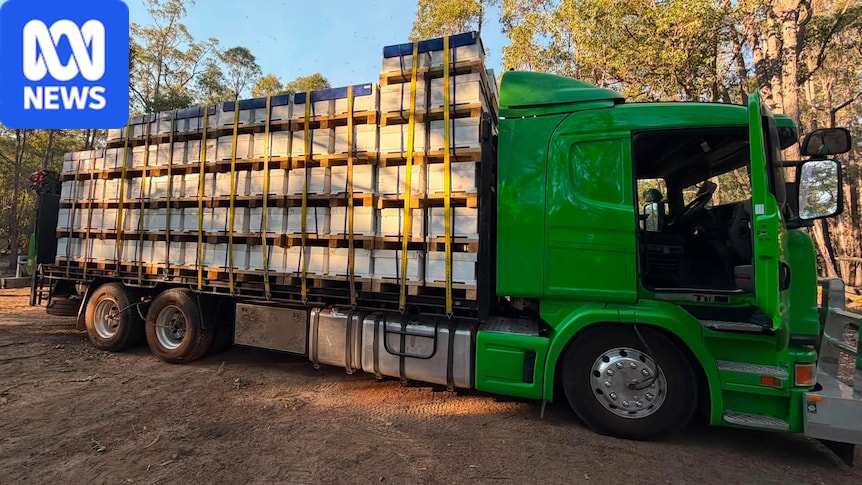
Millions of West Australian bees are being trucked across the Nullarbor on a one-way mission to provide critical pollination for South Australia's almond industry.Beekeepers are sending more than 7,500 healthy beehives to the neighbouring state where varroa mite has wreaked havoc on bee populations.WA remains free of the bee parasite, but its beekeepers are nervous.It is hoped thousands of WA beehives will boost the pollination of South Australian almonds. (Supplied: Steve Sannut)Three prime movers humming with mite-free bees have crossed the South Australian border and another two trucks will make the journey in the coming days.The bees were purchased by a commercial almond grower in a deal understood to be worth more than $2.3 million.A dozen WA beekeepers delivered their bees to collection points in Donnybrook, Gingin and Esperance last week, fetching $350 per hive.Trucks headed for the collection point were loaded with pallets of West Australian beehives. (Supplied: Steve Sannut)In the nick of timeWA beekeeper Steve Sannut said the bees would be delivered right on time for the opening of the almond flowers, which is predicted to the precise day."It's two drivers, non-stop, all the way through to South Australia," he said."The hives travel with the entrances open because if it gets too hot the bees can come outside and sit on the front of the beehive.Steve Sannut says millions of bees are on a one-way trip to varroa mite-ravaged South Australia. (Supplied: Steve Sannut)"You definitely hear them on the outside [of the truck]."Mr Sannut said the project had been in the making for several months after the same buyer initially purchased 600 hives this time last year.He said the deal was "fruitful" for WA beekeepers who had enjoyed good conditions following last year's rain."Everyone's been able to achieve good results, as far as producing bees," he said.Bees doomed by 'super mite'Mr Sannut said while the delivered bees would boost almond pollination this season, they would eventually succumb to the deadly mite.Bees are being decimated by the deadly varroa mite in Australia's eastern states. (Supplied: Phil Lester)"This is the sad truth. These guys are going to get smashed," he said."We're just plugging a temporary hole."I put a blue dot on the queens ... they're in for a hard time."WA beekeepers remain nervous about the varroa mite reaching WA, as the most recent incursion continues to devastate eastern states colonies."We call it the super mite," Mr Sannut said."It's now carrying viruses, so beekeepers are getting whole apiaries wiped out."Thousands of beehives bound for South Australia were dropped at collection points in WA. (Supplied: Steve Sannut)The WA government spruiked the delivery of WA bees to South Australia as evidence of its biosecurity success, but this left a bitter taste in Mr Sannut's mouth."The government has done nothing extra," he said."If you talk to people in DPIRD [Department of Primary Industries and Regional Development] right now, they'd love a budget to be able to get more people out there inspecting stuff coming into our ports, our rail ports, and coming across the border."In a public statement on Saturday, WA's Agriculture Minister Jackie Jarvis said the state government was working closely with industry and thousands of beekeepers to strengthen biosecurity.West Australian beekeepers are supplying bees to South Australia to assist with almond pollination. (Supplied: WA Government)Not enough healthy hivesBee Industry Council of Western Australia (BICWA) chair Kate Byrne said the mite had killed most of the wild bees in the eastern states since it entered Australia in 2022 and was now decimating managed hives.She said two different types of the mite were present, including a strain resistant to miticide."Because those hives have collapsed, there is now massive demand for managed honey-bee hives," she said.Kate Byrne says bolstering biosecurity is the key to protecting local colonies from varroa mite. (Supplied: Kate Byrne)"There's an estimated 290,000 hive shortfall for August pollination on the east coast this year."There just simply isn't enough hives over on the east coast to pollinate the crops."Ms Byrne said the situation was worsening and could impact food security."Decisions are having to be made around which crops will be provided with bees for pollination," she said.Ms Byrne said BICWA's first priority was bolstering WA's biosecurity defences, and it was exploring options that included replacing sentinel hives with AI-capable detection units along the Nullarbor.
Millions of WA bees trucked across Nullarbor to save South Australian almonds
Full Article
Original Source
Read the full article at Abc →KhanList aggregates and links to publicly available news content. We do not host full articles from third-party sources. Always verify important information with original sources.