
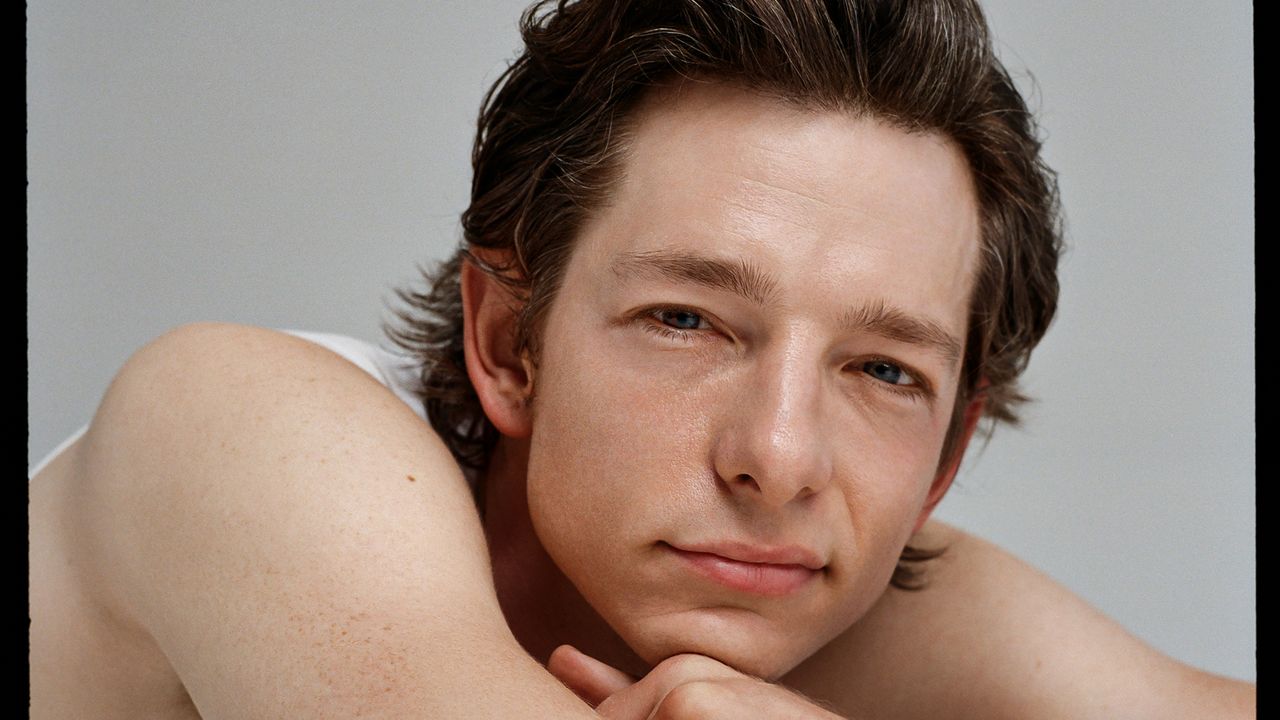
Mike Faist on Disappearing From the Spotlight—and Returning With East of EdenAfter breaking out in West Side Story, Mike Faist became a movie star thanks to Challengers. Then he decided to pump the brakes. Two years later, the young actor reemerges with a searing performance in Netflix’s new East of Eden series and tells us where he’s been—and how he feels about being back.It’s 7 a.m. on a Friday morning, and the day is already in full swing in Brooklyn’s Prospect Park. Dachshunds, Labradors, and golden retrievers sprint around untethered, while groggy people in cargo pants and running shorts tag along. On a patch of grass as luminous as a Terrence Malick frame, the mood is convivial as the dogs’ human companions greet each other.Among them is a tallish guy with a rescue pitbull mix, nursing a cup of coffee. He’s wearing a battered tee, a gray cap with a bite mark on the brim, and REI carpenter pants a few threads away from complete disintegration. His back pocket is so blown out, his beat-up wallet is threatening to spill. With his odd angularity and striking bone structure, he looks a bit like an Elizabeth Peyton portrait, with a sweet and toothy smile.That would be Mike Faist, the 34-year-old actor who stole scenes in Steven Spielberg’s 2021 West Side Story remake and stoked libidos in Luca Guadagnino’s 2024 tennis threeway Challengers. Then he seemingly vanished like he was in some sort of Witness Protection Program for talented and handsome Hollywood actors. No follow-up projects, pap walks, or fashion campaigns. If you wanted to find Faist, you’d be better off looking at the city’s dog parks instead of front row at Fashion Week. Only one person this morning seems to clock him—an older woman, who recognizes him from…being her neighbor.Stylist’s own vintage jacket by Buco. Shirt by Dior. Bandana by Front General Store. Watch by Cartier. Vintage bracelet by Van Cleef & Arpels from FD Gallery. “Here,” Faist says, handing me a treat for his dog, Austin. “Now he’ll love you forever.”Two summers ago, Faist ascended to a level of stardom most young actors would kill to achieve. Playing disillusioned tennis champ Art Donaldson in Challengers, he conjured enough heat with Zendaya and Josh O’Connor to burn through the worst movies-are-dead prognostications. In an era of green-screen epics and ran-through IP, an R-rated drama about adult desire and ruthless ambition became a bona fide phenomenon, racking up close to $100 million at the global box office and bringing threesomes, plaid shorts, and JFK Jr.’s “I Told Ya” tee to the center of the discourse. It even managed to turn the tip of a churro into an erogenous zone.“It did the thing that you hope movies do, which is they do get into the cultural sphere,” he says. “It definitely is a film that touches on a generation—which is crazy.”Challengers made the actor a bankable name as well as a meme, an object of obsession, and a type. In the middle of that summer, The New York Times ran a story on the rise of the ‘Rodent Man,’ a term for male celebrities like Faist, O’Connor, and Jeremy Allen White, “who look a bit like mice or rats” and have become some of the era’s most desired stars. “That didn’t bother me so much,” he tells me. Does he identify as a rodent man? “One hundo p!”Coat by Yves Salomon. Suit by Willy Chavarria. Shirt by Hermès. Tie by Brioni. Belt by Artemas Quibble. Sunglasses (in hand) by Jacques Marie Mage. Vintage watch by Rolex from FD Gallery. What did give him pause, he says, was the sense that he needed to seize that already big moment to quickly secure his next, even-bigger thing.“It became very apparent to me, there’s a moment of just needing to recalibrate probably for myself,” Faist tells me. “There’s so much noise in this industry and in the world.…“I think a lot of people will do one thing and then they double down and they get onto the next thing. They want this momentum,” he continues. “I don’t think that I have that kind of stamina. I’m not necessarily a marathon runner.”Was it the grind of promoting a movie all over the world?“It’s the public gaze,” he says. “It’s this: Before, you’re able to walk outside, you’re able to go to your neighborhood coffee shop, able to chat with your normal person, and you could kind of be whoever you wanted to be. I really loved operating in the world with anonymity and being able to talk to strangers without them knowing who I was, because for some reason that was an ability for me to be even more honest with them.”“And then after, it’s like, they point and they say, ‘Oh, you’re the guy.’ You’re like, ‘I guess I’ll wear a hat now,’” he cracks.Now, you can’t eat a churro in public.“Exactly,” he says. “Although…I probably would, if it were a good enough one and I was in the mood.”Where most of Challengers’ top players ran with the momentum, Faist largely disappeared from the limelight for two years. There were rumors that he might make the DC movie Sgt. Rock with Guadagnino and Challengers screenwriter Justin Kuritzkes, but that ultimately fell through. Last year, it was announced that he would appear in a new staging of Anna Christie starring Michelle Williams, before he dropped out of the production two months later. His sudden disappearance has felt like a conspicuously conscious choice—someone pumping the brakes on snowballing momentum and trying to rightsize a career.Shoes by Willy Chavarria. He seems to make decisions, perhaps at the expense of his career, in order to stick to his artistic convictions. The Pulitzer Prize–winning playwright and screenwriter Tony Kushner, who worked with Faist on West Side Story, saw that selectiveness up close. “Two or three people, friends of mine who were making movies after West Side Story came out, called about, ‘What’s Mike Faist like? Do you think he would do this part or that part?’” Kushner says. “And I think in both cases he turned them down. And he was very nice about it, but the stuff that they were asking just didn’t feel right to him at the moment, and it had nothing to do with size of the role or anything.”This week, he steps back into the spotlight in East of Eden, the latest adaptation of John Steinbeck’s classic novel, this time as a limited series on Netflix costarring Florence Pugh and Christopher Abbott. Zoe Kazan—whose grandfather, the legendary Elia Kazan, directed the 1955 version that introduced the world to James Dean—adapted the book and served as showrunner and executive producer of the series.As both an adaptation of one of America’s greatest novels and a prestige series in our post-prestige-series landscape, East of Eden delivers. It’s thrilling and moving, with the scope of an epic and the intimacy of a chamber piece. And Faist delivers a performance so searing that when his character all but disappears at the end of the third episode, his ghost hangs over the rest of the proceedings.“Aren’t those the best parts?” says Pugh—who leads the series as Cathy, the story’s doomed, destructive antagonist—about Faist’s performance. “Being a supporting role, but knowing that everyone is wishing for you to come back, is probably one of the coolest things you could possibly achieve. That’s all to do with an actor’s power.”Tank top by Zimmerli. Necklace by Ten Thousand Things. Even Faist’s closest collaborators say he has proved to be elusive. “There’s a privacy to Mike that I feel, even having worked with him and spent time with him, that I am very careful not to push on, because it feels so important to who he is,” Kazan tells me.“There’s something about Mike that reads to me like a hermit crab or something. There’s this shell on the outside and you can’t tell what’s inside. And there’s a softness to him, but there’s also this kind of toughness,” she says. “Like, steely.”Today, even while Faist is clearly proud of the project, it’s clear he has cold feet about his return to the spotlight: “This is the part that I don’t know how to do,” he tells me.“Look, the truth is, it’s a lot easier for me to put on a character and be in front of the world than be me,” he admits. “And I’m just proud that I’m able to go on a walk with you and do this. For me, that’s a big step."Up ahead, Faist’s dog has begun feasting on garbage on the park trail. “AUSTIIIN,” Faist calls out to him.“Don’t eat dirt,” he says. “You’re worth more. Come on, bub.”Steinbeck wrote East of Eden as a biblical allegory, alluding to the fall of Adam and Eve and the ruinous brotherhood of Cain and Abel. A story about how half-truths and unexpressed affection can curdle into destruction despite our best intentions, it’s as powerful today as it was in 1952. Unlike her grandfather’s adaptation of the novel, which covered only the last section of the book, Zoe Kazan’s seven-episode series more closely captures the author’s ambitious sprawl.In the series, Faist is playing against type, taking on Charles Trask, a character introduced by Steinbeck as “to be admired as one admires the sleek lazy danger of a black leopard” and “a dangerous man, even at fifteen.”Even after Faist expressed interest in East of Eden, Kazan says he needed some persuading to finally commit. “We met twice before he agreed to do this,” she says. “And he was very clear with me, ‘I don’t need you to convince me. I just need to know that this is right for me, because when I jump in, I jump in 100%. If you have me, you’re going to have me 100%.’”Kazan saw that firsthand on the set of East of Eden. Over the novel’s 602 pages, Charles really figures into only the first 125. In fidelity to the story, Faist was set to star in the first two episodes of the series, with a brief appearance at the top of the third episode. But Faist makes such a forceful impression in the role that after the first dailies of his Charles Trask came in, Netflix was compelled to invest more money into the production.“Netflix was like, ‘We love him so much. We’ll pay for another episode,’” says Kazan, who found a way to write Faist into a later episode.In hindsight, Faist thinks he signed on to East of Eden because the work provided a feeling of home, working with a showrunner who also started out in theater.Vintage jeans by Levi's from Raggedy Threads. Rings by Ten Thousand Things. “Challengers is the future, East of Eden is a little bit past,” he says. “And I think that, for me, that I had to go back a little bit to basics or a little bit to ‘Why did I get into this in the first place?’”An analog boy in a TikTok world, Faist often feels like a matinee idol right out of the midcentury. He rhapsodizes about films like All That Jazz, The Bridge on the River Kwai, and Ben-Hur. “You watch that movie and you say, ‘How did they do that?’” he says. “This is magic trick stuff. I’m always kind of looking for that.” One gets the sense that the hot sauce on Hot Ones might literally kill him.Growing up in Ohio, Faist realized his life’s purpose watching Gene Kelly MGM musicals like An American in Paris and Singin’ in the Rain. “Unfortunately, you can’t go back, but you can bring the past into the future,” he says. (When I ask him what was the last film he felt that for, his answer is a pleasant surprise. “You know what movie I really loved? Passages,” he says, referring to Ira Sachs’s intimate, devastating, terminally horny indie. “Franz [Rogowski]’s performance in that? I’m kind of like, ‘How did he do that?’ So fucking amazing.”)That reticence to just jump in, the standards he holds for himself and others, seems to safeguard a life that’s more than just a career.“I think a lot of, especially white, young men who get rewarded really early take it as a confirmation that they’re being anointed and don’t ask themselves deeper questions about it,” says Kazan. “It’s really admirable to me that Mike is pursuing a life that feels authentic to him. And I think that that goes across the board—his relationship to fame, his relationship to his work, his relationship with his family, where he lives, how he lives, his dog.”Shirt by Rag & Bone. Tank top by Zimmerli. Vintage jeans from Brut Archive. Belt by Artemas Quibble. Boots by Marsèll. Necklace by Ten Thousand Things. Vintage bracelet by Van Cleef & Arpels from FD Gallery. Watch by Cartier. “Once it’s all over, I’ll go back to construction work,” Faist said in an interview, around the time of his 2017 Tony nomination for Dear Evan Hansen, the Broadway production that served as his initial breakthrough. When I bring up that quote to him now, he laughs and calls it “the narrative of my life.”“I grew up in Ohio, and my parents—we renovated houses,” Faist says. “That in and of itself is this kind of laborious creative work that I found very satisfying and still continue to find satisfying in ways. And it’s very grounding. It’s real. It’s tangible.”In 2021, just after West Side Story, Faist packed up his belongings in New York and moved back to Ohio to help care for his ailing father, who was battling pulmonary fibrosis. During that time, father and son renovated a house together—a house he lives in now, whenever he’s not in Brooklyn. His father and grandfather passed within three weeks of each other, right before the release of Challengers changed his life in different ways. “All the men have passed,” he tells me. “It’s my sister, my mom and my grandmother, and me.”Like anybody who’s left home to pursue their dreams, he feels a push-pull between his life as an in-demand Hollywood actor and his life back home in Ohio. “I’m living in the Matrix,” he says, contrasting the two. “And I’ve got to go back into the real world.”But in many ways, he’s still just getting started.Tony Kushner tells me about a screenplay Faist wrote that the actor asked him to look at. “When people do that, you often think, ‘Oh God, help me. It’s not going to be good…,’” Kushner says, laughing. “Then I read it and I thought it was great. He’s also a terrific writer. It’s a very, very interesting, beautifully written script.… He’s very, very smart and empathic and insightful and thoughtful and curious in all the things that you want a writer and an actor to be.”Scarf by Charvet. Gloves by Seymoure. When we meet in August, Faist tells me he’s about to enter rehearsals for the first production he’s worked on since East of Eden two years ago. True to form, he’s tight-lipped about the nature of the production, or even if it is a play, a film, or a TV show.“There’s things that pop up and for whatever reason, they don’t happen because of the industry and financing,” he explains. “There’s no control in this industry.” Sgt. Rock, for example, was a project he was reportedly attached to last year. “Luca and I remain talking about things from time to time, for sure,” he says now.“I was so, so excited for that movie,” Justin Kuritzkes says about Sgt. Rock. “None of the people who were planning on doing it were people who were particularly interested in making big superhero movies.… Sgt. Rock was very much a superhero movie that was about everyday heroes, humans, normal people, where the superheroes were really not the focus at all. So it was a pretty experimental thing.” Kuritzkes reveals that they were “more or less in prep” when the film fell apart. (When I ask him why the movie fell apart, he says: “You can ask DC Studios.”)Jacket and pants by Officine Générale. Turtleneck by Dolce & Gabbana. Boots by Christian Louboutin. Pocket square by Charvet. Vintage watch by Rolex from Foundwell. At one point, Faist and I talk about his friendship with Oh, Mary! star and playwright Cole Escola, whom he goes way back with in the theater.Would he ever consider stepping into the role of Mary Todd? “You know what? I would rock Mary Todd. Why not?” he says.We live in a different world than the one Faist’s heroes inhabited. We demand a constant performance of intimacy, constant disclosure from our celebrities. In many ways, art is no longer the integral foundation of fame—it’s just another brick in a road made up of memes, TikTok dances, clipped Subway Takes guest spots, and queerbaiting red carpet antics.In an industry with an increasingly short attention span, with an insatiable demand for product from its artists, will the world continue to wait for Mike Faist?“That’s hard with actors, because you can also become an actor who says no to a lot,” Kushner says. “But I’m intrigued by what he’s decided to do and what he has decided not to do and what he’s fought hard to get out of.… I think Mike is a genuinely great actor. That’s not something I say about very many people, because it’s not true of very many people.”But like some of the actors he aspires to emulate, Faist possesses an essence that has a way of burning through the artifice. In his best work, he seems to be reckoning with the damage wrought by masculinity, the inability to express affection, the cycles of generational trauma. How to be a man. How to be a brother. How to be a friend. And his unknowability—that elusiveness—seems to only fortify what he reveals on the screen. It’s his magic trick.“I’m always saying,” Faist says, “if you want to get to know me, just watch my movies.”PRODUCTION CREDITS:Photographed by Adam DowlingStyled by Moses MorenoGrooming by Kumi Craig using La MerSet Design by Suzy ZietzmannTailoring by Ksenia GolubSign up for Manual to receive useful advice on style, health, and more, six days a week.Raymond Ang is GQ’s director of editorial operations. Since joining GQ in 2021, he has regularly written about Asian cinema, queer culture and pop music for the magazine. His work has been published in The Wall Street Journal, Vogue, Architectural Digest and Them. ... Read More
Mike Faist Returns to the Spotlight With ‘East of Eden’
Full Article
Original Source
Read the full article at Gq →KhanList aggregates and links to publicly available news content. We do not host full articles from third-party sources. Always verify important information with original sources.