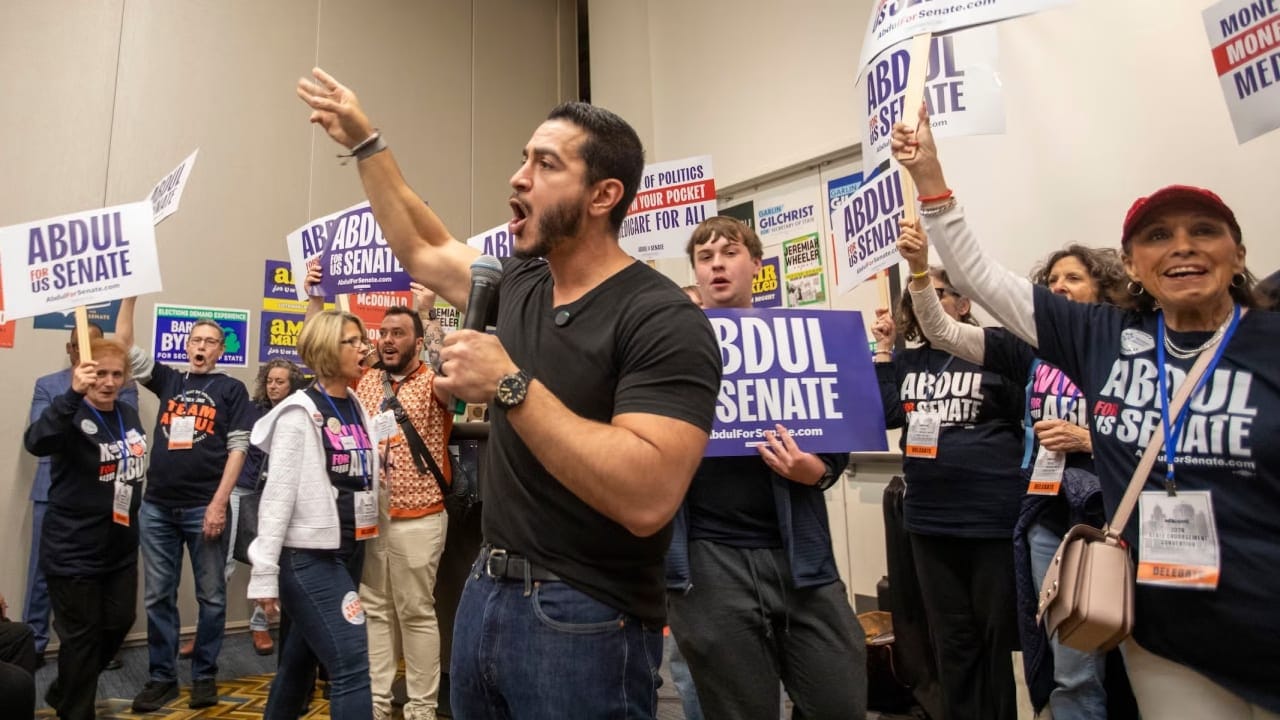
ByANDREW LAPIN/JTAJULY 20, 2026 17:40Joel Tauber has been through many an election in his 92 years. And, with the exception of “one out of 100 times,” he’s always backed a Democrat, something even more important in the current midterm cycle, he believes.“Winning the Senate and the House is the beginning of a way back to our democracy,” Tauber, a founding chair of Jewish Federations of North America who has hosted former President Bill Clinton and other Democratic leaders, told the Jewish Telegraphic Agency. “It’s really, really important to me.”But Tauber is a Michigan resident, and the state’s upcoming US Senate primary is making him deeply uneasy. Like many a Jew in the mitten state, he is pulling for pro-Israel centrist US Rep. Haley Stevens to win on Aug. 4.Should her opponent, former county health official and staunch Israel critic Abdul El-Sayed, prevail instead, Tauber would take a step he’s said he’s never done before: leave the Senate ballot blank.“I’d sit it out,” he said, of the general election. Of El-Sayed, he said, “There’s no way that I could vote for him.”U.S. Rep. Haley Stevens, D-Mich., holds a town hall meeting with employees after touring the Webasto Plymouth Plant in Plymouth, Michigan, May 1, 2026 . (credit: Sarah Rice/Getty Images)Traditionally Democrat fundraisers shift to planning for RepublicansSome Jewish Democratic leaders in the state are prepared to go even further. Several prominent Metro Detroit Jews who have traditionally fundraised for Democrats are also planning fundraisers for the presumptive GOP nominee, former US Rep. Mike Rogers, as a “hedge.” Others are planning to help him if El-Sayed wins the Democratic nomination, one Jew who is close to the Stevens campaign told JTA.Others affirmed the idea that the Jewish Democratic donor class, feeling abandoned by the party, would back Rogers.“There are leaders in our Jewish community who are longtime, lifelong Democrats and Democratic fundraisers, who are very concerned with where their party’s going,” said Dennis Bernard, national chair of government relations for the nonpartisan JFNA and a metro Detroit resident. “And if this is the case, they’ve made it clear, both financially and with their vote, that they would support Mike Rogers in the event El-Sayed wins the primary.”Detroit-area Jewish Democrats have asked Bernard, over golf outings, for introductions to Rogers, he said.The reason: They see El-Sayed, who has questioned whether Israel should be a Jewish state and suggested that Democrats who support Israel only do so because of financial motives, as portending an existential threat to the national Jewish community. If he wins in a purple state, one in which pro-Israel Jews have for years butted heads with US Rep. Rashida Tlaib, the pro-Palestinian Democrat, some fear more candidates with similar views will follow, and lead to an unsafe environment for Jews in Michigan and beyond. They worry that increasingly hostile discourse creates an environment in which antisemitic harassment becomes more acceptable and Jewish political activism is considered suspect.“This is a truly once-in-a-lifetime moment where you have to become a single-issue voter,” Bernard said. “And that issue is antisemitism, our Judaism and Israel. This is where you put party third: our people first, our country second.”Left-wing congressional primary wins in New York, Colorado and other states have stoked anxiety over the Senate race here, as Michigan, also home to a large Arab/Muslim population, is morphing into a litmus test for the relationship between pro-Israel Jews and the Democratic Party. For the majority of American Jews who back liberal policies, a decades-long bond is being tested like never before.A similar dynamic played out on a smaller scale after Zohran Mamdani, a vocal anti-Zionist, secured the Democratic nomination in New York City’s 2025 mayoral election. Then, several prominent Jewish donors backed a rival bid by former Gov. Andrew Cuomo, who ran as an independent while maintaining Democratic ties. Despite recent polling showing that 44% of American Jews hold a favorable opinion of the mayor, a higher favorability score than Israeli Prime Minister Benjamin Netanyahu, pro-Israel voters still regard his pro-Palestinian rhetoric as disquieting.Gaza war and calls to boycott AIPAC strain Jewish-Democratic bondsThe backlash against Israel’s handling of the war in Gaza and growing calls to shun the pro-Israel lobby AIPAC are further straining Jewish-Democratic bonds, and, for some of the most influential of Michigan’s estimated 129,000 Jews, are on the verge of breaking them.Another Jewish leader told JTA that there was also an effort underway to convince pro-Israel Republicans to vote for Stevens in the state’s open primary, even if they later decide to vote for Rogers in the general election.“Anyone who cares about the future of the US-Israel relationship, Democrat or Republican, needs to vote for Haley Stevens in the Democratic primary,” they said, requesting anonymity because they did not want to be seen as speaking for the community. The Republican Party is currently engaged in its own tug-of-war over Israel and antisemitism, with Vice President JD Vance recently criticizing Israel while entertaining conspiracy theories about its ties to Jeffrey Epstein on a popular podcast.When contacted by JTA, Halie Soifer, CEO of the Jewish Democratic Council of America (which is phone-banking for Stevens) and a native of East Lansing, Michigan, declined to comment directly on the possibility of the state’s Jewish Democrats backing Rogers over El-Sayed.“Our focus is ensuring Haley Stevens wins the primary election,” Soifer said in a statement, also saying that El-Sayed’s “views are not aligned with the vast majority of Jewish Americans.”At Michigan’s Democratic convention earlier this year in Detroit, Stevens was booed by the rank and file while state Sen. Mallory McMorrow, who was then also running for the seat, alleged that an attendee directed an antisemitic remark at her Jewish husband. At the same convention, a lawyer for pro-Palestinian encampment participants, who himself had a history of social media posts supporting Hezbollah and retweeting antisemitic conspiracy theories from far-right podcaster Candace Owens, ousted a pro-Israel Jewish incumbent for the party’s nomination for University of Michigan board of regents, a statewide elected position.The convention was an inflection point for many top Jewish Democratic supporters. Many of these Jewish leaders declined to comment to JTA. Others said much of the enthusiasm for the broader party goals among the staunchly pro-Israel Jews of the Detroit suburbs has been drained.“I’m feeling kind of confused, and it must be how my Republican friends felt once the Tea Party took over,” said Neil Gorosh, a retired commercial mortgage banker in West Bloomfield and past president of a local Jewish senior living community.Gorosh ran for office once: a local parks-and-recreation position in 1988. A Democrat during the George H.W. Bush-led GOP wave, he lost. Since then, he said, he has always backed Democrats while developing an elections calculus: He leads with local issues on local races, but Israel on contests of national import.Accusing the Democrats of “completely rejecting Israel,” he added, “I’m rudderless right now.”“If it came down to Mike Rogers and El-Sayed, I will vote for Mike Rogers,” Gorosh said. “I wouldn’t write a check, but I would vote for him, and I would tell my like-minded friends to do the same, and the reasons why.”'The Supreme Court is too critical to not support a Democrat,' some believeMichelle “Decky” Alexander, the Michigan Jewish Democratic caucus chair, was one of a very few Jewish leaders who told JTA on the record she would back El-Sayed over Rogers. She insists that there are many others.“This is what I’ve heard from Jews, even in Detroit: The Supreme Court is too critical to not support a Democrat,” she said.Alexander recently had an hours-long sit-down with El-Sayed, she said, and believes “he absolutely would be open to dialogue.” In his rallies, the candidate has welcomed Jews and stated, “AIPAC and Israel are not the same as Judaism and the Jewish people.”For now, though, the focus is purely on Stevens, who is not herself Jewish but represents a large slab of Oakland County, affluent, heavily Jewish Detroit suburbs that have trended liberal over the last few election cycles after formerly electing Republicans. While the Stevens campaign has not responded to interview requests for JTA, she recently told The New York Times that Israel is not a central issue for her and added, “I am not a Netanyahu apologist.”The congresswoman’s Jewish backers are hoping to drive a strong enough voter turnout to neuter both El-Sayed and the national progressive insurgent movement he represents. (The Democratic Socialists of America are behind many of the emerging candidates, though El-Sayed himself is not a member of the group and has distanced himself from the socialist label.)Stevens’ supporters point to a growing number of encouraging signs, including endorsements from party leaders such as retiring Sen. Gary Peters, whose seat she hopes to fill. Chuck Schumer, the Jewish Senate majority leader, has also endorsed her. A recent poll commissioned by the Detroit News shows her ahead by seven points, though social media in recent days has been flooded with so many unflattering memes of Stevens on the campaign trail that El-Sayed himself denounced his supporters’ behavior.Another Detroit News poll this week shows that most likely Democratic voters have a negative view of AIPAC, which, according to an AdImpact analysis of the most recent filings, has spent more than $28 million for Stevens to date. AIPAC’s support of Stevens is one of El-Sayed’s biggest attack lines. The candidate recently claimed that the group has spent more than $50 million against him, though a campaign representative told JTA that figure includes $20 million from new super PACs that have not disclosed their funding sources and have no immediately apparent links to AIPAC.The Jewish Stevens supporters who spoke to JTA, some of whom are or have been AIPAC supporters themselves, argue that AIPAC has been unfairly demonized compared to other lobbying groups.They also shrug off Stevens’ recent critiques of Netanyahu during a debate, at which she said the Israeli prime minister “is a danger to Jews in America and around the world.” Many of her backers chalked up the language to a new political reality for Democrats that rewards criticism of Israel, rather than a shift in her own thinking.“It’s the needle Democrats have to thread to have any credibility path at all,” Gorosh said. Referring to Israel’s own upcoming elections, he added, “I think he’ll [Netanyahu] be gone after October, but he’ll be gone eventually. Then what do you criticize?”El-Sayed also has Jewish supporters, most notably former US Rep. Andy Levin, a progressive member of a powerful Michigan political family who lost his House seat to Stevens after AIPAC spent heavily for her in 2022. There is also a Jews For Abdul affinity group.Speaking to JTA, Levin dismissed concerns about Jewish Democrats rejecting El-Sayed in the general. He said the conversation was being dominated by hardline pro-Israel donors in the community who have pushed similar red lines for decades, rather than being a new shift from the Jewish mainstream.“I do not take a backseat to any of these so-called ‘lifelong Democrats’ about self-determination for the Jewish people in the holy land, about fighting antisemitism at home and abroad,” he said. “I just have a different view of how we accomplish these things, and they do not have a monopoly in the Jewish community.”Levin also defended El-Sayed’s record on Jewish issues, saying, “He is a strong advocate for Jewish safety here, in our community.”For Jews who have long seen themselves as committed Democrats, the prospect of leaving the party is a tough sit. Tauber, for his part, says he still can’t bring himself to vote for any Republican “who is so controlled by Trump, who’s a man of immorality, no values.” (Rogers’ campaign touts his Trump endorsement, and the candidate has also backed Trump’s unfounded claims about election fraud in the state as well as supported the president’s holding up of an international bridge in Michigan. The candidate has also acknowledged antisemitism on the right.)The Rogers campaign did not respond to a JTA request for comment. Republicans reach to appeal to Jewish DemocratsThe nationwide importance of this race and the Jewish vote was evident when New York state Republicans recently made an explicit appeal for Jewish Democrats, stating in a digital ad campaign that Jews were leaving the party “in droves” “from Maine to Michigan.” Before he dropped out last week as the Democratic Senate nominee in Maine over sexual assault allegations he has denied, Graham Platner put anti-Israel criticism near the center of his platform.Some Jews who spoke to JTA comfort themselves by insisting that the House, at least, seems likely to flip, providing a check on Trump even if the Senate remains led by Republicans. Shimon Levy, an Israeli-American entrepreneur who has lived in the Detroit area since 2014, said he was unconcerned about the prospect of Republicans keeping the Senate.“F*** that,” Levy told JTA. Levy has drifted between the parties over the years, he said, but “I stand and I lead with my Jewish identity. Safety and security of the Jewish community is my first and foremost goal.”That wouldn’t be possible with El-Sayed on the ticket, he insisted: “El-Sayed has done nothing but put Jews at risk and in danger, and through his words has been so poisonous and has ostracized and villainized, single-handedly, the Jews of Southeast Michigan.”He added, “If today, as a Jew, you’re still like, ‘Democratic all the way, Democratic down the ticket,’ you need to rethink your survivalist instinct.”Recently, Levy, who describes himself as a reluctant political activist, hosted a candidate meet-and-greet fundraiser that brought in more than $70,000 for Stevens. Attendees were not just Jewish, and not just Democrats. Republicans, too, showed up: “People who are concerned about common-sense politics, who would vote for Haley in a heartbeat.”The question of how Jewish safety is linked to Israel discourse isn’t abstract in Michigan. West Bloomfield’s Temple Israel was the site of an attack this spring by a Michigan resident whose family members were killed when Israel targeted a Hezbollah outpost in Lebanon. The incident became a factor in the Senate campaign after El-Sayed said of the attacker, “Hurt people hurt people,” which critics felt minimized the crime and equated the attacker with his intended victims.In late June, the temple itself, the largest Reform congregation in the country, sent an email to congregants stating, “This year, antisemitism is on the ballot.” Without naming candidates, the unsigned message concluded, “The Talmud reminds us that our leaders are chosen by us; silence is not a choice we can make right now.”Mailers funded by AIPAC’s United Democracy Project and sent to some voters in Michigan and circulated online attacked El-Sayed for his friendship with left-wing streamer Hasan Piker and for his statement after the Temple Israel attack.The mailers accused El-Sayed of having “rationalized a terrorist attack on a Michigan synagogue filled with Jewish children.” (The synagogue preschool was open at the time of the attack.) El-Sayed had condemned the attack, but the mailers accused him of equivocating.This was not a total break with all Democrats, many emphasized. Jewish pro-Israel state Sen. Jeremy Moss, who is running for Stevens’ congressional seat, and gubernatorial candidate Jocelyn Benson, along with others, continue to receive high marks from the Jewish donor class.Across Michigan, particularly in the Detroit area, there are (literal) signs of strain. Last month, the Oakland County roads commission ordered the removal of Adopt-a-Road signs, located a few miles from Temple Israel, that had been sponsored by a group called “Voices for Palestinians” after temple members voiced objections. A Fourth of July parade in Huntington Woods, another heavily Jewish suburb in the county, was briefly disrupted by a protest after parade organizers had put in place rules forbidding pro-Palestinian signs from being displayed.In early July, the state Anti-Defamation League chapter, together with Temple Israel, hosted a bipartisan delegation of Michigan lawmakers on the site of the attack, and advocated for increased synagogue security funding. Sen. Elissa Slotkin, a Jewish Democrat, as well as Rep. Shri Thanedar, a Democrat who has tacked from the left to the center on Israel since his election and is now facing a primary challenger endorsed by El-Sayed, were among those in attendance.Rabbis at the temple gave voice to the uneasiness of the political moment for Jewish liberals.Rabbi Paul Yedwab, who called the state Democratic convention “a shonda,” or shame, in a recent sermon, said during the same sermon, “The glib answer would be to say, I guess you become a Republican. But that is not as easy as it seems for a liberal Jew.” He went on to criticize the Trump administration’s legal assault on the Southern Poverty Law Center, a monitor of far-right extremism.Yedwab concluded, “From here on in, it will be incumbent upon us as Americans and as Jews to evaluate each proposal, each issue, each platform, and, indeed, each candidate according to our own independent set of values.”Follow us on Google
Michigan's Senate race tests pro-Israel Jews' loyalty to Democratic Party
Full Article
Original Source
Read the full article at Jpost →KhanList aggregates and links to publicly available news content. We do not host full articles from third-party sources. Always verify important information with original sources.