
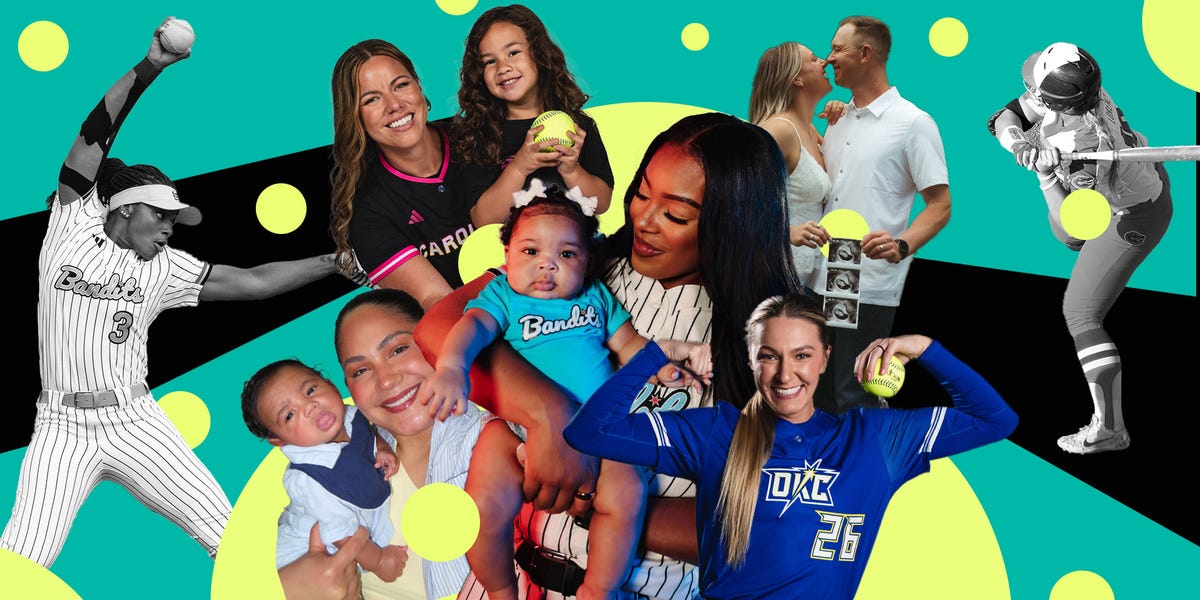
11 min readOdicci Alexander-Bennett was in the middle of a softball game when she fell apart. After more than two decades playing the game, she knew what it felt like to make mistakes and recover from them. The inaugural season of the Athletes Unlimited Softball League last summer should have been no different. But in this particular moment—a misstep so small, she doesn’t even remember the specifics of it now—the Chicago Bandits pitcher couldn’t hold it together.“I just started bawling,” Alexander-Bennett says. “I thought it was the end of the world.”Her closest teammates had already suspected something was up. Her eating habits had changed, she slept all the time, and she kept to herself. And once she broke down in a game, her coach started to question her, too. Alexander-Bennett told her the truth. “I’m like, ‘Dude, I’m pregnant,’” she recalls.She found out right after the 2025 season began that June, and, with her doctor’s clearance, played the entire two-month AUSL season while growing a human. When she announced the news to the world after the season concluded, it ignited a flurry of headlines that Alexander-Bennett did not expect. “I was actually quite overwhelmed,” she says. “I’m just pregnant. Big deal.”Odicci Alexander-Bennett and her daughter HaloIt may appear that Alexander-Bennett had something to hide by concealing her pregnancy. Women’s sports have historically not entirely known what to do with its pregnant athletes. In just one example, WNBA guard Skylar Diggins-Smith played the entire 2018 season with the Dallas Wings while pregnant, telling no one, and later said she got little real support once her son was born. That helped push the league toward its 2020 labor deal, which for the first time guaranteed full pay during pregnancy leave.But Alexander-Bennett had nothing to lose—or gain—by keeping her pregnancy quiet. Her AUSL contract was never at risk. She simply hadn't decided that she was ready to tell her team, and that got to be entirely her call.Alexander-Bennett’s daughter Halo was born in January, and she’s also a stepmom. She's one of at least six AUSL players who are pregnant, newly postpartum, or actively raising young kids while playing professional softball. And all of them have benefited in some way from a league-wide pregnancy and postpartum policy that separates pay from playing status entirely and leaves the timing of any disclosure up to the athlete.“Prior to our incorporation, there certainly were plenty of stories of athletes either being forced to disclose that they were pregnant, or as soon as they disclose, they lose their contract,” says Hilary Meyer, the AUSL's chief impact and athlete engagement officer, whose department helps incorporate athlete voices into league decision-making. “We didn't want to do that.”Meyer says she was “thrilled” when she found out that Alexander-Bennett had played an entire season pregnant without telling the league. “To me, that meant it was working,” she says of the AUSL’s pregnancy policy. “For lots of moms in any discipline, having the ability to manage what the expectations are, how people are going to react to you—in the case of pro athletes, how fans are going to react—all of that is so deeply personal. We want to make sure that athletes maintain whatever level of control around that information they want, and that they are the ones making the decisions.”Betting on Softball MomsAthletes Unlimited, the multi-sport women’s league AUSL belongs to, was founded in 2020 by sports exec Jon Patricof and investor Jonathan Soros. It launched with softball, and in 2025, Major League Baseball made an eight-figure investment in a new version of the AUSL specifically. This summer, as the AUSL expanded from four teams to six, AU paused its volleyball and basketball leagues through 2027 to redirect resources. Softball was left alone. (“The tremendous success of AUSL Season 2 has positioned Athletes Unlimited for an exciting new chapter,” read a statement from AU. “As we build on that momentum, we’re evaluating our portfolio to ensure we’re investing where we can create the greatest long-term impact for athletes, fans, and partners.”)The AUSL’s pregnancy policy, refined season over season with input from a five-person Player Executive Committee, separates pay from playing status entirely. Pregnant or postpartum athletes keep their salary whether or not they take the field. They aren't required to disclose anything to anyone, on any timeline. And that protection extends to players who weren't even on the roster yet when they got pregnant.Chicago Bandits infielder Jocelyn Alo was drafted into the league last December when she was roughly six months into a pregnancy she hadn't spoken about publicly. Her previous team, the Oklahoma City Spark, moved from the Association of Fastpitch Professionals to the AUSL in late 2025; the Bandits selected Alo in the second round of the resulting allocation draft. Alo, a two-time USA Softball Collegiate Player of the Year, holds the NCAA Division I career home run record and has two national championships from her time at the University of Oklahoma.Jocelyn Alo, Bobby Evans Jr., and their son Bobby Evans III“I kind of share my life with everyone on social media, and this was just one thing I wanted to keep to myself, to me and my husband,” Alo says. (Her husband, Bobby Evans Jr., won a Super Bowl in 2022 as an offensive tackle for the Los Angeles Rams.) When she did tell her new team, they offered immediate support. “I just received it with a full heart, and they were all super happy for me.”She gave birth to her son, Bobby Evans III, in April of this year. And when AUSL training camp rolled around in late May, she opted to sit out for the season—a decision she says the league has been supportive of. “I just wasn't in the right head space to come back this season—and my body, just a lot of changes,” she says. The league’s trainers check in with her, offering programming or just moral support. She doesn’t want to push herself to compete if she doesn’t feel like she’s at her highest level. “Being able to build my body back and build its foundation back, it's going to be super helpful for next season—and really just getting my feet under me as a mom, too.”In between worrying about baby Bobby’s sleep schedule and whether he’s eating enough, she recently began easing back into her workouts. She lifts weights on her back patio as Bobby looks on from his bouncer seat. “I'm like, ‘Hey man, you're all right,’ just getting my lifts done,” she says with a smile. “This season of life looks a little different, but I wouldn't change anything.”Gerald Leong//Getty ImagesJocelyn AloThe AUSL’s policies also benefit players who are already moms. Carolina Blaze pitcher Keilani Ricketts got pregnant back in 2021, right after making her fourth U.S. national team as an Olympic alternate, and played an entire season in Japan during her first trimester. “It was honestly probably one of my best seasons over in Japan, too,” she says. “I don't know if it's the hormones when you're pregnant, I guess you kind of have some superpowers.” Today, the AUSL offers game-changing childcare stipends, travel for children and a caregiver, and housing or hotel accommodations. “It is doable, as long as you have the right support system. And I think that's the biggest thing why I'm able to do this, is because my family is able to be there,” Ricketts says. “You don't have to put your dreams on the back end just because you want to be able to have a family.”That doesn’t mean all fear disappears the moment a policy exists on paper. The AUSL is still a young league, and many players like Ricketts spent years competing for Team USA or overseas, in environments that never had anything like this framework to fall back on.Spark catcher Kinzie Hansen, who is currently pregnant and due in December, describes finding out in openly anxious terms. "I feel like usually in softball, the stereotype is you can't have both. You can't be an elite softball player and also be a mom—you have to choose. So when that did happen, I was scared," she says, adding that having a family is her “ultimate dream.” She waited until a few days before reporting to training camp, right after her 12-week pregnancy scan, to let the league know she would sit out this season. "They loved it. They were so excited for us," she says of their response.And after the congratulations, Hansen says, they asked, “You’re going to play next year, right?” To which Hansen replied: “Absolutely.”But Meyer, whose job is to make the case that this works, doesn't pretend the job is finished. “To the extent that athletes still feel nervous about the implications on their career if and when they have children, I think that is where we need to continue to push as a field,” she says. “In all of the ways that manifests, I think that's critical, and every league needs to be doing that in every forum.”Kinzie Hansen and her husband Kobie McKinzieWriting the PlaybookKatie Rovtar, the AUSL’s head athletic trainer, has built this kind of infrastructure from zero before. The first time was nearly two decades ago, in her graduate program at Virginia Tech, "before the NCAA really had pregnancy protections,” she says. “It wasn't standardized across the nation. So I was actually on the ground floor of helping write that policy.”Even today, prenatal exercise guidelines for professional athletes are a fairly new idea. “For a very long time, it was don't lift, don't run, don't do these things,” Rovtar says. “And now it's very clear that that helps not only the physical health of mom and baby, but the mental and emotional health of mom and baby.” As for established postpartum-return guidelines, they don’t really exist yet.So Rovtar built her own network of ob-gyns, pelvic floor therapists, and physical therapists who specialize in postpartum care to learn as much as she can to support the moms of the AUSL. This year, she and her department—Kendall Stewart, the director of medical services for Athletes Unlimited, and the AUSL’s head of strength and conditioning, Emily Guimond—also sought out Canadian researcher Margie Davenport, one of the lead experts on a new set of FIFA guidelines for pregnant and postpartum soccer players. After a cold DM on social media, Davenport agreed to a Zoom call so they could pick her brain and see what they could extrapolate from soccer to softball.Keilani Ricketts and her daughter ElizabethUltimately, Rovtar and the 11 other athletic trainers in the AUSL take guidance from players’ own medical teams. A pregnant athlete must be cleared by their ob-gyn in order to play (and if they don’t currently have one, the AUSL will help them find one). From there, trainers check in with the athletes daily on their sleep, hydration, and how their pregnant body might be compensating: Is a pitcher’s sore shoulder an old injury, or joint laxity from pregnancy? “We have to think all those things through sequentially and how it could be affecting them, but not blame everything on pregnancy at the same time,” Rovtar says. “They're still a very elite athlete. We're going to treat them like an elite athlete, but just have that general thought process that their bodies are reacting to something very different than everybody else’s.”For postpartum athletes, the traditional standard of waiting until six weeks after birth to resume activity may not necessarily make sense for them. Rovtar and Guimond regularly communicate with athletes to assess how they are feeling and program movement for where they are in their recovery, like easy walks or core contractions. “Nobody's timeline is going to be the same,” Rovtar says. “We have to be able to treat everybody like an individual.”The AUSL is only a three-month season, but that support extends throughout the year. “It’s very encouraging,” Ricketts says. “Knowing that there are people out there encouraging you to chase both dreams, that’s really special.”Built-In VillageThe players also count each other as part of their valued support system. Alo says multiple moms in the AUSL have connected with her since giving birth. “Postpartum's been tough at times, just kind of getting used to a new stage in life, but I've had nothing but support around me,” she says. Seeing other moms show up when it’s hard inspires her to do the same. “There is no recovering when it comes to being a mom,” she says. “You just do it.”Hansen, who counts Alo among her good friends, says there’s nothing like having other softball players to talk to in this specific era of her life and career. “It’s tough to go through this phase of life alone,” she says. “Obviously, you have your husband, but you need your girls that know what you're going through, too. And if you haven't been through it, you don't know.”Texas Volts outfielder Amanda Lorenz is pregnant and due two days apart from Hansen; it’s the first baby for both of them. “It’s been so cool to go through the same changes as her and check in about, ‘How are you feeling?’ And, ‘Whoa, this is wild,’” Lorenz says. “Definitely thankful to have somebody to reach out to and hype up, too, because she's in the gym as well and still doing all of the things. It's been fun to cheer her on.”Amanda Lorenz and her husband Griffin MazurLorenz says talking to other moms in the league about the “identity shift” of becoming a mom has been grounding for her mental health. “We're trained [that] we do X, Y, and Z, and our body is going to look like this, and this is the results that we're going to have. And through pregnancy, it's like all of that flies out the window. You can't really control anything,” she says. She’s grateful to have women who don’t sugarcoat it. “You can be so thankful and also say, ‘This sucks.’ Two things can be true at once, and they've really helped me with that.” (As for the rest of Lorenz’s teammates, who she also considers best friends, “I said, ‘Absolutely do not remove me from any group chats. I want to be involved in all of the inside jokes,’” she says, laughing. “I'm like, ‘I’m going to have so much FOMO, so please don't forget about me.’ And they did it. They did a good job.”)As a kid, Lorenz says playing professional softball wasn’t a goal she even knew she could have, let alone concurrently with becoming a mom. Now, she’s aiming for the Los Angeles Olympics in 2028. “For so long, it was like, ‘Oh, college is it for us.’ And then it became like, ‘You can be a pro as long as you want, until you want to be a mom, and then it's done.’ So it just feels like we keep pushing the envelope a little bit more,” she says. “AU has given us the space to make that dream a possibility.”And that’s constantly on display in the AUSL clubhouses, where kids like Ricketts’ now-4-year-old call her mom’s teammates “the softball girls.” She goes to the braid bar between innings, stops by the arts-and-crafts table, says hi to all the staff, and runs on the field after games. “She gets really close with girls that are All-Americans, they're world record breakers. They have all these different types of softball titles, but she just sees them as her aunties,” Ricketts says. “I love being able to take her to training or to our games just to be able to see that it is tough, but that it is enjoyable at the same time.”For Alexander-Bennett, who just wrapped her first AUSL season as a mom, she hopes to show Halo that she can do anything. “Whatever I needed, I had the people for that and I had the resources for that, so I'm grateful for that—grateful for the opportunity to be able to play in the league as a mother,” she says. “And how cool will that be when I do retire and say that I did that? I played with kids. I had kids, yes. And I was still playing professional. I feel like that's so cool.”
Meet the Pro Softball Moms Who Are Redefining What an Elite Athlete Can Look Like
Full Article
Original Source
Read the full article at Womenshealthmag →KhanList aggregates and links to publicly available news content. We do not host full articles from third-party sources. Always verify important information with original sources.