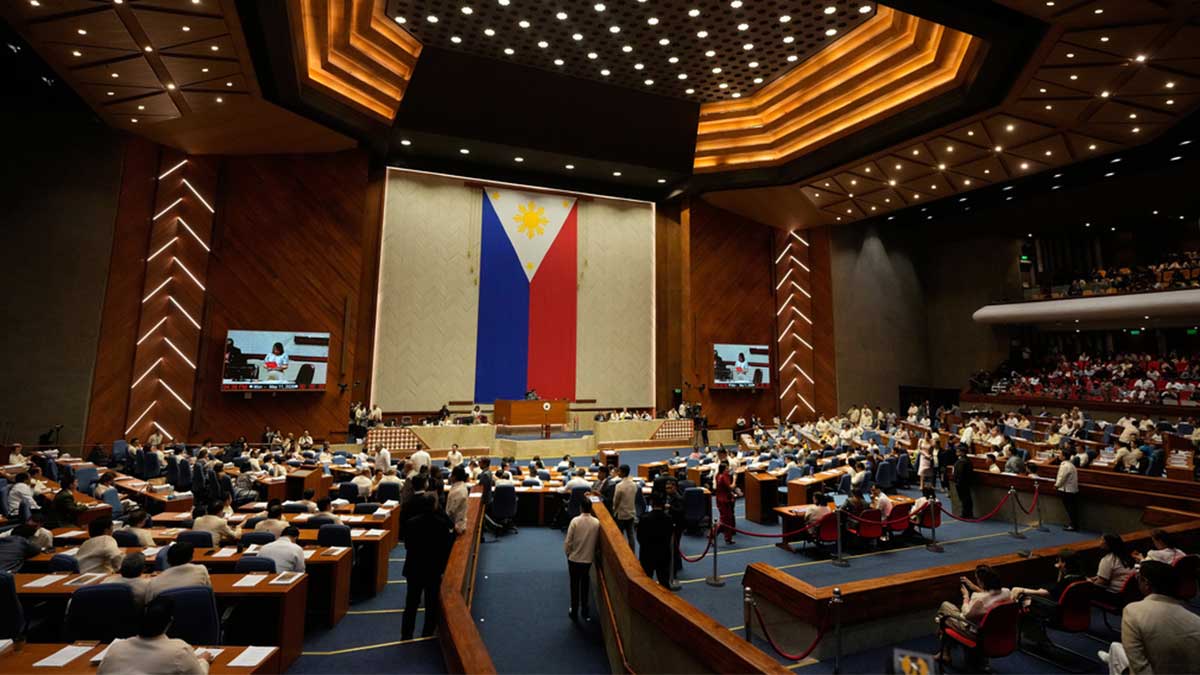
House of Representatives. (AP Photo/Aaron Favila) MANILA, Philippines – Media organizations said that pending anti-disinformation bills, which are the House Bill No. 9465 and its Senate equivalent, are the “wrong response to a real problem,” saying it undermines democratic freedoms. Earlier in June, the House of Representatives approved on third and final reading a bill that seeks to penalize disinformation deemed harmful to the public or a threat to national security. READ: House approves anti-fake news bill on final reading Article continues after this advertisement In a united statement initiated by the Movement for Media Safety PH, media groups said that “the pending anti-disinformation bills confuse the symptoms with the disease.” As of Thursday, 55 media organizations and multiple independent journalists joined the fight by signing the statement. “Instead of addressing the political, economic, and technological systems that manufacture and profit from coordinated information manipulation, they place the burden on individual expression and expand government authority over speech,” they said. “Rather than moving to dismantle the architecture of disinformation, these measures primarily criminalize expression, expand the State’s authority to regulate speech, and create legal mechanisms that are vulnerable to misuse against journalists, critics, and ordinary citizens,” said the organization. “At the same time, they leave largely untouched the opaque algorithms, commercial incentives, coordinated influence operations, and platform structures that enable disinformation to flourish,” it added.Existing laws Article continues after this advertisement They said current Philippine laws already provide legal remedies for offenses such as libel, fraud, identity theft, election violations, cybercrime, and other deceptive acts. “Before creating new criminal restrictions on protected expression, Congress should examine whether existing laws are being effectively implemented and how transparency and accountability mechanisms can instead be strengthened,” groups said. Article continues after this advertisement Groups said treating disinformation primarily as a criminal offense is a “ineffective” approach that overlooks the systems enabling its spread. They said it risks criminalizing individual users—the “small fry”—while failing to address the platforms, algorithms, and coordinated networks that drive disinformation at scale. “Digital platforms play a significant role in the amplification of disinformation, yet current legislative proposals focus disproportionately on content removal,” they said. They said true accountability depends on transparency in algorithms, political ads, and coordinated efforts to manipulate online discourse. ‘Inconsistent interpretation’ “Broad and ambiguous definitions of prohibited speech invite inconsistent interpretation and selective enforcement,” they added. They said laws regulating expression must be precise and narrowly crafted, warning that vague provisions could discourage legitimate journalism and limit public participation. Your subscription could not be saved. Please try again. Your subscription has been successful. “Government is frequently the subject of investigative reporting and public scrutiny. It cannot simultaneously serve as the ultimate authority on the truthfulness of speech concerning its own actions,” they said.According to their statement, the most effective response to falsehood is “greater transparency, timely access to public information, independent journalism, and more democratic debate.” /jpv
Media groups: Anti-disinfo bills are wrong response to real problem
Full Article
Original Source
Read the full article at Newsinfo →KhanList aggregates and links to publicly available news content. We do not host full articles from third-party sources. Always verify important information with original sources.