
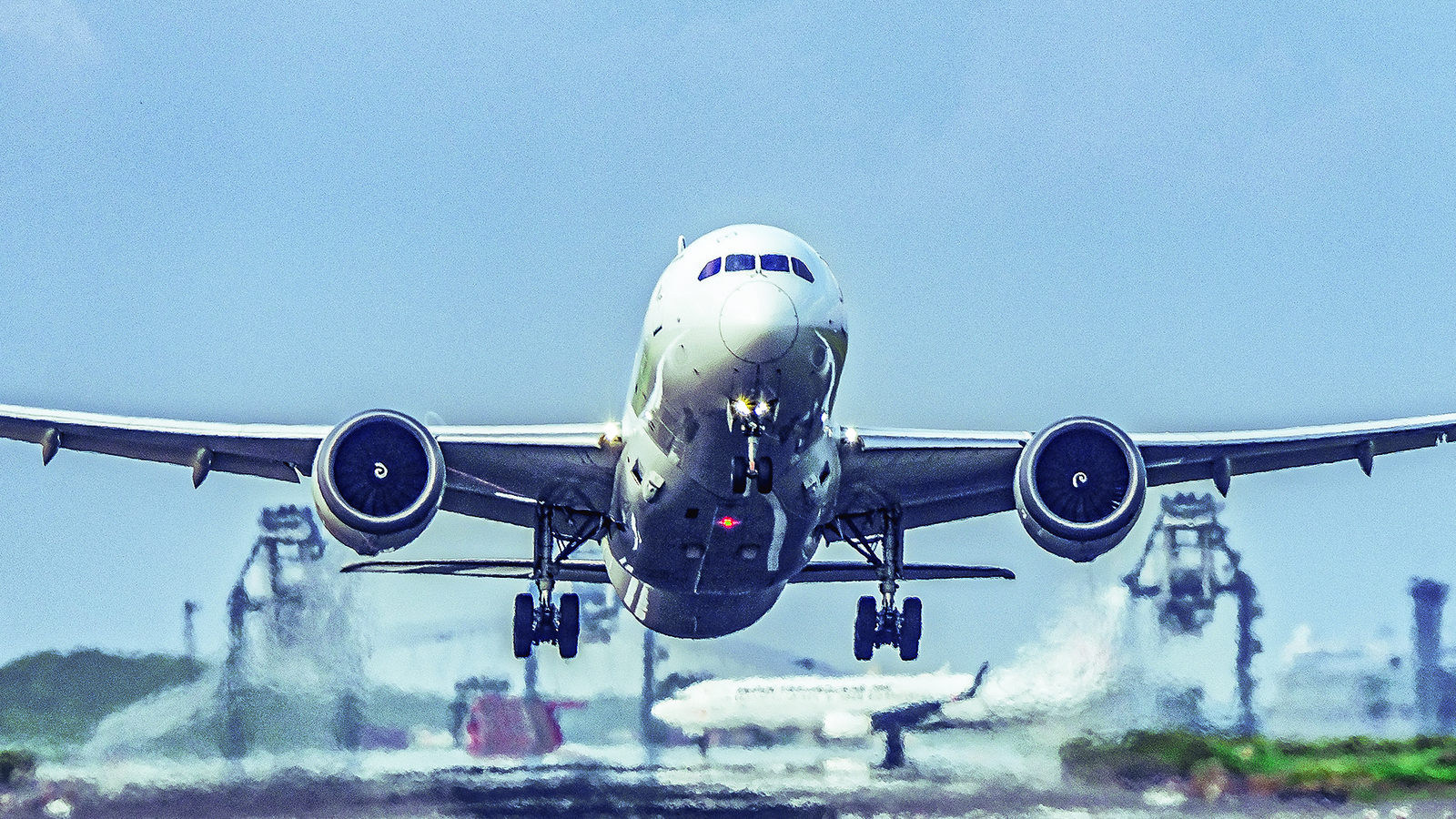
Published Aug 26, 2026, 1:00 AM EDT Luke Diaz is a freelance military writer with experience with active duty experience in the US Navy as well as defense and industrial engineering. He is a former Naval Flight Officer who performed tactical air control on the carrier-based E-2 Hawkeye. Aborted landings are a relatively rare occurrence in commercial aviation, with only one to three go-around maneuvers occurring per 1,000 approaches. Still, this rarely used maneuver is a vital skill for flight safety in the business of passenger air travel. In 2026, there is a debate ongoing about the way that a go-around should be flown. Veteran pilots and even retired airline captains have expressed concerns about the universal standard operating procedure that dictates an aircraft performing a go-around should use max power. They are not alone; new technology and techniques are under consideration by agencies like the Federal Aviation Administration (FAA) and manufacturers like Airbus. Despite the very low number of go-arounds performed every year, about 10% report a potentially hazardous outcome after initiating the procedure, according to the Flight Safety Foundation. New technology aims to automate a 'soft' go-around that uses less power, which puts less strain on the jets and crew to improve safety. Spatial Disorientation And Somatogravic Illusion Credit: Airbus During a standard all-engines-operating go-around, the rapid application of full Take-Off/Go-Around, or TOGA, thrust generates massive forward acceleration. When a pilot has no outside visual references, such as at night or in low-visibility instrument conditions, this strong longitudinal acceleration confuses the inner ear. The brain misinterprets the physical sensation of forward acceleration as a steep nose-up pitch. This is known as the somatogravic illusion. Airbus is developing soft go-around technology, which aims to reduce spatial disorientation by limiting excessive longitudinal acceleration and extreme pitch-up attitudes. The physical execution of a soft go-around keeps standard pilot muscle memory intact while providing a much gentler flight path. When integrated into modern airspace infrastructure managed by agencies like the FAA, this system drastically decreases flight crew workload during a highly critical phase of flight. Airbus SGA technology solves this by automatically providing optimized, reduced thrust adjusted to the aircraft’s current weight, altitude, and speed. Instead of an aggressive rocket-like ascent, it smoothly caps the initial vertical speed to roughly 2,000 feet per minute. The pilot always clicks the thrust levers forward into the TOGA detent first to safely arm the flight guidance go-around modes. If maximum power is unnecessary, the pilot simply pulls the levers back one notch. By smoothing out the physical acceleration, it completely eliminates the sensory mismatch that generates the illusion. The flight computer targets a stable, controlled climb. If maximum emergency power is ever suddenly required, the pilot can instantly push the levers back to full TOGA at any time. The Demands Of 21st Century Airspace Credit: Shutterstock Decades ago, aircraft featured lower thrust-to-weight ratios, but modern commercial airliners have much more high-thrust engines, and airports operate under immense traffic congestion with tightly packed arrival and departure streams. When a go-around is initiated at low speed close to the ground, the sudden surge in power means events happen exponentially faster, leaving minimal time for error identification and correction. Dave Carbaugh, a Boeing Test and Evaluation captain and chief pilot, made these remarks at the 2014 Flight Safety Foundation’s International Air Safety Summit in Abu Dhabi, United Arab Emirates: "Airlines should emphasize to flight crews the importance of making the proper go-around decision if their landing approach exhibits any element of an unstabilized approach... We [formerly] had low thrust-to-weight ratios, so the airplane just didn’t climb very quickly. We had less traffic density, so there wasn’t anybody in front of you and… and a lot of times, the go-around was non-complex [such as the air traffic controller saying,] ‘Fly runway heading to 4,000.' It was basically easy. But those days are gone.” In modern jets, when full go-around thrust is applied, the sudden nose-up pitching moment can outmatch the pilot's immediate elevator downforce application. That risks a nose-high upset if not actively managed. At the same time, crews must immediately transition from a landing configuration to tracking waypoints in a Performance-Based Navigation route while retracting gear and flaps under extreme time pressure. How High Cognitive Workload Impacts The Flight Deck Credit: Shutterstock In some cases, analysts have found that the timing of the decision to perform a go-around highly contributes to unsafe conditions. The hesitation or lack of decision by aircrew to initiate a go-around in and of itself creates hazards. That is at least partially due to the infrequency of the maneuver. Subject matter experts from safety agencies and original equipment manufacturers, like Boeing, stress the value of routine training to address this issue. General estimates hold that the average pilot flying short to medium distances would likely only need to execute a go-around once or twice a year, while long-haul pilots would be even more infrequent statistically, perhaps every two or three years. The result is often late acknowledgment of an unstabilized approach followed by a hectic go-around execution. Carbaugh commented on these studies, saying that crews need to be objectively aware of their own conditions to make the call at the right time. Elaborating to say that when pilots are "basically not ready to land," it is best to execute the go-around. Carbaugh commented that a pilot needs to be self-aware enough to identify when they have failed to anticipate the next step in the approach by focusing too much on present tasks, also known as 'getting behind the airplane.' The Tragic Fate Of Gulf Air Flight 072 Credit: Shutterstock Over two decades ago, a tragic example of the hazards presented by every go-around maneuver occurred on August 23, 2000. That day, an Airbus A320 operated by Gulf Air was performing flight 072 into Bahrain International Airport (BAH). The jetliner performed a missed approach at night but never made it back to the runway after crashing into the Persian Gulf and killing all 143 souls aboard. The official investigation that followed concluded the pilot had suffered from a severe case of somatogravic illusion, or SI. The inner ear imbalance caused the pilot to believe the plane had suddenly pitched up when in fact it had not. Since it was dark outside, there was no horizon to reference aside from what the instruments depicted. The pilot reacted, seemingly without confirming his 'seat of the pants' feeling against instrument readings. The overcorrection caused controlled flight into terrain. Because of the extreme sensory confusion and high stress, the crew did not cross-check their attitude indicators or respond to the Ground Proximity Warning System alerts until it was too late. The aircraft impacted the water at 267 mph (429 km/h). Crew resource management failures on Flight 072 also exposed a dangerous, non-assertive cockpit hierarchy and a complete absence of structured training. The accident report revealed how a breakdown in communication allowed the captain's fatal errors to go completely unchecked. Overengineering TOGA For Flight Safety Credit: Airbus Airbus SGA technology combined with modern FAA infrastructure is working in parallel to deliver an engineering solution to the physical and psychological environment that caused the Gulf Air disaster. SI was the primary culprit when it 'tricked' the captain's inner ear into feeling a false pitch-up, and he pushed the stick forward into the water. SGA uses a two-prong approach to prevent pilots from feeling compelled by the urge to correct a nose angle that doesn't need it and maintain CRM. Airbus technology automatically calculates and delivers the minimum optimized thrust required to achieve a safe, uniform climb. SGA typically targets 2,000 feet per minute. Because the engines do not aggressively surge to maximum emergency power when the aircraft is light, the sudden forward G-force is eliminated. The computer eases the thrust to just the necessary level for safety and thus prevents SI from being induced. Keeping the inner-ear pressure balanced prevents impulsive control inputs because the sensation that prompts the 'knee-jerk' reaction is absent. As SGA aids the flight deck in executing a smooth TOGA maneuver to climb away from the runway, the stress level is also reduced. The autopilot assist creates a gentler, more predictable climb rate; it slows down the speed at which events happen in the cockpit. This gentle vertical path gives the first officer the time and focus needed to verify flight parameters, cross-check instruments, and step in to assist if needed. The Federal Aviation Administration's NextGen Rollout Credit: Shutterstock To maximize emerging technology in the cockpit, FAA NextGen is working to construct refined airspace infrastructure that eliminates ambiguity and automates guidance in the terminal area with absolute clarity. Many of the programs that are part of the Next Generation Air Transportation System are already operational. Digital communications, navigation, and surveillance systems feature greater satellite support and superior information exchange to increase safety in the terminal area. CDTI-assisted visual separation will take advantage of the cockpit display of traffic information to reduce go-arounds in the final approach caused by traffic. NextGen will also introduce separation assistance through CDTI data. NextGen supports safety over the airfield by enhancing the systems available to both pilots and air traffic controllers on the ground. The FAA reported on August 17 that it had already rolled out 20 new capabilities in over 200 implementation projects over the past decade and a half.
Max Power & Chaos: Why Some Retired Pilots Say Go-Around Procedures Need Rethinking
Full Article
Original Source
Read the full article at Simpleflying →KhanList aggregates and links to publicly available news content. We do not host full articles from third-party sources. Always verify important information with original sources.