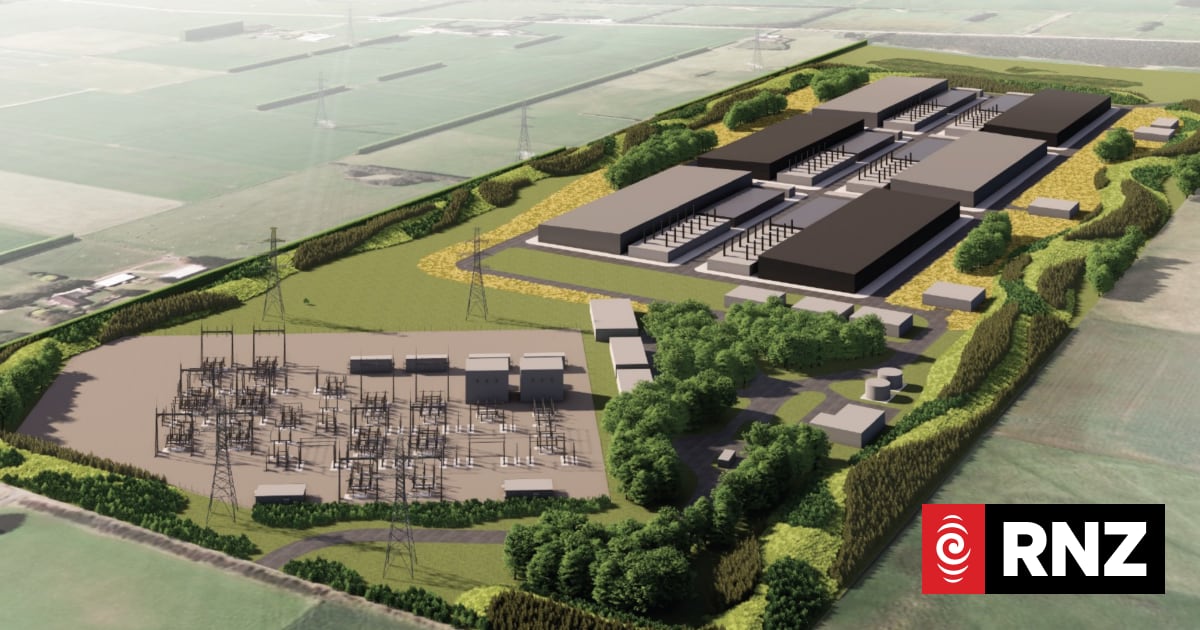
A leading expert on consents for water is warning the country's resource management scheme is not fit to manage the long term impact of hyperscale data centres.Singapore-based company Datagrid was given 10 resource consents this year for an AI factory in Southland, that included the ability to draw more than 600,000 litres of groundwater every day and to discharge some 5000 litres of treated wastewater.Expected to open in 2028, the 78,000 square metre AI factory in Makarewa was tracking to become the second single biggest user of electricity behind the aluminium smelter at Tiwai Point, near Bluff.Chairperson of a climate change research group at Water New Zealand, engineer Evan Vaughters, told Nine to Noon, the sheer scale of water the consents allow the data centre to use meant there could be long term unforeseen consequences and the consents did not provide for the kind of monitoring needed to assess this.But Datagrid said it would not use any groundwater - preferring rainwater when needed.Vaughters agreed technologies pointed to the fact the centre would primarily use rainwater harvesting but he said it begged the question, why were the consents needed if that were the case.The volumes consented for, 600,000 litres a day from a groundwater reserve was high, Vaughters said, and would be about the amount a town the size of Kaikōura would run on.Data centres used large amounts of water mainly for cooling the systems, Vaughters said, and as a water professional it was something he was very interested in.Inside Google's data centre in Douglas County, Georgia, in the US. (File photo)UNU-INWEH Google GalleryHe said due to the water being used for cooling the wastewater discharge ended up having quite an increased temperature, so additional energy costs then had to go towards cooling the wastewater prior to its discharge."Certainly it wouldn't be a long walk off a short pier to say that there is a much wider resource allocation question here."For instance, they've been able to demonstrate they can mitigate the localised effects taking from this particular aquifer but the bigger question is, is this the best use of those finite water resources, and the wider energy picture, is that the best allocation for the grid?"Globally, Vaughters said regulatory frameworks needed to be thinking about doing better with the climate."We build and plan on the environment of the past and [we] need to be thinking about the environment of the future."Data centres were simply a technology that did not exist when these frameworks were created, he said.A proposed Amazon data centre site in Auckland's Westgate.Google Maps / Screenshot"At the moment they're [Datagrid], assuming they don't need to use high amounts of groundwater but what if that changes?"Once you're consented we move on and focus on what's inside our box."Vaughters said New Zealand could look to Australia or the state of New York for guidance on data centre approvals."Australia for instance has now come out and said you need to incorporate new energy projects alongside these projects, the state of New York has just announced a moratorium on new data centres until they can get new framework in place."Datagrid's executive chairperson Rémi Galasso declined to be interviewed on Nine to Noon, but said in a statement there was a vast difference between the absolute maximum amount permitted in a resource consent and the "highly efficient ultra green reality" of what Datagrid was building."Invercargill's cool temperatures allow it to rely entirely on free air cooling, no groundwater draw."A small amount of water was needed, Galasso said, for "occasional evaporative adiabatic assist" on warm days, but this would be supplied by rainwater harvesting.
Massive Southland data centre's water consent concerns engineer
Full Article
Original Source
Read the full article at Rnz →KhanList aggregates and links to publicly available news content. We do not host full articles from third-party sources. Always verify important information with original sources.