
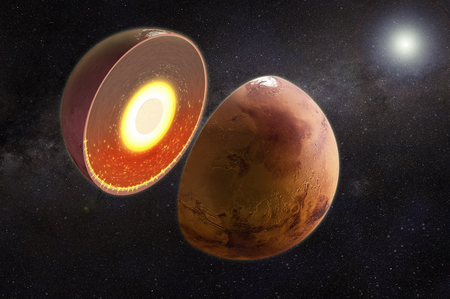
The planet Mars is a cold and dry world completely devoid of life, but billions of years ago things were much different. This is when Mars had a much warmer interior than it does today, resulting in active volcanism that replenished its atmosphere, a magnetic field that protected the planet from harmful solar and cosmic radiation, and a surface of flowing liquid water. But due to Mars’s small size, the interior cooled far faster than Earth’s has cooled, leading to a loss of volcanism, near-absolute depletion of its magnetic field, and complete evaporation of all surface liquid water. But what is the interior heat of Mars like today? Now, an international team of scientists might have shed new light on the present-day interior heat of Mars, as they presented new findings recently published in Nature that could show the interior heat of Mars might not be evenly distributed. To accomplish this, the researchers examined archival data obtained from NASA’s Mars Global Surveyor (MGS), NASA’s Mars Odyssey, and NASA’s Mars Reconnaissance Orbiter, with MGS having ended its mission in 2006 but the other two remain active orbiting Mars. This spacecraft orbital data was combined with longstanding knowledge regarding the orbital eccentricity and planetary tilt of Mars, both of which are more extreme than Earth. For example, a planet’s eccentricity is measured from 0 to 1 with 0 being a perfect circle, and while Earth’s eccentricity is 0.017, the eccentricity of Mars is 0.093. This means the orbit of Mars is slightly more oval-shaped than Earth’s. Additionally, while the planetary tilt of Earth is currently 23.44 degrees, the tilt of Mars is currently 25.19 degrees. Using the slight changes in spacecraft velocities over time, the team built a gravitational model of Mars through a common method called tidal tomography, which resulted in a model of the interior heat of Mars. Interior Temperatures at Odds In the end, the researchers found that the southern hemisphere of Mars has an interior temperature difference of about 200-400 degrees Celsius (392-752 degrees Fahrenheit) greater compared to the northern hemisphere’s interior. This exciting finding builds on past findings from the now-retired NASA InSight lander that discovered seismic waves that passed through the southern hemisphere’s interior dissipated quicker than seismic waves passing through the northern hemisphere’s interior. "Scientists usually assume that the interiors of planetary bodies are generally spherically symmetric, but this is not necessarily true," said Dr. Alexander Berne, who is a postdoctoral associate at the University of Arizona who conducted the research as a PhD student at Caltech, and is lead author of the study. "As we get more gravity data, we can determine the three-dimensional intricacies of a planet's interior structure. These inferences in turn give us a blueprint for designing future missions and scientific exploration of these worlds. Understanding the interior structure of planetary bodies helps us unravel the processes that shaped their formation and evolution." The researchers noted that the much thicker southern hemisphere could have resulted in its interior heat becoming insulated from cooling that the rest of the planet’s interior experienced billions of years ago, meaning this heat being observed could have been maintained for the last several billion years. This is because the landscape of the northern and southern hemispheres on Mars is in stark contrast. While the northern hemisphere is known as the northern lowlands due to the vast plains where scientists hypothesize water once flowed, the southern hemisphere is known as the southern highlands due to its vast mountain ranges. However, there is the exception of Hellas basin, which is a large impact basin in the southern hemisphere whose elevation is thousands of meters lower than the average elevation of the northern hemisphere. What new insights into Mars’s interior heat will researchers make in the coming years and decades? Only time will tell, and this is why we science! As always, keep doing science & keep looking up!
Mars's Interior is 400°C Hotter Under Southern Hemisphere
Full Article
Original Source
Read the full article at Universetoday →KhanList aggregates and links to publicly available news content. We do not host full articles from third-party sources. Always verify important information with original sources.