
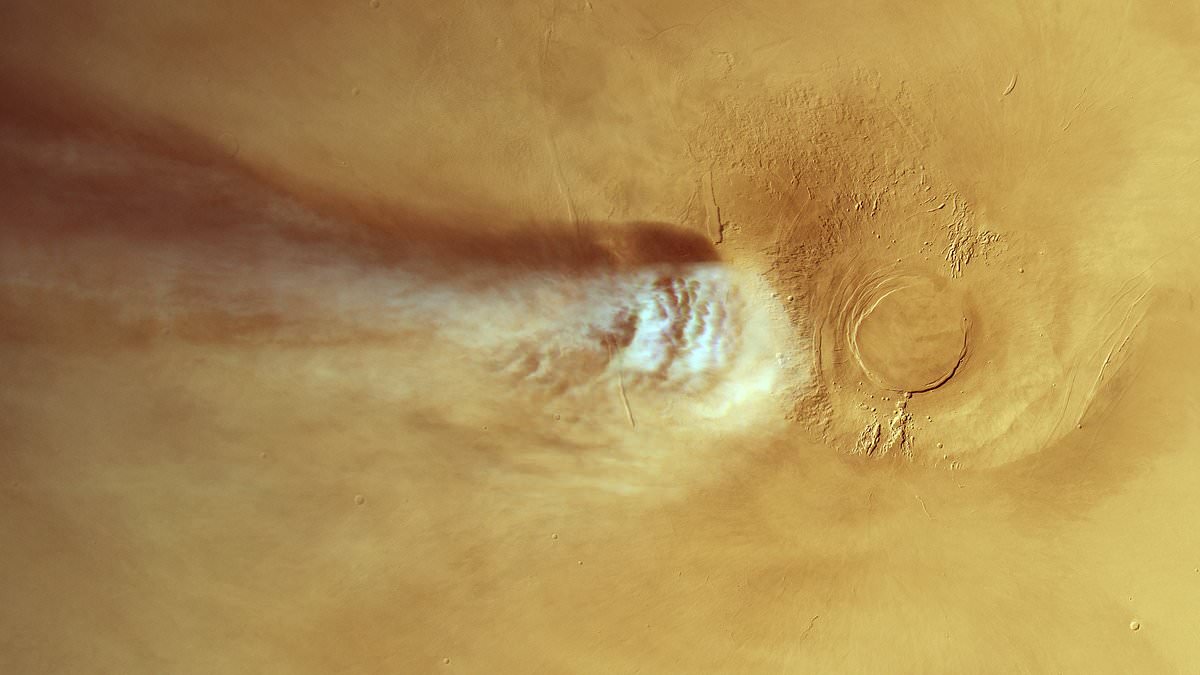
Scientists have finally solved one of Mars's most perplexing mysteries: the puzzle of an 'impossible' giant cloud.Every day during spring and autumn, a vast trail of frozen water vapour emerges downwind of the Red Planet's 12.5-mile-tall (20km) Arsia Mons volcano.The cloud forms, grows, and fades on a daily basis, reaching an astonishing length of 1,120 miles (1,800km) – nearly twice the length of the UK – before vanishing just as fast.Known as the Arsia Mons Elongated Cloud (AMEC), this seemingly impossible behaviour has baffled scientists since it was first spotted in 2018.Now, experts say this bizarre formation may be due to some very 'exotic' physics.Lead author Dr Jorge Hernández-Bernal, of Sorbonne University, says: 'To create the AMEC in our modelling, we found that we needed to include some exotic physics… physics that, while included in textbooks, is treated as theoretical and usually thought not to happen in nature.'Once we included this physics in our simulations, the AMEC emerged just as we hoped.' Scientists have finally solved the mystery of a giant cloud which forms every day downwind of Mars' 12.5-mile-tall (20km) Arsia Mons volcano The cloud forms, grows, and fades on a daily basis, reaching an astonishing length of 1,120 miles (1,800km) before vanishing just as fast Scientists now believe the cloud forms due to a piece of 'exotic' physics known as homogeneous nucleation, which allows water droplets to condense without any particles to form around Scientists have a solid understanding of Mars' atmosphere and about the processes which form clouds, but AMEC stands out as exceptionally odd.Dr Hernández-Bernal told the Daily Mail: 'What made it difficult to understand is that it seems to form the long tail by expansion from the origin point next to Arsia Mons, but given its high altitude it cannot be the result of the transport of water from the surface.'Variations of temperature need to be the main driver, but in such a case we would usually expect the cloud to disappear when temperatures rise again after the starting point next to Arsia Mons.'Likewise, when scientists tried to recreate the AMEC in a computer simulation, they couldn't get it to match the real-life observations made by the European Space Agency’s Mars Express orbiter.On Earth, clouds form through a process known as heterogeneous nucleation, which involves water vapour condensing around a little speck of material in the atmosphere.This could be a piece of pollen, a grain of salt, soot or, in the case of Mars, dust swept up from deserts below.But that doesn't seem to be the case with the massive cloud that forms daily around Arsia Mons.Instead, in a paper published in Nature Geoscience, scientists suggest that droplets in the AMEC condense without any particles at all to form around.Dr Hernández-Bernal says: 'Water vapour turns directly into icy cloud particles without any middle step. It’s akin to droplets of condensation appearing in the middle of a room, rather than on a window.'We call this homogeneous nucleation, and we’ve never seen it before in a planetary atmosphere. It’s wholly unexpected.'Some scientists have previously suggested that this process might happen in the very upper reaches of the atmosphere on Earth and Venus, but it's never been observed. The researchers now believe that the unique combination of Mars' thin atmosphere and the incredible height of Arsia Mons combine to create the rare conditions needed for this exotic cloud formation As the wind blows over Arsia Mons, it creates a powerful wave that drags moist air up very quickly. That causes the temperature to drop and the relative humidity to increase, leading to homogeneous nucleation That's because homogeneous nucleation requires extremely specific conditions with extreme levels of humidity.'In our daily lives it is uncommon to have relative humidities higher than 100 per cent, but we need around 100,000 times that for homogeneous nucleation to occur,' says Dr Hernández-Bernal.Yet, however unusual it may be, once the scientists added this process into the simulation, their model started producing results that matched the real AMEC.The researchers now believe that the unique combination of Mars' thin atmosphere and the incredible height of Arsia Mons combine to create the rare conditions needed for this exotic cloud formation.As the wind flows past Arsia Mons, the bulk of the volcano creates a powerful wave that yanks parcels of moist air several miles into the sky within a few minutes.That process rapidly cools the atmosphere, causing temperatures to drop by 30°C (54°F) in just 10 minutes and humidity levels to spike.Those conditions allow water vapour to freeze directly into cloud particles, creating the enormous structure we can see from orbit as the AMEC.Even though some details of the model don't exactly match the real cloud, the researchers say that the results are 'remarkable'.Since we don't know as much about Mars' atmosphere as we do about Earth, even getting close to reality with a computer model suggests the researchers are on the right track.And, if homogeneous nucleation really is going on in the Martian atmosphere, it might mean the Red Planet is a far stranger place than scientists had previously thought.Dr Hernández-Bernal says: 'We’ve not seen these conditions on Mars before, but our finding now strongly suggests that the planet’s humidity can indeed reach these extreme levels.'MARS: THE BASICSMars is the fourth planet from the sun, with a 'near-dead' dusty, cold, desert world with a very thin atmosphere. Mars is also a dynamic planet with seasons, polar ice caps, canyons, extinct volcanoes, and evidence that it was even more active in the past. It is one of the most explored planets in the solar system and the only planet humans have sent rovers to explore.One day on Mars takes a little over 24 hours and a year is 687 Earth days.Facts and Figures Orbital period: 687 daysSurface area: 55.91 million mi²Distance from Sun: 145 million milesGravity: 3.721 m/s²Radius: 2,106 milesMoons: Phobos, Deimos
Mars mystery solved: Scientists reveal the secret behind 'impossible' giant cloud that appears and vanishes every day
Full Article
Original Source
Read the full article at Dailymail →KhanList aggregates and links to publicly available news content. We do not host full articles from third-party sources. Always verify important information with original sources.