
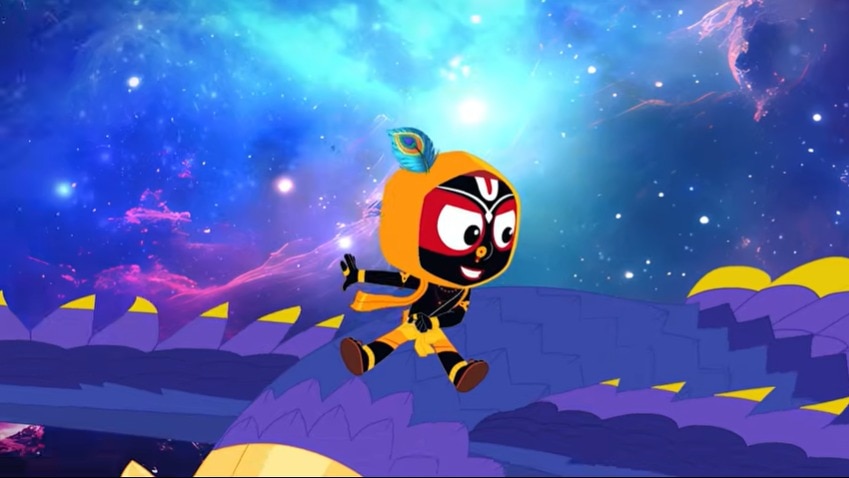
Some films dazzle you with spectacular visuals and elaborate world-building. Director Shripad Warkhedkar’s animation film, Mahaprabhu Jagannath takes a simpler route. This animated devotional film explores questions that have existed long before cinema, theatre and folklore — what does faith really mean? Why do people surrender themselves to something larger than life? And can devotion coexist with love, jealousy, greed and arrogance? Set in the 15th century, Mahaprabhu Jagannath turns these questions into a story about good versus evil, with Lord Jagannath at its spiritual centre.The story follows Aham Kumar, a brilliant student at sage Yogeshwar's ashram whose knowledge gradually turns into hubris. After studying the downfall of the demon Tarakasur, Aham begins questioning divine authority and traditional ethics. Determined to challenge the laws of the universe, he undertakes extreme penance and secures a boon from Lord Brahma that allows him to create his own realm — a domain where no deity can defeat or kill him. As Aham turns into a vengeful adversary of Lord Jagannath, the film introduces Balram, a village child whose innocent friendship with the deity becomes the unlikely answer to Aham’s growing darkness.Balram befriends a Lord Jagannath idol and names him Jagan, only for the deity to appear in human form as his friend. It is here that Warkhedkar’s film finds its simplest and most accessible idea: perhaps pleasing God is not about complicated rituals and customs, but about genuine affection and devotion. But can a child’s innocent faith really have the power to defeat a demonic force? And can that same devotion reach people who have become disillusioned by fear, ego and disbelief?Pallavi Sharma’s screenplay and dialogues are strongest when they allow Aham and Balram to express their ideas through simple emotions rather than heavy sermons. Aham, despite his immense knowledge and growing powers, believes that surrendering himself to the divine can eliminate fear. That idea becomes particularly effective when placed against Balram’s relationship with Jagan. In one of the crucial scenes, Balram tells Lord Vishnu, "Maine apna sab kuchh tujhe samarpit kar diya, ab koi bhay nahi (I have surrendered my all to you, now there is no fear)."In a world where human relationships can become complicated by expectations and performative behaviour, Balram simply sees God as a friend. He does not want power, wealth or a grand reward. Sometimes, all he wants is a warm hug from Jagan. And when he gets it, he is filled with gratitude and bliss. Without resorting to elaborate monologues, Mahaprabhu Jagannath makes a gentle statement about friendship and love — the kind that asks for nothing in return. The contrast between Aham and Balram is ultimately the crux of the story. Aham is proud of his knowledge of sacred texts, Vedas, mantras and rituals. His spiritual austerity gives him extraordinary powers, but instead of making him humble, it makes him more arrogant. Balram, on the other hand, is still learning the ways of the world. He respects his parents, is surrounded by maternal affection and sees God as no different from an ordinary human being he can love and trust.That difference gives the film its emotional core. Aham wants to understand, control and challenge the divine. Balram simply loves it. One seeks power through knowledge and austerity; the other finds strength in innocence, affection and faith. The film does not constantly tell viewers which lesson they should take away. Instead, its simplest sequences place love and kindness against jealousy, greed and arrogance and allow the audience to decide where they stand. Aham and Balram do not merely represent good and evil. They represent the impulses within human beings that can push us towards either.Mahaprabhu Jagannath does not boast of large-scale VFX or highly polished animation, and its visual quality is one area where the film has room to improve. But as a devotional film accessible to children, it remains engaging and emotionally straightforward. In that sense, it attempts to revive the kind of accessible storytelling associated with Panchatantra and Amar Chitra Katha for a new generation.The graphics and animation can certainly be more refined, and there is still a long way to go for Indian animation cinema. Yet the film’s visual limitations do not completely undermine its storytelling. More importantly, its depiction of Lord Jagannath works. The film recreates the distinctive idol associated with Puri’s sacred temple and brings it to life through animation without losing its recognisable visual identity. The lyrics by Atul Kumar bring the film's devotional theme full circle, particularly in the climax.The achievement of Mahaprabhu Jagannath, therefore, is not that it delivers spectacular animation. It is that beneath its devotional setting lies a deeply human story about belief and disbelief, devotion and desire, kindness and cruelty, and the sacrifices we make for something larger than ourselves.The film ultimately goes beyond preaching spirituality. Its ideas are also about human values that can easily get lost in a world driven by competition, ambition and the desire for instant results. Lord Jagannath’s teaching on attaining God becomes a metaphor for achieving life’s goals as well. Just as devotion does not necessarily require grand rituals, but sincerity, love, kindness and faith, life too is also often shaped by ordinary efforts — persistence, patience, conviction and dedication.Perhaps that is the simplest lesson Mahaprabhu Jagannath leaves behind: it is not always the grandness of the plan that takes you to the destination. Sometimes, it is the sincerity of the intention and the consistency with which you keep walking.Mahaprabhu Jagannath is produced by Durga Prasad Dalai.The film theatrically released on September 4, 2026.- EndsPublished By: Anurag BohraPublished On: Sep 6, 2026 09:05 IST
Mahaprabhu Jagannath review: A devotional saga celebrating victory of good over evil
Full Article
Original Source
Read the full article at Indiatoday →KhanList aggregates and links to publicly available news content. We do not host full articles from third-party sources. Always verify important information with original sources.